
A homogeneous mixture contains two liquids. How are they separated ?
- (a)By filtration
- (b)By evaporation
- (c)By distillation
- (d)By condensation
Answer
Why
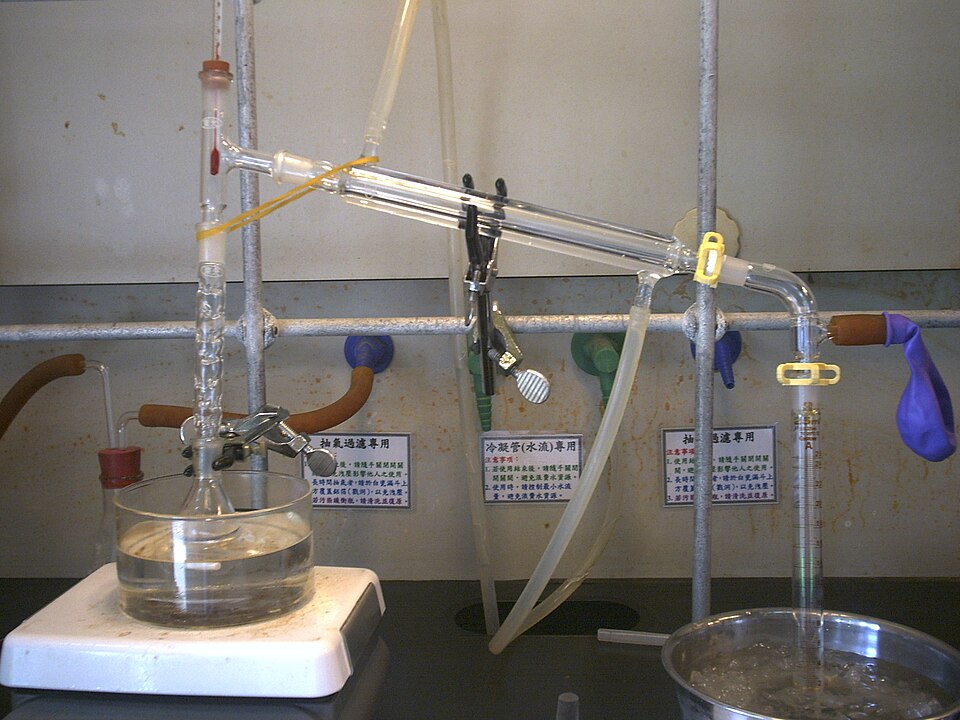
Correct — C, By distillation. A homogeneous mixture of two liquids is a single clear phase in which the components are mixed at the molecular level, so nothing can be strained, skimmed or settled out. What the two liquids do not share is their boiling point, and distillation exploits exactly that: the mixture is heated, the liquid with the lower boiling point vaporises first, the vapour is led away and cooled in a condenser, and it is collected as a separate pure liquid while the higher-boiling liquid stays behind. When the two boiling points are close, the same idea is run in a fractionating column as fractional distillation.
Why the others are wrong
- (a)By filtration — Filtration only holds back particles too large to pass through the filter, so it works on a heterogeneous mixture such as sand in water. In a homogeneous liquid mixture there is nothing of that size to trap, and both liquids run through together.
- (b)By evaporation — Evaporation lets the volatile liquid escape into the air and leaves the residue behind, so it can recover a dissolved solid but throws away the liquid. With two liquids it is worse still, since both can evaporate and neither is collected.
- (d)By condensation — Condensation is only the second half of distillation — turning vapour back into liquid. On its own it separates nothing, because nothing has been selectively vaporised for it to condense.
Concept
The technique used to separate a mixture follows from the kind of mixture it is. Heterogeneous mixtures are separated on physical differences — filtration for an insoluble solid in a liquid, a separating funnel for two immiscible liquids, sublimation for a solid that passes straight to vapour. A homogeneous mixture of miscible liquids must be separated on a difference in a bulk property, and the boiling point is the one distillation uses. Simple distillation suffices when the boiling points differ by a wide margin; when they are close, a fractionating column repeats the vaporisation and condensation many times over.
The trap is that evaporation feels like the everyday answer, because that is how salt is recovered from seawater. Ask what you are trying to keep: evaporation keeps the residue and loses the vapour, while distillation keeps both, because it condenses the vapour and collects it. Also keep the immiscible case apart — kerosene and water form two layers and are run off through a separating funnel, whereas kerosene and petrol mix completely and need fractional distillation, which is also how a refinery splits crude oil.
Key facts
- A homogeneous mixture is uniform throughout, so its components cannot be separated by filtration or settling.
- Distillation separates miscible liquids using the difference in their boiling points, and it collects the vapour by condensing it.
- Fractional distillation, using a fractionating column, is used when the boiling points are close — as in the refining of petroleum.
- Two immiscible liquids, which form separate layers, are separated by a separating funnel rather than by distillation.
Study next
Common traps
- Choosing evaporation, which recovers the solid residue but loses the liquid.
- Treating condensation as a separation technique in its own right.
- Reaching for a separating funnel when the two liquids are miscible — that funnel needs two visible layers.
NDA names a specific pair of substances and asks for the technique, or gives a technique and asks which mixture it suits.
Related PYQs
Kerosene and petrol mixture can be best separated by
- (a) Sublimation
- (b) Separating funnel
- (c) Fractional distillation
- (d) Compressing and cooling
Answer(c) Fractional distillation
The same principle applied to a named pair of miscible liquids, and it shows when simple distillation has to become fractional.
Refining of petroleum is carried out using which one of the following techniques?
- (a) Evaporation
- (b) Fractional distillation
- (c) Separating funnel
- (d) Sublimation
Answer(b) Fractional distillation
Puts the same boiling-point principle to work on an industrial scale, and rules out evaporation for the same reason it fails here.
Practice
- practice — not a real PYQ
A mixture of acetone and water, which mix completely, is best separated by
- (a)filtration
- (b)distillation
- (c)a separating funnel
- (d)sedimentation
Answer(b) distillation — the two are miscible but boil at different temperatures, so the more volatile one can be vaporised and condensed away. - practice — not a real PYQ
Which technique is used to obtain pure water from sea water?
- (a)Filtration
- (b)Distillation
- (c)Decantation
- (d)Chromatography
Answer(b) distillation — the water is vaporised and condensed, leaving the dissolved salts behind, so the water itself is recovered rather than lost.