
What is the magnification produced by a concave lens of focal length 10 cm, when an image is formed at a distance of 5 cm from the lens?
- (a)2.0
- (b)1.0
- (c)0.5
- (d)0.33
Answer
Why
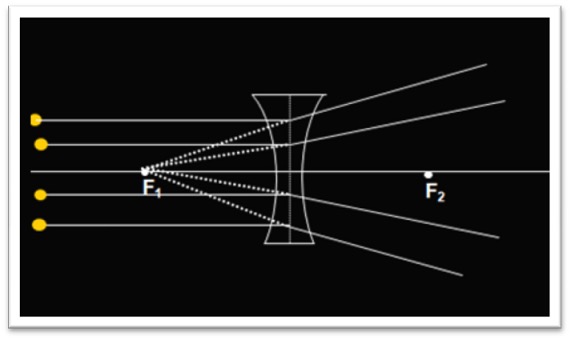
Correct — C, 0.5. A concave (diverging) lens always forms a virtual, erect, diminished image on the same side as the object, so the image distance v = −5 cm (with f = −10 cm). Using the lens formula 1/v − 1/u = 1/f: 1/(−5) − 1/u = 1/(−10) gives 1/u = −1/10, so u = −10 cm. The magnification m = v/u = (−5)/(−10) = 0.5 — the image is half the size of the object.
Why the others are wrong
- (a)2.0 — This is the reciprocal of the correct value; it comes from inverting the ratio (using u/v instead of m = v/u).
- (b)1.0 — A magnification of 1 would mean the image is the same size as the object, which never happens for a diverging concave lens — its images are always diminished.
- (d)0.33 — This results from a mis-substitution in the lens formula; the correct working gives u = −10 cm and m = v/u = 0.5.
Concept
The lens formula 1/v − 1/u = 1/f, with the Cartesian sign convention, relates object distance u, image distance v and focal length f. The linear magnification is m = v/u. A concave lens has a negative focal length and always produces a virtual, erect, diminished image.
Getting the signs right is the whole game: for a concave lens f is negative and its virtual image distance v is negative. Solving for u and then computing m = v/u yields 0.5, a diminished image as expected.
Key facts
- The lens formula is 1/v − 1/u = 1/f (Cartesian sign convention).
- The magnification of a lens is m = v/u (also equals image height ÷ object height).
- A concave lens has negative focal length and forms a virtual, erect, diminished image.
- Here f = −10 cm and v = −5 cm give u = −10 cm and m = 0.5.
Study next
Common traps
- Forgetting the negative signs for a concave lens (both f and v).
- Using m = u/v instead of m = v/u.
A numerical using the lens formula and m = v/u for a concave lens; the image is diminished (m < 1).
Related PYQs
An air bubble in water will act like a
- (a) convex mirror
- (b) convex lens
- (c) concave mirror
- (d) concave lens
Answer(d) concave lens
Same optics idea — a concave (diverging) lens. An air bubble in water diverges light because air's refractive index is lower than water's, so it behaves like the concave lens whose magnification is computed here.
The focal length of a concave lens is 0.5 m. The power of the lens is
- (a) +0.5 D
- (b) -0.5 D
- (c) +2.0 D
- (d) -2.0 D
Answer(d) -2.0 D
Same object — a concave lens with a negative focal length (and therefore negative power). Both items hinge on treating a concave lens's focal length as negative in the standard formulae.
Practice
- practice — not a real PYQ
A concave lens always forms an image that is
- (a)real and inverted
- (b)virtual, erect and diminished
- (c)real and magnified
- (d)formed at infinity
Answer(b) virtual, erect and diminished. - practice — not a real PYQ
The linear magnification produced by a lens is defined as
- (a)u/v
- (b)v/u
- (c)u × v
- (d)v − u
Answer(b) v/u.