
Which one of the following devices changes low voltage alternating current to high voltage alternating current and vice versa ?
- (a)Generator
- (b)Motor
- (c)Transformer
- (d)Vibrator
Answer
Why
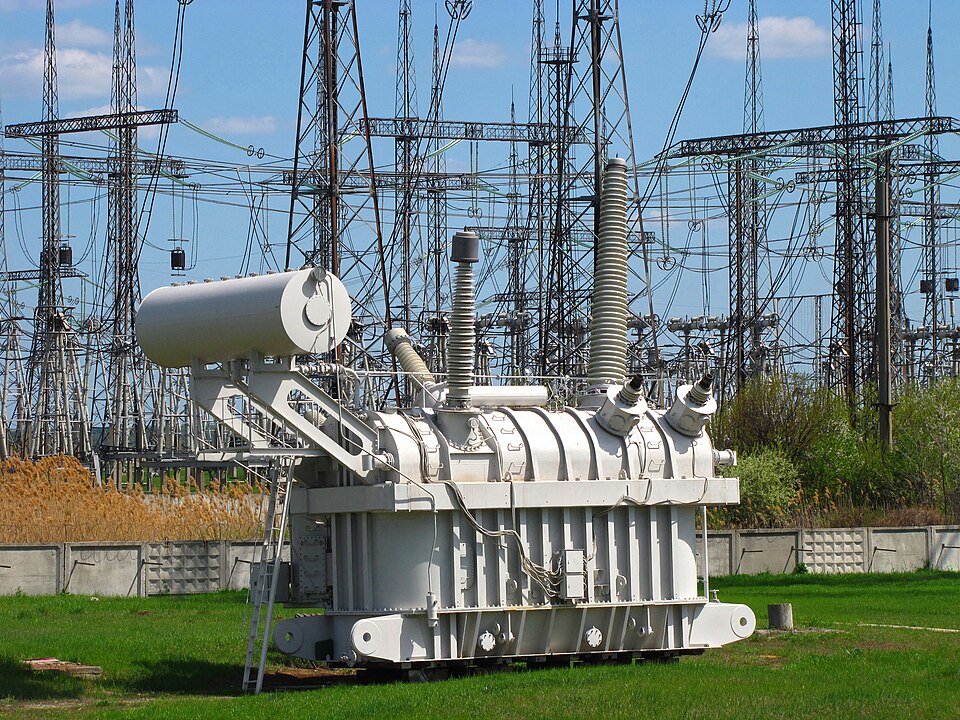
Correct — C, Transformer. A transformer is a pair of coils wound on a common soft-iron core. Alternating current in the primary coil sets up a magnetic flux in the core that grows and collapses with every cycle, and that changing flux induces an alternating emf in the secondary coil. Because the induced emf in each coil is proportional to its number of turns, the output voltage stands to the input voltage in the ratio of secondary turns to primary turns — more turns in the secondary and the alternating voltage is stepped up, fewer turns and the same device steps it down. The very same transformer works both ways depending on which winding you feed, which is exactly the 'and vice versa' in the stem. It cannot do this job for steady direct current, because a steady current produces a steady flux and a steady flux induces nothing.
Why the others are wrong
- (a)Generator — A generator converts mechanical energy into electrical energy — a coil is spun in a magnetic field and an emf is induced in it. It creates the alternating voltage in the first place; it does not take an existing alternating voltage and raise or lower it.
- (b)Motor — A motor does the reverse of a generator, turning electrical energy into mechanical rotation by the force on a current-carrying coil in a magnetic field. Its job is to move a load, not to change the level of a voltage.
- (d)Vibrator — In electrical work a vibrator is an electromechanical switch that rapidly interrupts a direct current so that the resulting pulses can be fed to a transformer. It only chops the current — the actual raising or lowering of voltage in such a supply is still done by the transformer that follows it.
Concept
A transformer transfers energy from one circuit to another by mutual induction, with no moving part and no electrical connection between the two coils. The core, made of laminated soft iron, carries the alternating flux from the primary winding to the secondary. The turns ratio fixes the voltage ratio, and in an ideal transformer the power delivered equals the power drawn, so whatever is gained in voltage is lost in current.
The word that decides this question is 'alternating'. Induction needs a flux that changes with time, so the device is useless on steady direct current — that is the standard trap, and UPSC has set it as an assertion-reason item. The other trap is treating a generator as the answer because generators also work by induction. Both a generator and a transformer use Faraday's law, but a generator makes electrical energy out of mechanical energy, while a transformer only re-packages electrical energy that already exists.
Key facts
- A transformer works only on alternating current, because mutual induction needs a magnetic flux that changes with time.
- The voltage ratio equals the turns ratio — a step-up transformer has more turns in the secondary than in the primary.
- An ideal transformer conserves power, so stepping the voltage up steps the current down in the same proportion.
- The frequency of the supply is unchanged by a transformer; only voltage and current levels change.
- Long-distance transmission steps voltage up at the generating end and down near the consumer to cut heating losses in the line.
Study next
Common traps
- Believing a transformer can step up a battery's DC voltage — it cannot, because steady current gives no changing flux.
- Thinking a transformer changes the frequency of the supply; frequency stays the same.
- Mixing up generator, motor and transformer, all of which involve magnetic fields but do different jobs.
NDA asks either to name the device that changes AC voltage levels, or to state the principle it works on, or to spot the false claim that a transformer works on DC.
Related PYQs
Assertion (A): Transformer is useful for stepping up or stepping down voltages. Reason (R): Transformer is a device used in D.C. circuits. In the context of the above two statements, which one of the following is correct?
- (a) Both A and R are true and R is the correct explanation of A.
- (b) Both A and R are true but R is not a correct explanation of A.
- (c) A is true but R is false.
- (d) A is false but R is true.
Answer(c) A is true but R is false
Same device, tested from the trap side — it confirms that a transformer does step voltage up and down, and that it belongs to AC and not DC circuits.
The device used to produce electric current is known as
- (a) motor
- (b) generator
- (c) ammeter
- (d) galvanometer
Answer(b) generator
Separates two of the very options offered here — the generator produces the current, while the transformer only changes the level of an alternating voltage.
A DC generator works on the principle of
- (a) Ohm's law
- (b) Joule's law of heating
- (c) Faraday's laws of electromagnetic induction
- (d) None of the above
Answer(c) Faraday's laws of electromagnetic induction
Names the same law of induction that a transformer runs on, so the two questions together fix which machine does which job.
Practice
- practice — not a real PYQ
A step-up transformer has 100 turns in its primary and 1000 turns in its secondary. If the primary is fed 220 V AC, the secondary voltage is about
- (a)22 V
- (b)220 V
- (c)1100 V
- (d)2200 V
Answer(d) 2200 V — the voltage ratio equals the turns ratio, so 220 V multiplied by 1000/100 gives 2200 V. - practice — not a real PYQ
Which one of the following quantities remains unchanged when electrical energy passes through an ideal transformer?
- (a)Voltage
- (b)Current
- (c)Frequency
- (d)Number of turns
Answer(c) Frequency — a transformer alters voltage and current in inverse proportion but reproduces the supply frequency exactly.