
An optical illusion which occurs mainly in deserts during hot summer is based on the principle of
- (a)Reflection
- (b)Interference
- (c)Dispersion
- (d)Total internal reflection
Answer
Why
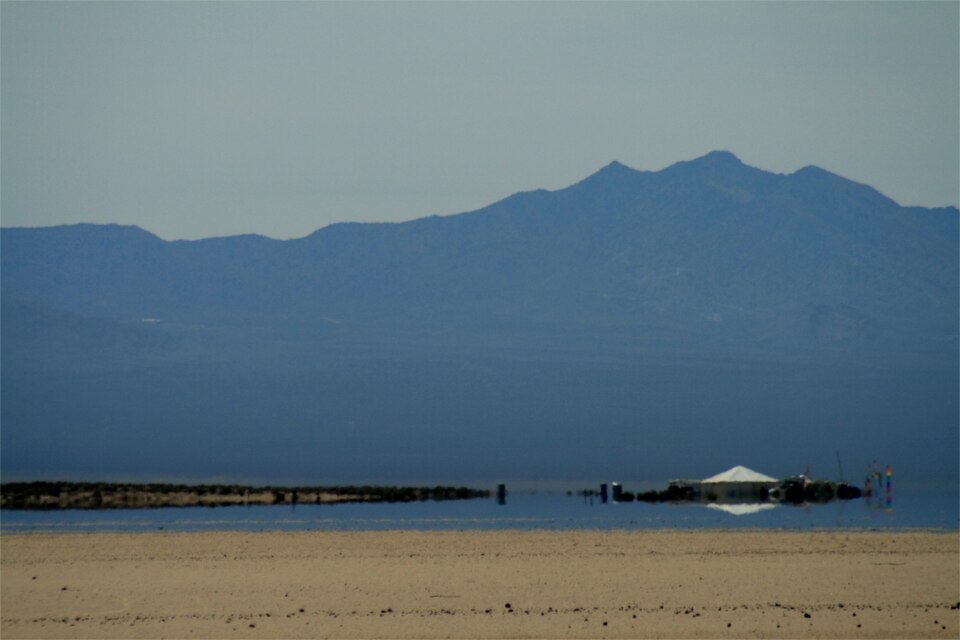
Correct — D, Total internal reflection. On a hot summer afternoon the sand or the road heats the air touching it, so the layers of air near the ground are hotter, thinner and optically rarer than the layers above them. A ray of light coming down from the sky therefore travels from denser air into rarer air, layer after layer, and bends a little further away from the normal at every boundary. Its path curves until, in one of the lowest layers, it strikes the boundary at an angle greater than the critical angle — at that point no light crosses over, and the ray is turned back upward by total internal reflection. The observer, whose eye traces the ray back along a straight line, sees an inverted image of the sky lying on the ground, and reads that shimmering patch of sky as a sheet of water.
Why the others are wrong
- (a)Reflection — Ordinary reflection needs a surface to bounce off — a mirror, a water surface, a polished metal. There is no such surface over hot sand; the light never leaves the air, and what turns it around is the behaviour of the air layers themselves.
- (b)Interference — Interference is the superposition of two coherent waves producing alternating bright and dark bands, as in thin films and soap bubbles. A mirage shows an ordinary continuous image of the sky, with no fringe pattern anywhere in it.
- (c)Dispersion — Dispersion splits white light into its colours because the refractive index of the medium is slightly different for each wavelength, as a prism or a rainbow shows. The mirage of the desert is not coloured — it is a plain image of the sky, so dispersion is not what produces it.
Concept
Total internal reflection happens when light travelling in a denser medium meets a rarer medium at an angle of incidence larger than the critical angle for that pair. No refracted ray then enters the second medium and all the light is thrown back. In a mirage the two media are simply layers of air at different temperatures — hot air near the ground is rarer, cooler air above is denser — and the gradual bending through many such layers ends in exactly that condition.
Examiners word this item in two ways and both are defensible, so read the options offered. The bending in each layer is refraction, and UPSC in 2002 asked which phenomena form a mirage and accepted terrestrial heating together with refraction. NDA has asked it as a straight choice and marked total internal reflection here in 2017, and in 2021 offered a fuller option — 'both refraction and total internal reflection' — and marked that. The physics behind all three keys is the same sequence, so pick the most complete option that the paper actually prints, and if refraction is not on the list, total internal reflection is the intended answer.
Key facts
- Total internal reflection needs light to pass from a denser to a rarer medium at an angle of incidence greater than the critical angle.
- Air heated by the ground becomes less dense and has a smaller refractive index than the cooler air above it.
- The desert and hot-road mirage is an inferior mirage — the false image appears below the real object.
- Over a very cold surface the temperature gradient reverses and a superior mirage forms, with the image appearing above the object.
- Optical fibres, the brilliance of a cut diamond and the shine of a crack in glass are other everyday effects of total internal reflection.
Study next
Common traps
- Choosing reflection because the sky is seen 'as if in a mirror' — there is no reflecting surface involved.
- Assuming a mirage needs a desert; a hot tarred road produces the same effect.
- Forgetting that the layers of air are the two media here, so their densities decide everything.
NDA asks for the optical principle behind a mirage, or the reverse — which everyday sight illustrates total internal reflection.
Related PYQs
Consider the following natural phenomena: 1. Terrestrial heating 2. Reflection of light 3. Refraction of light 4. Diffraction of light. Due to which of these phenomena is mirage formed?
- (a) 1 and 2
- (b) 2, 3 and 4
- (c) 1 and 3
- (d) 4 only
Answer(c) 1 and 3
The same mirage, keyed to heating plus refraction because total internal reflection was not among its options — a clean demonstration of why you must answer from the list the paper prints.
Optical fibre works on the principle of
- (a) total internal reflection
- (b) refraction
- (c) scattering
- (d) interference
Answer(a) total internal reflection
The same principle in its other standard application, where light stays trapped inside the fibre core because it always strikes the boundary beyond the critical angle.
Mirage is an illustration of
- (a) only dispersion of light.
- (b) only reflection of light.
- (c) only total internal reflection of light.
- (d) both refraction and total internal reflection of light.
Answer(d) both refraction and total internal reflection of light.
The same phenomenon four years later with a fuller option on the list, which is why its key names refraction as well as total internal reflection.
Practice
- practice — not a real PYQ
Total internal reflection of light can take place when light travels from
- (a)air into water
- (b)air into glass
- (c)water into glass
- (d)glass into air
Answer(d) glass into air — total internal reflection is possible only when light goes from an optically denser medium to a rarer one beyond the critical angle. - practice — not a real PYQ
The mirage seen over a hot road, in which the road ahead appears wet, is an example of
- (a)a superior mirage with the image above the object
- (b)an inferior mirage with the image below the object
- (c)dispersion of sunlight by dust
- (d)interference of light in the air
Answer(b) an inferior mirage with the image below the object — the hot layer lies at the bottom, so the false image of the sky appears below the line of sight.