
Name the calligrapher in Akbar’s court who was honoured with the title “Zarrin Kalam” or Golden Pen
- (a)Abul Fazl
- (b)Tansen
- (c)Muhammad Husayn
- (d)Muhammad Kasim
Answer
Why
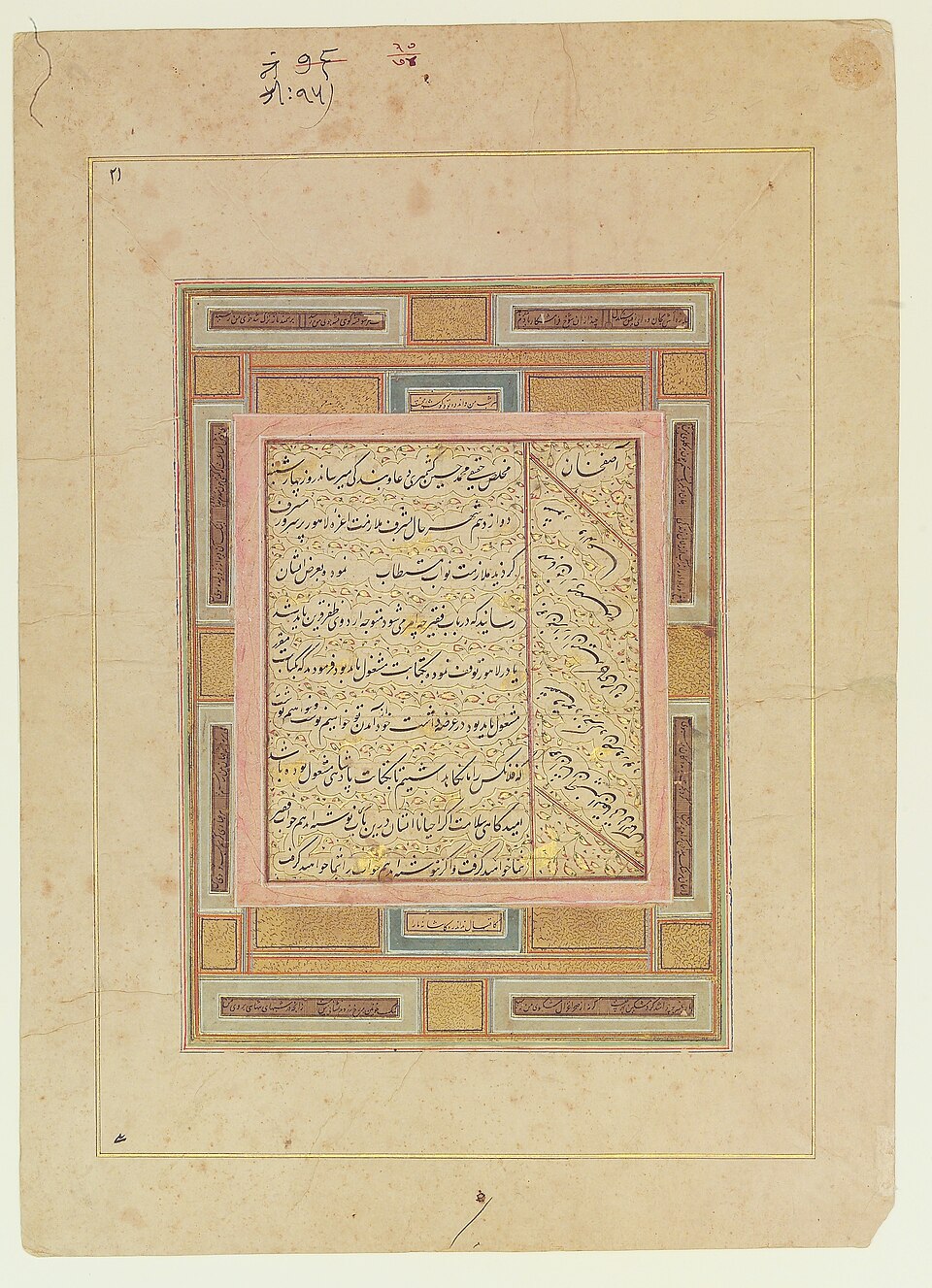
Correct — C, Muhammad Husayn. He is Muhammad Husayn al-Kashmiri, the Kashmiri master of the nasta'liq script who worked at Akbar's court and is known by the title Zarrin Qalam, the golden pen. His hand survives in the deluxe manuscript of Amir Khusrau's Khamsa produced in Lahore during Akbar's reign and now in the Walters Art Museum; standard reference accounts list him among the notable masters of nasta'liq who worked for Akbar and record his death in 1611 or 1612.
Why the others are wrong
- (a)Abul Fazl — Abu'l Fazl was the author at Akbar's court, not the calligrapher — he wrote the Akbar Nama, of which the Ain-i-Akbari forms a part. Writing the text and writing out the text were separate crafts in a Mughal atelier.
- (b)Tansen — Tansen was the musician among Akbar's celebrated courtiers. He belongs to the same list of court talents, which is exactly why his name is placed here, but he has nothing to do with the pen.
- (d)Muhammad Kasim — The name echoes Muhammad Qasim Firishta, the historian of the Deccan courts, and Muhammad bin Qasim, the eighth-century Arab commander in Sind. Neither was a calligrapher of Akbar's court, and the near-miss name is the trap.
Concept
A Mughal manuscript was made by a workshop, not by one person: a paper-maker, a calligrapher, painters, a gilder and a binder each had a defined role, and the calligrapher ranked at the top. Akbar's atelier produced the great illustrated copies of Persian classics and of the court's own chronicles, and titles such as zarrin kalam were the emperor's way of ranking the men who did that work.
The four options are a mixed bag of court figures and near-miss names, which is the usual construction for a 'name the person' item on Mughal culture. Sort them by craft first — author, musician, calligrapher, soldier-or-historian — and the answer follows without any need to recall the calligrapher's dates. The wider point worth carrying away is that nasta'liq, the flowing Persian hand, was the script of the Mughal court, and that its masters were honoured as highly as its painters and poets.
Key facts
- Muhammad Husayn al-Kashmiri is known by the title Zarrin Qalam, meaning golden pen.
- He copied the deluxe Khamsa of Amir Khusrau made in Lahore during Akbar's reign, now Walters Art Museum manuscript W.624.
- He is listed among the notable masters of the nasta'liq script who worked for Akbar, and died in 1611 or 1612.
- Abu'l Fazl was Akbar's chronicler, author of the Akbar Nama, of which the Ain-i-Akbari is a part.
- Calligraphy ranked above painting in the hierarchy of the Islamicate book arts.
Study next
Common traps
- Choosing the most famous courtier on the list rather than the one who matches the craft named.
- Confusing the author of a text with the calligrapher who copied it.
- Falling for a name that resembles a historian or a general from another century.
Mughal-court items are set as person-to-role matches; the paper usually mixes a writer, a musician and a look-alike name into the four options.
Related PYQs
Ibadat Khana at Fatehpur Sikri was
- (a) the mosque for the use of Royal Family
- (b) Akbar’s private prayer chamber
- (c) the hall in which Akbar held discussions with scholars of various religions
- (d) the room in which the nobles belonging to different religions gathered to discuss religious affairs
Answer(c) the hall in which Akbar held discussions with scholars of various religions
The same court and the same kind of detail — an institution or an office of Akbar's establishment identified from four near-miss descriptions.
Which one of the following statements about the Ain-i-Akbari is not correct?
- (a) It was written by Abu'l Fazl.
- (b) It is a part of a larger work called Akbar Nama.
- (c) It describes the Mughal Empire as having a diverse population and a composite culture.
- (d) It was later revised by Sadullah Khan on the orders of Shah Jahan.
Answer(d) It was later revised by Sadullah Khan on the orders of Shah Jahan.
The same Akbari court and its book culture, tested on who produced which text.
Practice
- practice — not a real PYQ
The title 'zarrin kalam', or golden pen, was conferred at Akbar's court on
- (a)A calligrapher
- (b)A painter
- (c)A revenue officer
- (d)A court musician
Answer(a) A calligrapher — Muhammad Husayn al-Kashmiri, master of the nasta'liq script. - practice — not a real PYQ
The Ain-i-Akbari forms a part of which larger work?
- (a)Babur Nama
- (b)Akbar Nama
- (c)Badshah Nama
- (d)Tuzuk-i-Jahangiri
Answer(b) Akbar Nama — Abu'l Fazl's history of Akbar's reign, of which the Ain forms the concluding part.