
Which one of the following statements about the Ain-i-Akbari is not correct?
- (a)It was written by Abu'l Fazl.
- (b)It is a part of a larger work called Akbar Nama.
- (c)It describes the Mughal Empire as having a diverse population and a composite culture.
- (d)It was later revised by Sadullah Khan on the orders of Shah Jahan.
Answer
Why
Correct — D. The statement that the Ain-i-Akbari was 'later revised by Sadullah Khan on the orders of Shah Jahan' is not correct — it is invented. The Ain-i-Akbari was written by Abu'l Fazl during Akbar's reign as the third and final volume of the Akbar Nama; it was not re-worked under Shah Jahan. Statements (a), (b) and (c) are all accurate, so the odd-one-out is (d).
Why the others are wrong
- (a)It was written by Abu'l Fazl. — This is correct — Abu'l Fazl, Akbar's court historian, authored it; hence it is not the answer to a 'not correct' question.
- (b)It is a part of a larger work called Akbar Nama. — Correct — the Ain-i-Akbari forms the third book of the Akbar Nama, so this statement is true.
- (c)It describes the Mughal Empire as having a diverse population and a composite culture. — Correct — Abu'l Fazl portrays the empire as ethnically and religiously diverse with a composite culture, so this is a true statement.
Concept
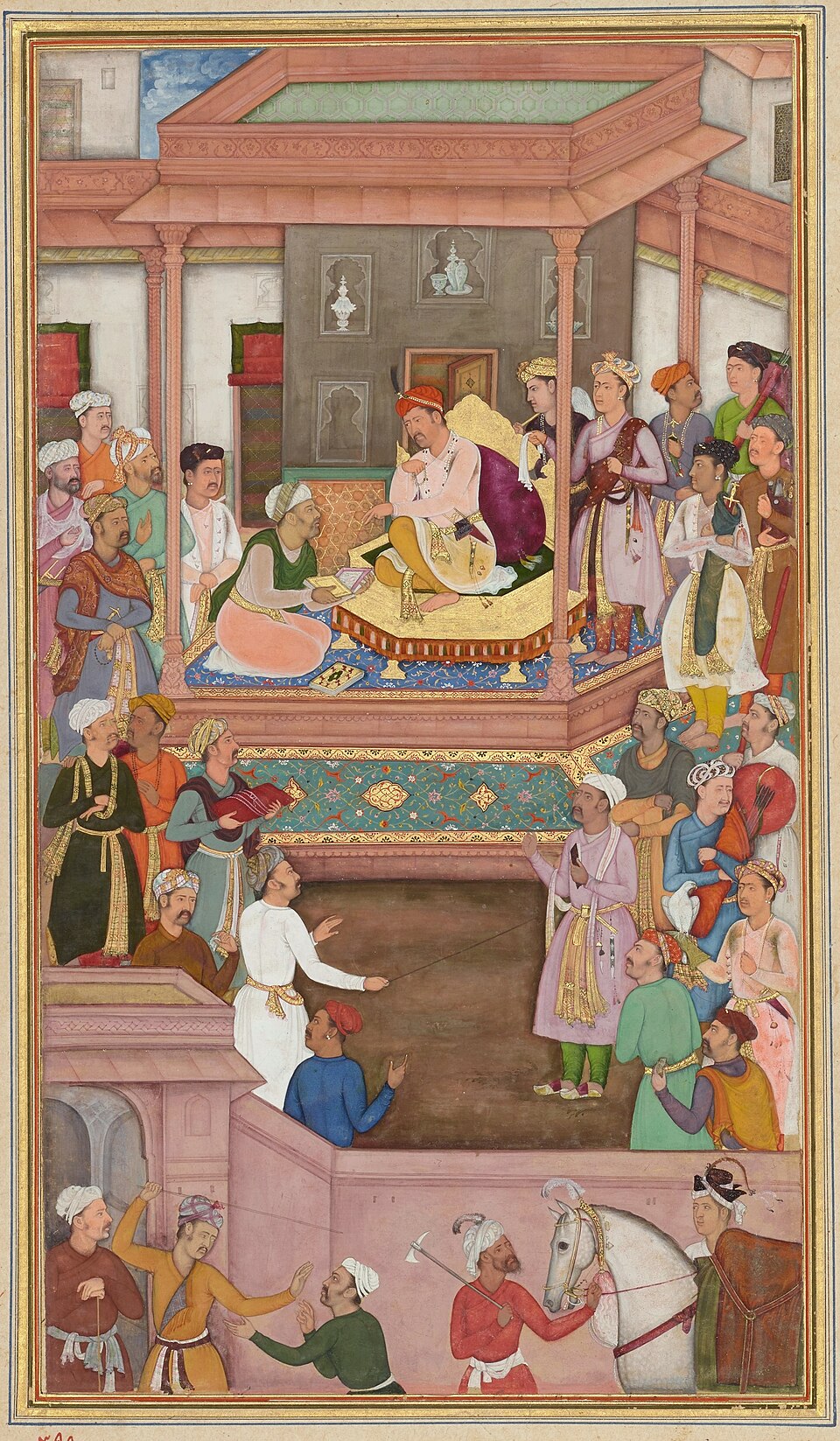
The Akbar Nama, written by Abu'l Fazl, is the official chronicle of Akbar's reign. Its first two volumes narrate the history of Akbar and his ancestors; the third volume, the Ain-i-Akbari, is an administrative gazetteer describing the empire's provinces, revenue, army, household and social order — a key source for reconstructing Mughal governance.
The question mixes three genuine facts with one fabricated detail. Knowing that the Ain-i-Akbari is Abu'l Fazl's own work, completed in the 1590s under Akbar, exposes the Shah Jahan/Sadullah Khan 'revision' as false.
Key facts
- The Ain-i-Akbari was written by Abu'l Fazl, Akbar's court historian.
- It is the third and concluding volume of the Akbar Nama.
- It is an administrative account of the empire's provinces, revenue, army and society.
- It presents the Mughal realm as having a diverse population and a composite culture.
Study next
Common traps
- Assuming any famous Mughal minister (Sadullah Khan) must be linked to a famous text.
- Confusing the Ain-i-Akbari (Akbar's reign) with Shah Jahan-era works like the Padshahnama.
Asked as 'which statement is not correct' about a named source, or by matching Mughal texts to their authors.
Related PYQs
In medieval India, Mansabdari system was introduced mainly for
- (a) making recruitment to the army
- (b) facilitating revenue collection
- (c) ensuring religious harmony
- (d) effecting clean administration
Answer(a) making recruitment to the army
Same domain — Akbar's administrative institutions, the very machinery the Ain-i-Akbari documents in detail.
Practice
- practice — not a real PYQ
The Ain-i-Akbari forms which part of the Akbar Nama?
- (a)First volume
- (b)Second volume
- (c)Third (final) volume
- (d)An appendix by Badauni
Answer(c) Third (final) volume — it is the administrative gazetteer. - practice — not a real PYQ
The memoirs Tuzuk-i-Jahangiri were written by which Mughal emperor?
- (a)Babur
- (b)Akbar
- (c)Jahangir
- (d)Aurangzeb
Answer(c) Jahangir — his own autobiography in Persian.