
Which one of the following elements is used in pencil-lead ?
- (a)Zinc
- (b)Lead
- (c)Carbon (Graphite)
- (d)Tin
Answer
Why
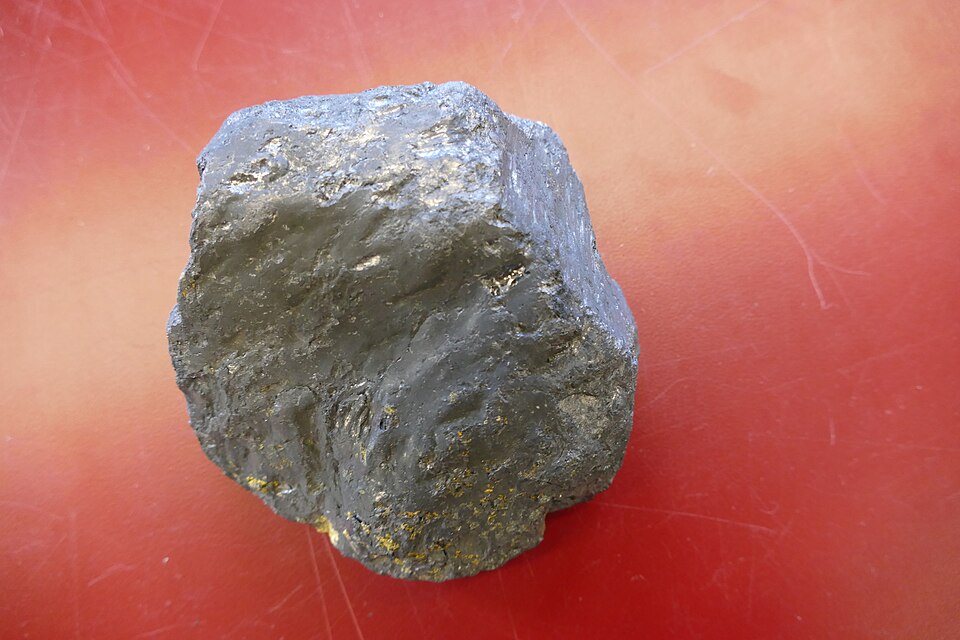
Correct — C, Carbon (Graphite). The writing core of a pencil is graphite, one of the crystalline forms of carbon, ground fine and baked with clay — more clay for a harder, fainter line and more graphite for a softer, darker one. Graphite works because of its structure: its carbon atoms are bonded to three neighbours each in flat hexagonal sheets, and the sheets are held to one another only weakly, so they shear off in layers whenever the point is dragged across paper. Those layers are the mark you see. The same slippery structure makes graphite a dry lubricant, and because each carbon keeps one loose electron, it also conducts electricity — unusual for a non-metal.
Why the others are wrong
- (a)Zinc — Zinc is a metal used to galvanise iron and as the case of a dry cell. It leaves no mark on paper and has no role in a pencil.
- (b)Lead — This is the trap the question exists for. The core has been called 'lead' since the days when the graphite dug out of the ground was mistaken for an ore of lead, and the name stuck; but there is no lead metal in a pencil, and modern pencils are a source of no lead poisoning whatever.
- (d)Tin — Tin is a soft metal used to coat steel cans and, with copper, to make bronze. It is neither soft enough in the right way nor dark enough to write with.
Concept
Carbon exists in several forms that are chemically the same element and physically nothing alike. In diamond every carbon is bonded to four others in a rigid three-dimensional network, which makes it the hardest natural substance and an electrical insulator. In graphite each carbon is bonded to three others in sheets, which makes it soft, slippery and electrically conducting. Fullerene closes sixty carbon atoms into a football-shaped cage, and graphene is a single sheet of graphite one atom thick. The contrast between diamond and graphite is the standard classroom illustration of how structure, not composition, decides properties.
This is a naming trap rather than a chemistry problem. The word 'lead' is printed in the question and again in the options, and a candidate reading quickly will match the two. The answer to hold on to is that the historical name survives from a mistaken identification of graphite centuries ago. UPSC made the same point from the health side in 2012, when it asked what still causes lead poisoning after leaded petrol was banned, and pencils were among the sources to be rejected. Learn the graphite structure alongside the name, because that is where the follow-up questions on lubrication, conduction and hardness will come from.
Key facts
- Pencil cores are made of graphite mixed with clay; the proportion of clay sets the hardness grade.
- Graphite is an allotrope of carbon in which each atom is bonded to three others in hexagonal layers.
- Graphite conducts electricity and is used as a dry lubricant and as a moderator in nuclear reactors; diamond does neither.
- Pencils contain no lead metal, and the name is a survival from graphite once being taken for a lead ore.
Study next
Common traps
- Choosing lead because of the name; the core is graphite.
- Assuming an electrical conductor must be a metal — graphite conducts and is not one.
- Treating diamond and graphite as different elements rather than different forms of carbon.
NDA asks which allotrope of carbon has a given property, or which statement about diamond and graphite is incorrect.
Related PYQs
Lead, ingested or inhaled, is a health hazard. After the addition of lead to petrol has been banned, what still are the sources of lead poisoning? 1. Smelting units 2. Pens and pencils 3. Paints 4. Hair oils and cosmetics Select the correct answer using the codes given below :
- (a) 1, 2 and 3 only
- (b) 1 and 3 only
- (c) 2 and 4 only
- (d) 1, 2, 3 and 4
Answer(b) 1 and 3 only
The same misnomer tested from the health angle — pencils are rejected as a source of lead poisoning precisely because their 'lead' is graphite.
Which one of the following statements about diamond and graphite is not correct?
- (a) Diamond has a tetrahedral structure, whereas graphite has a hexagonal planar structure.
- (b) Both physical and chemical properties of diamond and graphite are different.
- (c) Graphite is soft but diamond is hard.
- (d) Graphite is a good conductor of electricity while diamond is not.
Answer(b) Both physical and chemical properties of diamond and graphite are different.
The structural contrast that explains why graphite writes and diamond cuts, stated in the form NDA prefers.
Which among the following statements is not correct with respect to allotropes of Carbon?
- (a) Graphite is a good conductor of electricity.
- (b) Diamond is the hardest substance known.
- (c) Fullerene is one of the allotropes of carbon.
- (d) Next to diamond, graphite is the second hardest known substance.
Answer(d) Next to diamond, graphite is the second hardest known substance.
The softness of graphite stated outright, and the property that makes a pencil work at all.
Practice
- practice — not a real PYQ
Graphite conducts electricity while diamond does not because in graphite
- (a)each carbon atom is bonded to four others
- (b)each carbon atom has one electron free to move
- (c)the atoms are held by ionic bonds
- (d)metal impurities are always present
Answer(b) each carbon atom has one electron free to move — bonding to only three neighbours leaves a delocalised electron per atom. - practice — not a real PYQ
Diamond and graphite differ in their properties because they differ in
- (a)the element they are made of
- (b)the arrangement of their carbon atoms
- (c)the number of protons in each atom
- (d)their chemical formula
Answer(b) the arrangement of their carbon atoms — both are pure carbon, and only the bonding pattern is different.