
Which one of the following statements about diamond and graphite is not correct?
- (a)Diamond has a tetrahedral structure, whereas graphite has a hexagonal planar structure.
- (b)Both physical and chemical properties of diamond and graphite are different.
- (c)Graphite is soft but diamond is hard.
- (d)Graphite is a good conductor of electricity while diamond is not.
Answer
Why
Correct — B. Diamond and graphite are allotropes of the same element, carbon, so their chemical properties are essentially the same — both are pure carbon and both burn in oxygen to give only carbon dioxide. Only their physical properties differ, because the atoms are bonded differently. So the claim that 'both physical and chemical properties are different' is not correct; the other three statements describe genuine physical differences.
Why the others are wrong
- (a)Diamond has a tetrahedral structure, whereas graphite has a hexagonal planar structure. — This is true — diamond forms a three-dimensional tetrahedral network while graphite forms flat hexagonal layers, so it is a correct statement, not the answer.
- (c)Graphite is soft but diamond is hard. — True — graphite's layers slide over one another making it soft and slippery, while diamond is the hardest natural material; a real physical difference.
- (d)Graphite is a good conductor of electricity while diamond is not. — True — graphite has delocalised electrons between its layers and conducts, whereas diamond, with all four valence electrons locked in bonds, does not.
Concept
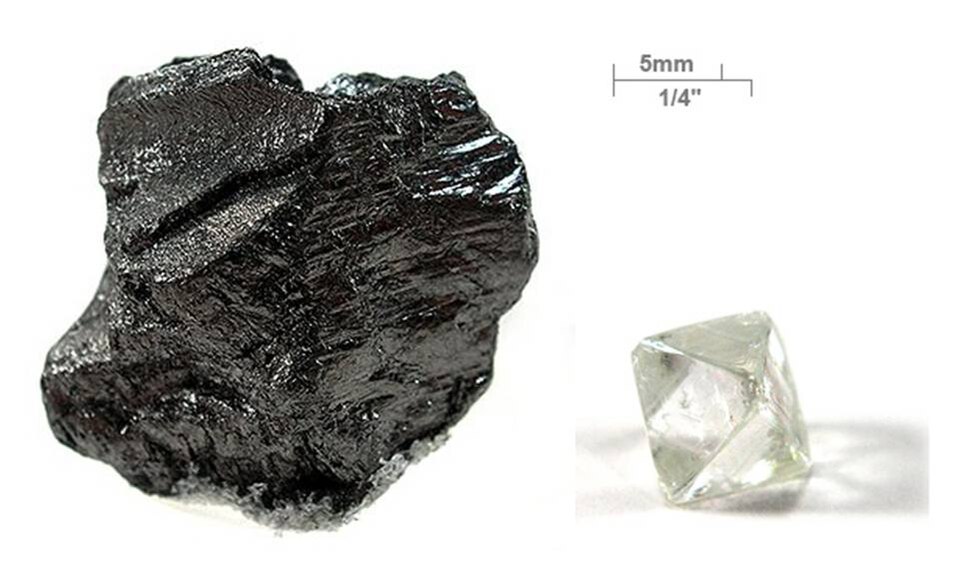
Allotropes are different structural forms of the same element. Because they are the same element, allotropes share their chemical properties but can differ sharply in physical properties owing to different bonding and arrangement. Diamond (a rigid tetrahedral network) and graphite (soft layered sheets) are the classic allotropes of carbon.
The false statement over-claims by saying the chemical properties also differ. Both solids are pure carbon and behave the same chemically — burning to carbon dioxide — so only the physical properties (hardness, structure, conductivity) set them apart.
Key facts
- Diamond and graphite are allotropes of carbon — same element, same chemistry.
- Both burn in oxygen to give only carbon dioxide.
- Diamond is hard and non-conducting with a tetrahedral network; graphite is soft and conducting with a layered structure.
- Other carbon allotropes include fullerenes and carbon nanotubes.
Study next
Common traps
- Assuming allotropes must differ chemically — they share chemical properties, differing only physically.
- Forgetting graphite conducts electricity while diamond does not.
Asked as 'which statement about diamond and graphite is not correct' — the false option usually claims their chemistry differs.
Related PYQs
The elemental composition of diamond is
- (a) Carbon and Hydrogen
- (b) Carbon and Oxygen
- (c) Pure Carbon
- (d) Pure Silicon
Answer(c) Pure Carbon
Directly reinforces this card — diamond is pure carbon, so it shares its chemistry with graphite (also pure carbon), which is exactly why statement B here is wrong.
Match List-I with List-II and select the correct answer using the code given below the Lists: List-I (Allotrope of Carbon) A. Graphite B. Diamond C. Fullerene D. Graphene List-II (Property) 1. Thinnest and strongest material 2. Hardest natural substance 3. Very light and strong material 4. Soft and slippery material Code:
- (a) A-4, B-2, C-3, D-1
- (b) A-4, B-3, C-2, D-1
- (c) A-1, B-3, C-2, D-4
- (d) A-1, B-2, C-3, D-4
Answer(a) A-4, B-2, C-3, D-1
Same concept — the allotropes of carbon and their differing physical properties. That NDA item matches graphite, diamond, fullerene and graphene to their properties; this one tests that these allotropes share chemistry but differ physically.
Practice
- practice — not a real PYQ
Diamond and graphite are
- (a)isotopes of carbon
- (b)allotropes of carbon
- (c)isomers of carbon
- (d)compounds of carbon
Answer(b) allotropes of carbon — different structural forms of the same element. - practice — not a real PYQ
Graphite conducts electricity because
- (a)it is very hard
- (b)it has free (delocalised) electrons between its layers
- (c)it contains metal atoms
- (d)it is a compound
Answer(b) it has free (delocalised) electrons between its layers, which carry current.