
The chemical name of baking soda is
- (a)Na₂CO₃
- (b)NaHCO₃
- (c)CaCO₃
- (d)NaOH
Answer
Why
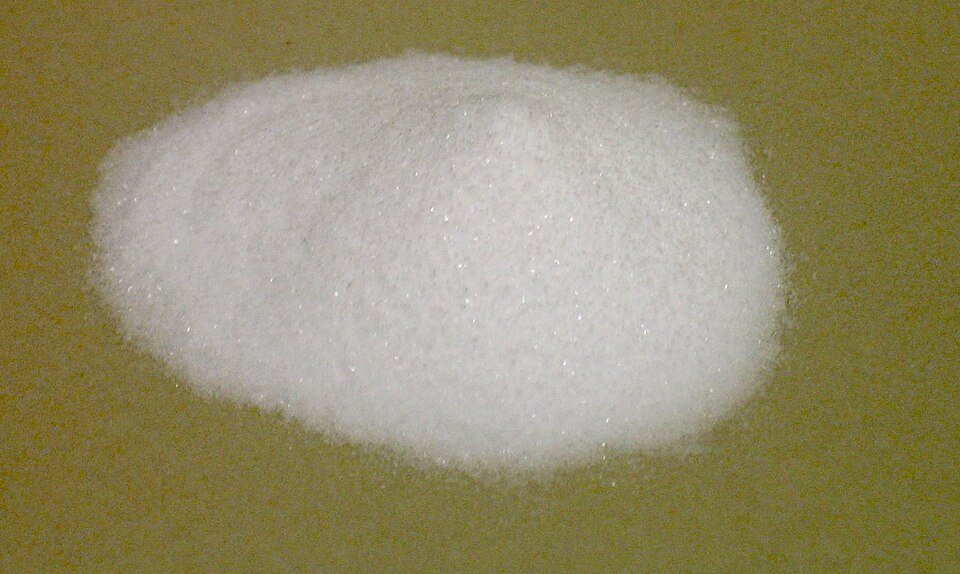
Correct — B, NaHCO₃. Baking soda is sodium hydrogencarbonate, also written as sodium bicarbonate, a white crystalline solid that is a mild base. Its usefulness in the kitchen comes from one reaction: on heating, or on meeting an acid such as the tartaric acid in baking powder or the citric acid in a lemon, it releases carbon dioxide, and the bubbles of that gas make dough rise. The same reaction explains its other uses — as an antacid, because it neutralises excess hydrochloric acid in the stomach, and as the active ingredient in soda-acid fire extinguishers, where the carbon dioxide it gives off smothers a flame.
Why the others are wrong
- (a)Na₂CO₃ — Sodium carbonate is washing soda, not baking soda, and in the laboratory it is usually met as the decahydrate. It is a much stronger base than baking soda, is used to soften hard water and to make glass and soap, and is not eaten. Confusing the carbonate with the hydrogencarbonate is the trap the question is built on.
- (c)CaCO₃ — Calcium carbonate is limestone, marble and chalk, and it is also the raw material of the Solvay process. It shares the carbonate group with the answer but has calcium in place of sodium, and it is not soluble enough to work in dough.
- (d)NaOH — Sodium hydroxide is caustic soda, a strongly corrosive alkali made by the chlor-alkali process and used in soap making and in cleaning agents. It carries no carbon at all, so it can release no carbon dioxide and could never be used in food.
Concept
Baking soda is made from common salt by the Solvay process, in which brine saturated with ammonia takes up carbon dioxide and the sparingly soluble sodium hydrogencarbonate settles out. Heating that solid drives off water and carbon dioxide and leaves sodium carbonate, which is washing soda, so the two compounds are two stages of the same chemistry. Baking powder is not another name for baking soda; it is baking soda mixed with a solid edible acid, so that carbon dioxide is released as soon as the mixture is wetted rather than only when it is heated.
Read the stem as it is printed — it asks for the 'chemical name' and then offers four formulae, so what it really wants is the formula. Nothing about the chemistry changes. Sort the four by the common names attached to them, since that is how these compounds are examined: baking soda, washing soda, caustic soda and limestone. Keep the sodium compounds apart by the hydrogen — the one you eat has an H in it, the one you wash with does not. That single letter is the whole question.
Key facts
- Baking soda is sodium hydrogencarbonate, NaHCO₃; washing soda is sodium carbonate decahydrate, Na₂CO₃·10H₂O.
- On heating, baking soda decomposes to sodium carbonate, water and carbon dioxide, and it is the carbon dioxide that makes dough rise.
- Baking powder is baking soda mixed with a mild edible acid such as tartaric acid.
- Baking soda is made from common salt through the Solvay process and is used as an antacid and in fire extinguishers.
Study next
Common traps
- Swapping the carbonate for the hydrogencarbonate; only the latter is baking soda.
- Treating baking powder and baking soda as the same thing.
- Assuming every substance called a 'soda' is a sodium carbonate — caustic soda is a hydroxide.
NDA asks for the formula behind a common chemical name, or matches a set of common names with their formulae.
Related PYQs
Consider the following statements : 1. Anhydrous sodium carbonate is commonly known as baking soda 2. Baking soda is used in fire extinguishers 3. Bleaching powder is manufactured in Hasenclever plant Which of the statements given above is/are correct?
- (a) 1, 2 and 3
- (b) 2 and 3
- (c) 3 only
- (d) 1 and 2
Answer(b) 2 and 3
The same carbonate-against-hydrogencarbonate confusion planted as a statement to be rejected, together with the fire-extinguisher use that follows from the carbon dioxide.
Match List I with List II and select the correct answer using the codes given below the lists: List I I. Blue vitriol II. Epsom salt III. Baking soda IV. Caustic soda List II A) Sodium bicarbonate B) Sodium hydroxide C) Magnesium sulphate D) Copper sulphate
- (a) I-C, II-D, III-B, IV-A
- (b) I-D, II-C, III-A, IV-B
- (c) I-C, II-D, III-A, IV-B
- (d) I-D, II-A, III-B, IV-A
Answer(b) I-D, II-C, III-A, IV-B
Common names matched to compounds, with baking soda and caustic soda side by side — the pairing this question also relies on.
At nearly 70 °C, sodium bicarbonate shows the property of gradually decomposing, which makes it usable in bakery products. The product of decomposition responsible for this use of sodium bicarbonate is
- (a) Carbon dioxide
- (b) Hydrogen
- (c) Water vapour
- (d) Oxygen
Answer(a) Carbon dioxide
The reason baking soda is used at all, which is the natural follow-up to knowing its formula.
Common salt (NaCl) is not used as a raw material for preparation of which one of the following compounds?
- (a) Bleaching powder
- (b) Baking soda
- (c) Plaster of Paris
- (d) Washing soda
Answer(c) Plaster of Paris
Practice
- practice — not a real PYQ
When baking soda is heated strongly, the gas evolved is
- (a)oxygen
- (b)hydrogen
- (c)carbon dioxide
- (d)ammonia
Answer(c) carbon dioxide — sodium hydrogencarbonate breaks down into sodium carbonate, water and carbon dioxide, which is what makes a cake rise. - practice — not a real PYQ
Washing soda has the chemical formula
- (a)NaHCO₃
- (b)Na₂CO₃·10H₂O
- (c)NaOH
- (d)CaOCl₂
Answer(b) Na₂CO₃·10H₂O — sodium carbonate decahydrate, used to soften hard water, is distinct from the hydrogencarbonate used in baking.