
The following 6 (Six) items consist of two statements, Statement I and Statement II. Examine these two statements carefully and select the correct answer using the code given below : Statement I : Chartism was the political reform campaign for democratic rights which swept over Britain between 1838 and 1848. Statement II : The trade union movement declined by the 1830s as it failed to fulfil the aspirations of the working class.
- (a)Both the statements are individually true and Statement II is the correct explanation of Statement I
- (b)Both the statements are individually true but Statement II is not the correct explanation of Statement I
- (c)Statement I is true but Statement II is false
- (d)Statement I is false but Statement II is true
Answer
Why
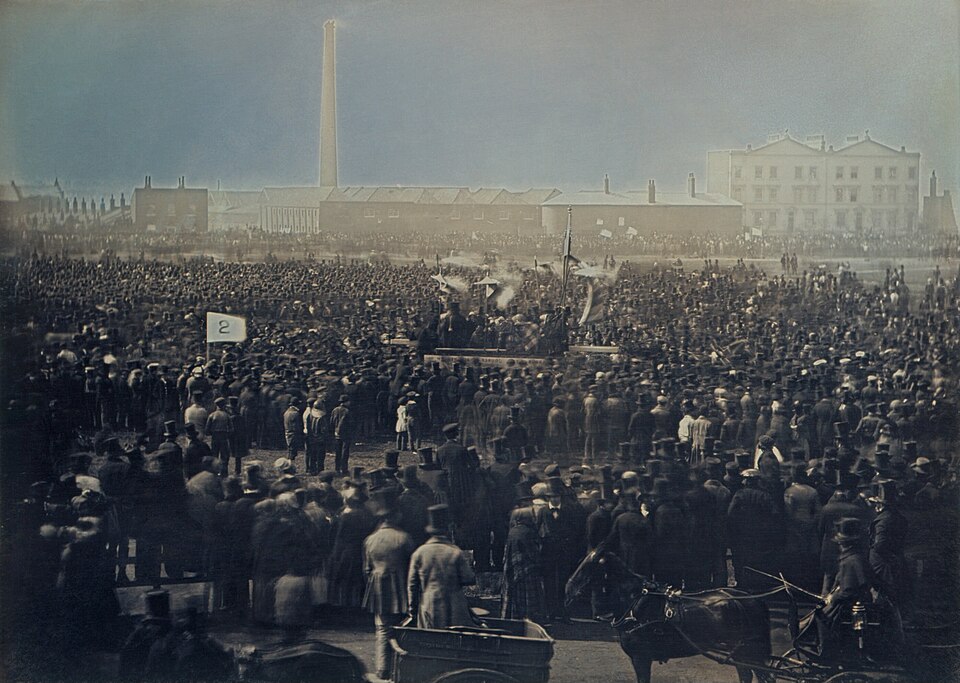
Correct: A, both statements are individually true and Statement II is the correct explanation of Statement I. Chartism was indeed the British working class's campaign for democratic rights, and the years the stem names are its mass phase, when the three great national petitions went to Parliament in 1839, 1842 and 1848. Statement II is true as well: organised trade unionism collapsed in the mid-1830s. The Grand National Consolidated Trades Union, founded in February 1834 to unite workers across trades, was dissolved by November of the same year after lost strikes and the prosecution of the Tolpuddle labourers. And the two are linked, not merely adjacent. When industrial action failed to win better wages and hours, working men shifted their effort from the workshop to Parliament, arguing that they would never be heard until they had the vote. The most important successor to the collapsed union was William Lovett's London Working Men's Association: the very body that drafted the People's Charter in 1838. Statement II therefore names the cause and option (a) is right.
Why the others are wrong
- (b)Both the statements are individually true but Statement II is not the correct explanation of Statement I: The safe-looking choice, and wrong here because the connection is institutional and not just chronological. The organisation that wrote the People's Charter grew directly out of the wreckage of the trade-union effort, so the failure of one produced the other.
- (c)Statement I is true but Statement II is false: The mid-1830s collapse of general trade unionism is well documented: the Grand National Consolidated Trades Union lasted less than a year, and the transportation of the Tolpuddle labourers in 1834 for administering unlawful oaths broke the movement's confidence.
- (d)Statement I is false but Statement II is true: Statement I is accurate as far as it goes. Chartism's outer span runs on past 1848 in some accounts, but the years given are exactly the movement's mass phase, bracketed by the Charter of 1838 and the last great petition of 1848.
Concept
Chartism took its name from the People's Charter of 1838 and its six demands: votes for all adult men, a secret ballot, no property qualification for members of Parliament, payment of members, equal-sized constituencies and annual parliaments. It was the first mass political movement of the British working class, and it worked through monster petitions and mass meetings rather than through strikes. Every demand except annual parliaments was eventually granted, though decades later.
The pair asks a candidate to know the sequence of working-class strategy in industrial Britain, not just two isolated dates. Test the causal link by asking what filled the gap: after the general union collapsed in 1834, the same men and the same grievances reappeared in a body that petitioned Parliament instead of striking. That is a genuine cause. The one honest caveat is on dates: Chartism's mass phase ends in 1848 as the stem says, but historians often extend the movement to the later 1850s, so treat the printed span as the phase of the three petitions rather than the movement's whole life. Anchoring to the exam, this remains a syllabus topic taught alongside the Industrial Revolution.
Key facts
- The People's Charter of 1838 set out six demands, of which all but annual parliaments were eventually conceded.
- Chartism's three national petitions went to Parliament in 1839, 1842 and 1848.
- The Grand National Consolidated Trades Union was founded in February 1834 and dissolved in November 1834 after lost strikes.
- Six Dorset labourers, remembered as the Tolpuddle Martyrs, were sentenced to transportation in 1834 for swearing a union oath.
- William Lovett's London Working Men's Association, successor to the collapsed union effort, drafted the People's Charter.
Study next
Common traps
- Reading Chartism as a trade-union movement; it was a campaign for political rights, pursued by petition rather than by strike.
- Rejecting the stem because Chartism is sometimes dated beyond 1848: the years printed are its mass phase.
Industrial Britain is a reliable NDA GAT theme, asked as statement pairs, as who-coined-the-term items and as multi-statement lists, so keep the chain from factory conditions to unions to Chartism in one story.
Related PYQs
Which among the following was/were among the factors for England to experience the Industrial Revolution first? 1. The scientific inventions had paved the way for Industrial Revolution. 2. It had favourable social and political structures in place. 3. Navigable rivers had made inland transport easier. 4. It had seen the ascendancy of capitalist practices. Select the correct answer using the code given below:
- (a) 1 and 3 only
- (b) 1, 3 and 4 only
- (c) 4 only
- (d) 1, 2, 3 and 4
Answer(d) 1, 2, 3 and 4
Sets the scene for Chartism: the same industrial Britain that produced the factory workforce whose failed unions turned to political agitation.
Practice
- practice, not a real PYQ
The People's Charter of 1838 demanded all of the following EXCEPT
- (a)a secret ballot
- (b)payment of members of Parliament
- (c)votes for all adult men
- (d)the abolition of the monarchy
Answer(d) the abolition of the monarchy: the Charter's six points were about representation, not about ending the crown. - practice, not a real PYQ
The Tolpuddle labourers, transported in 1834, were prosecuted for
- (a)rioting in a textile mill
- (b)administering an unlawful oath in forming a union
- (c)presenting a petition to Parliament
- (d)destroying threshing machines
Answer(b) administering an unlawful oath in forming a union: their sentence helped break the trade-union movement of the 1830s.