
Who among the following rulers, ruled for the maximum period?
- (a)Alauddin Khilji
- (b)Muhammad bin Tughluq
- (c)Bahlol Lodi
- (d)Balban
Answer
Why
Correct — C, Bahlol Lodi. Line the four reigns up with their dates and the arithmetic is not close. Bahlul Khan Lodi, chief of the Afghan Lodi tribe and governor of Sirhind, took the throne of Delhi on 19 April 1451 after Alam Shah, the last of the Sayyids, gave up his claim, and he ruled until his death on 12 July 1489 — thirty-eight years and nearly three months. Muhammad bin Tughluq reigned from February 1325 to his death at Thatta in March 1351, twenty-six years. Balban declared himself Sultan in 1266 on the death of Nasiruddin Mahmud and died on 13 January 1287, twenty-one years. Alauddin Khalji seized power in 1296 and died on 4 January 1316, twenty years. So the order is 38 > 26 > 21 > 20, and Bahlul Lodi wins by a full twelve years over his nearest rival on this list. It is worth noticing how long that is by Sultanate standards: the reign usually cited as the Sultanate's longest, that of Firuz Shah Tughluq from 1351 to 20 September 1388, comes to thirty-seven years — a year less than Bahlul's. Bahlul's longevity was not accidental. He founded the Lodi dynasty, the only Afghan house to hold Delhi, and he governed on an Afghan tribal understanding of kingship in which the Sultan was first among equals rather than an untouchable despot — he seated his nobles beside him instead of demanding prostration, which cost him some grandeur but bought him a stable coalition. He spent much of those decades rebuilding a Sultanate that had shrunk almost to the walls of Delhi after Timur's sack of 1398, recovering Mewat, Etawah and Sambhal — Gwalior stayed with the Tomars, Man Singh Tomar buying off a campaign with a tribute of 800,000 tankas, and the Sultanate took the fort only under Ibrahim Lodi in 1518 — and finally absorbing the Sharqi kingdom of Jaunpur in 1479 after a long contest with Husain Shah Sharqi.
Why the others are wrong
- (a)Alauddin Khilji — Alauddin Khalji, 1296 to January 1316, is the shortest of the four at twenty years — yet he is the most frequently chosen wrong answer, because his is the most eventful reign in the Sultanate: the market-control regulations, the measurement-based kharaj, the dagh and chehra branding and descriptive-roll system, the southern campaigns under Malik Kafur and the repeated defeats of Mongol invasions. Importance is being mistaken for duration.
- (b)Muhammad bin Tughluq — Muhammad bin Tughluq, February 1325 to March 1351, is twenty-six years — the longest of the three wrong options and the only one that is genuinely arguable if you are working from impressions. His reign feels enormous because so much is crammed into it: the transfer of the capital to Daulatabad, the token currency, the Khurasan and Qarachil projects, Ibn Battuta's years at his court. It is still a dozen years short of Bahlul's.
- (d)Balban — Balban's sultanate runs from 1266 to 13 January 1287, twenty-one years, and the question asks who ruled longest, not who held power longest. The trap is real: Balban had effectively governed Delhi as naib to the boy-sultan Nasiruddin Mahmud since 1246, so his period of dominance is nearer forty years. Counted that way he would rival Bahlul, but he did not hold the throne until 1266.
Concept
The Delhi Sultanate ran from 1206 to 1526 under five successive houses — the Mamluk or so-called Slave dynasty to 1290, the Khaljis to 1320, the Tughluqs to 1414, the Sayyids to 1451 and the Lodis to 1526 — and the four names in this question are drawn one each from the first four of those eras except the Sayyids, so the question doubles as a test of whether you can place a ruler in his dynasty at all. Reigns in the Sultanate were characteristically short and violently terminated; a great many sultans lasted under five years, and reigns reaching the mid-thirties are rare enough that only two are usually named, Firuz Shah Tughluq's and Bahlul Lodi's. The Lodis matter for a second reason beyond arithmetic. They were Afghans, not Turks, and Afghan political culture rested on tribal equality rather than on the Persian-Turkish theory of divinely sanctioned autocracy that Balban had imported. Where Balban insisted on sijda and paibos, prostration and the kissing of the royal feet, and called himself the shadow of God, Bahlul sat with his amirs and called them partners in the kingdom. That difference explains both his long survival and the later collapse of Ibrahim Lodi, who tried to reverse it and drove his own nobles to invite Babur.
This is a pure recall question with no internal logic to exploit, so the honest advice is to memorise a short table rather than to reason. But the table is small. Four dates settle it: Balban 1266–1287, Alauddin Khalji 1296–1316, Muhammad bin Tughluq 1325–1351, Bahlul Lodi 1451–1489. The single discriminating fact is that only one of these four spans crosses thirty years, and it is the Lodi one. If the dates will not come, there is a weaker structural cue: three of the four rulers are famous for what they did in office, while Bahlul Lodi is famous mainly for founding a dynasty and for patiently reassembling a wrecked Sultanate — the kind of career that takes decades rather than a decade. Two traps sit inside this question. The first is equating historical importance with time served, which pushes candidates towards Alauddin Khalji, the shortest reign on the list. The second is subtler and catches better-prepared candidates: Balban's real dominance of Delhi began in 1246, when he became naib to Nasiruddin Mahmud, so anyone counting his influence rather than his sultanate gets about forty years and picks him. The wording of the stem — who ruled, not who wielded power — is what excludes that reading.
Key facts
- Bahlul Khan Lodi became Sultan of Delhi on 19 April 1451 and died on 12 July 1489, a reign of about 38 years — the longest of the four rulers offered, and a year longer than Firuz Shah Tughluq's 1351–1388, the 37-year reign usually cited as the Sultanate's longest.
- Alauddin Khalji ruled 1296 to 4 January 1316, about 20 years; Balban 1266 to 13 January 1287, about 21 years; Muhammad bin Tughluq February 1325 to March 1351, about 26 years.
- Balban was one of Iltutmish's group of forty Turkic slaves and served as regent to Sultan Nasiruddin Mahmud from 1246 before declaring himself Sultan in 1266 — which is why his period of effective power is nearly twice his reign.
- Bahlul Lodi founded the Lodi dynasty, the only Afghan house to rule Delhi, on the abdication of the last Sayyid claimant Alam Shah; he annexed the Sharqi kingdom of Jaunpur in 1479, and was succeeded by his son Sikandar Lodi, 1489–1517, and then Ibrahim Lodi, 1517–1526.
- The Tomb of Sikandar Lodi in Lodi Gardens, New Delhi, was built in 1517–1518 by Ibrahim Lodi and is India's earliest surviving enclosed garden tomb — the architectural form that leads on to Humayun's tomb and the Taj Mahal.
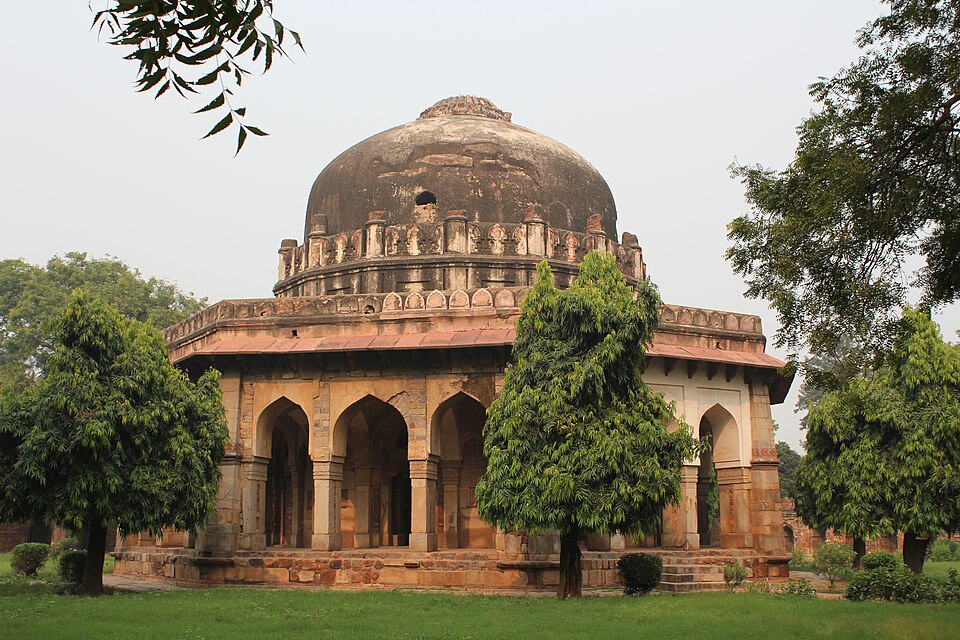
Study next
Common traps
- Choosing Alauddin Khalji because his reign is the most consequential — at 20 years it is in fact the shortest of the four
- Counting Balban's regency from 1246 instead of his sultanate from 1266; the stem asks who ruled, and his reign as Sultan is 21 years
- Reaching for Firuz Shah Tughluq's 37 years, the usual longest-reign answer, when he is not among the options — Bahlul Lodi's 38 years actually exceeds it
BPSC asks the regnal table directly — four sultans, one line, and you either hold the dates or you guess, which is why a memorised span list pays for itself across the whole medieval section. UPSC prefers to make the same dates do work inside a larger problem: in 2006 it asked for the chronological order of the three Afghan rulers of Delhi, and in 2000 it buried Firoz Tughlaq's death among the Qutb Minar, the Portuguese arrival and Krishnadevaraya's reign, so the dates are a tool rather than the answer.
Related PYQs
Which one of the following is the correct chronological order of the Afghan rulers to the throne of Delhi?
- (a) Sikandar Shah-Ibrahim Lodi-Bahlol Khan Lodi
- (b) Sikandar Shah-Bahlol Khan Lodi-Ibrahim Lodi
- (c) Bahlol Khan Lodi-Sikandar Shah-Ibrahim Lodi
- (d) Bahlol Khan Lodi-Ibrahim Lodi-Sikandar Shah
Answer(c) Bahlol Khan Lodi-Sikandar Shah-Ibrahim Lodi
The same regnal table read for order instead of length — Bahlol Lodi 1451–1489, Sikandar Lodi 1489–1517, Ibrahim Lodi 1517–1526; a candidate who knows the spans well enough to answer the BPSC question answers this one from the same three dates.
Consider the following events: I. Reign of Krishna Deva Raya of Vijayanagara. II. Construction of Qutab Minar. III. Arrival of Portuguese in India. IV. Death of Firoz Tughlaq. Which one of the following is the correct chronological sequence of the above events?
- (a) II, IV, III, I
- (b) II, IV, I, III
- (c) IV, II, I, III
- (d) IV, II, III, I
Answer(a) II, IV, III, I
Tests the same Sultanate date-table from the other side — it turns on Firoz Tughlaq's death in 1388, the reign of 37 years that is the classic near-miss whenever a paper asks which Delhi Sultan ruled longest.
Practice
- practice — not a real PYQ
Bahlul Lodi ascended the throne of Delhi in 1451 following the abdication of the last ruler of which dynasty?
- (a)Tughluq dynasty
- (b)Sayyid dynasty
- (c)Khalji dynasty
- (d)Sharqi dynasty
Answer(b) Sayyid dynasty — Bahlul Lodi became Sultan on 19 April 1451 when Alam Shah, the last Sayyid claimant, gave up the throne. The Sharqis ruled Jaunpur, not Delhi, and Bahlul annexed their kingdom in 1479. - practice — not a real PYQ
Which one of the following Delhi Sultans had the longest reign?
- (a)Iltutmish
- (b)Firuz Shah Tughluq
- (c)Alauddin Khalji
- (d)Sikandar Lodi
Answer(b) Firuz Shah Tughluq — he ruled from 1351 to 1388, about 37 years, against Iltutmish's 1211–1236 (25 years), Alauddin Khalji's 1296–1316 (20 years) and Sikandar Lodi's 1489–1517 (28 years).