
Consider the following dynasties of Ancient India : 1) Shunga 2) Maurya 3) Kushana 4) Kanva Which of the following is the correct chronological order of their rule?
- (a)2-1-4-3
- (b)1-2-3-4
- (c)2-3-1-4
- (d)2-1-3-4
Answer
Why
Correct — A, 2-1-4-3. Read the four dynasties in date order and the sequence writes itself. (2) MAURYA, about 322 to 185 BCE — founded by Chandragupta Maurya after he displaced the Nandas of Magadha, ruled from Pataliputra, and ended when the last Mauryan king Brihadratha was assassinated by his own commander-in-chief. (1) SHUNGA, about 185 to 73 BCE — that commander-in-chief was Pushyamitra Shunga, who took the throne of Magadha and kept Pataliputra as his capital, while later Shungas such as Bhagabhadra also held court at Besnagar, modern Vidisha; there were ten Shunga rulers, and the Bharhut railings and the enlargement of the Great Stupa at Sanchi belong to this period. (4) KANVA, 73 to 28 BCE — the last Shunga, Devabhuti, was assassinated by his own Brahmin minister Vasudeva Kanva, who founded a line of four kings that the Puranas place at Pataliputra, though their coins cluster around Vidisha; the Puranas end the dynasty in 28 BCE at the hands of the Satavahanas. (3) KUSHANA, roughly the first century CE onwards — a wholly different story in a wholly different region: the Kushans were a branch of the Yuezhi who moved out of Central Asia into Bactria, and Kujula Kadphises founded their empire in the early first century CE, well after the last Kanva king had fallen. So the chain is Maurya, then Shunga, then Kanva, then Kushana — 2-1-4-3, which is option (a). Note the tidy internal logic of the first three: each is founded by the servant who murdered his master, all three are Magadhan houses, and all three run from Pataliputra, the city that is now Patna.
Why the others are wrong
- (b)1-2-3-4 — 1-2-3-4 puts the Shungas before the Mauryas, which inverts the single best-documented succession in early Indian history — Pushyamitra Shunga was the Mauryan commander-in-chief and took the throne by killing the last Mauryan king in 185 BCE. It is the option a candidate ticks by reading the list numbers straight down without reading the dynasty names at all.
- (c)2-3-1-4 — 2-3-1-4 starts correctly with the Mauryas but then inserts the Kushanas between Maurya and Shunga, which is off by more than two centuries and by half the subcontinent. It tempts anyone who ranks by size rather than by date, on a vague sense that the next big empire after the Mauryas must have been the Kushanas — but the Shungas immediately succeeded the Mauryas at Pataliputra.
- (d)2-1-3-4 — 2-1-3-4 is the option the question was built for. It gets Maurya then Shunga right and only swaps the last two, putting the Kushanas third and the Kanvas last. The instinct is that the obscure short-lived dynasty must be the tail-end of the list. In fact the Kanvas ruled 73 to 28 BCE and ended before the Common Era began, while the Kushan empire only starts in the first century CE.
Concept
The four dynasties in this list are not four equivalent entries; they are three Magadhan successors plus one outsider, and understanding that structure makes the order impossible to forget. Maurya, Shunga and Kanva form a single continuous chain at Pataliputra between about 322 and 28 BCE, each one founded by the man who murdered the last ruler of the one before — Chandragupta over the Nandas, Pushyamitra over Brihadratha, Vasudeva Kanva over Devabhuti — and each successively smaller, until the Satavahanas of the Deccan extinguished the Kanvas in 28 BCE. The Kushanas belong to a different process entirely. From the second century BCE the north-west of the subcontinent absorbed wave after wave of Central Asian arrivals: the Indo-Greeks first, then the Sakas or Indo-Scythians, then the Parthians or Pahlavas, and finally the Yuezhi confederation from which the Kushans emerged. Kujula Kadphises welded the Kushan empire together in the early first century CE and it lasted, on the usual reckoning, to about 375 CE, ruling from Purushapura and Mathura rather than from Magadha, with the Kanishka era conventionally beginning in 127 CE. So the question is really asking whether you can keep two separate chronologies — the Magadhan succession and the north-western invasions — in the right relation to each other.
Attack this by anchoring, not by recall of all four spans. Two anchors do the whole job. The first is that Pushyamitra Shunga was Brihadratha's own senapati, so Shunga must immediately follow Maurya — that alone kills option (b), which reverses them, and option (c), which pushes a foreign dynasty in between. The second is the era boundary: the Kanvas ruled 73 to 28 BCE and therefore finished before the Common Era, while the Kushan empire only begins in the first century CE. That is the single discriminating fact, because options (a) and (d) are identical in their first two places and differ only in whether Kanva or Kushana comes third. Anyone who can say 'Kanva is BCE, Kushana is CE' has the answer without knowing a single other date. The trap is a habit of mind rather than a gap in knowledge. Candidates rank the four by prominence and assume the obscure dynasty is a footnote appended at the end, so the little-known Kanvas get pushed behind the famous Kushanas and option (d) is ticked. The corrective is to remember that the Kanvas are obscure precisely because they were the last, weakest link in the Magadhan chain, not because they were late — a dynasty of four kings holding a shrinking realm for forty-five years just before the Satavahanas swept it away.
Key facts
- Maurya, about 322 to 185 BCE, ended when Brihadratha was assassinated by his commander-in-chief Pushyamitra, who founded the Shunga dynasty; the Shungas ruled Magadha from Pataliputra for roughly 185 to 73 BCE with ten rulers, later kings also holding court at Besnagar, modern Vidisha.
- The Kanva dynasty was established in 73 BCE by Vasudeva Kanva, minister of the last Shunga emperor Devabhuti, whom he assassinated; there were four Kanva rulers, and the Puranas record that the Satavahanas ended the dynasty in 28 BCE.
- The Kushan Empire, roughly 30 to 375 CE, was formed by the Yuezhi in Bactria and founded by Kujula Kadphises in the early first century CE — entirely after the Kanvas had gone; Kushan inscriptions in India reach at least Saketa and Sarnath.
- The north-western sequence of arrivals runs Indo-Greeks from about 200 BCE, then the Sakas or Indo-Scythians from the late first century BCE, then the Kushans from about 30 CE — which is why the Kushanas sit last in this list.
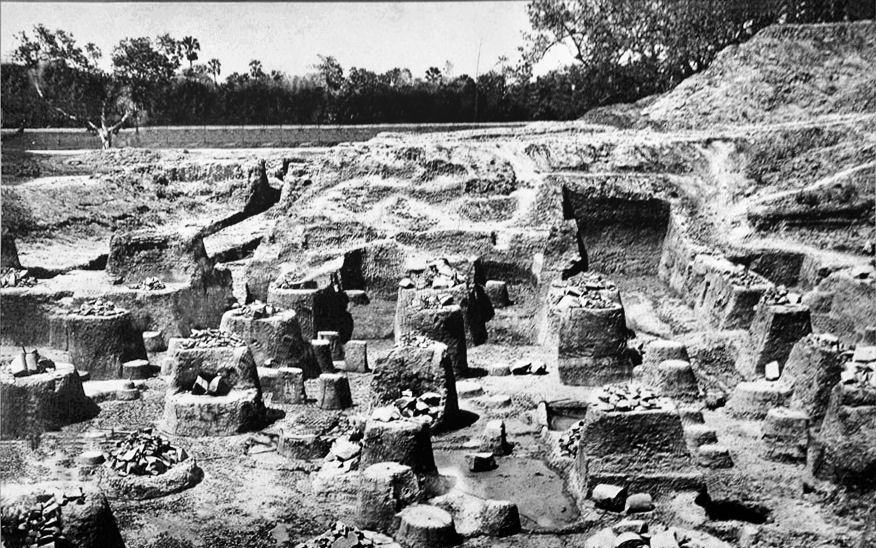
- Pataliputra, the capital shared by the Mauryas, Shungas and Kanvas, has been excavated since 1913 at Kumhrar in Patna, about 5 km east of Patna Junction, where the remains of a hypostyle eighty-pillared Mauryan hall were found; the deposits there run continuously from about 600 BCE to 600 CE.
Study next
Common traps
- Placing the Kanvas after the Kushanas because they are less famous — the Kanvas end in 28 BCE, the Kushan empire begins in the first century CE
- Reading the numbered list top to bottom as though it were already in order, which produces option (b) and reverses Maurya and Shunga
- Assuming a bigger empire must come sooner after the Mauryas and slotting the Kushanas in at second place, when Pushyamitra Shunga took the throne directly from the last Mauryan king
BPSC states four dynasties as a bare numbered list and asks for the sequence, so the marks turn on one boundary — here BCE against CE — and a candidate who has memorised even two spans can eliminate to a single option. UPSC rarely asks a dynasty sequence so nakedly: it tests the same chain as a statement set on who assassinated whom, as in 2003, or shifts the frame to the invaders and asks for Greeks, Sakas and Kushans in order, as in 2006, so the dates have to be usable rather than merely recited.
Related PYQs
Consider the following statements: 1. The last Mauryan ruler, Brihadratha was assassinated by his commander-in-chief, Pushyamitra Sunga. 2. The last Sunga king, Devabhuti was assassinated by his Brahmana minister Vasudeva Kanva who usurped the throne. 3. The last ruler of the Kanva dynasty was deposed by the Andhra's. Which of these statements is/are correct?
- (a) 1 and 2
- (b) Only 2
- (c) Only 3
- (d) 1, 2 and 3
Answer(d) 1, 2 and 3
The same Maurya to Shunga to Kanva chain, told through the three assassinations that link it — and the third statement adds the closing date the BPSC question needs, since the Satavahanas or Andhras ended the Kanvas in 28 BCE, before the Kushan empire existed.
With reference to the invaders in ancient India, which one of the following is the correct chronological order?
- (a) Greeks – Sakas – Kushans
- (b) Greeks – Kushans – Sakas
- (c) Sakas – Greeks – Kushans
- (d) Sakas – Kushans – Greeks
Answer(a) Greeks – Sakas – Kushans
Sequencing ancient powers by date in exactly the same way, and it fixes the fact the BPSC question turns on: the Kushans arrive last in the post-Mauryan procession, after the Indo-Greeks of about 200 BCE and the Sakas of the late first century BCE, and therefore after the Kanvas.
Practice
- practice — not a real PYQ
The Kanva dynasty of Magadha was brought to an end, according to the Puranas, by which power?
- (a)The Satavahanas
- (b)The Kushanas
- (c)The Indo-Greeks
- (d)The Guptas
Answer(a) The Satavahanas — the Puranas record that the last of the four Kanva rulers was overthrown by the Satavahanas, also called the Andhras, in 28 BCE. The Kushanas were then still in Bactria, and the Guptas are more than three centuries later. - practice — not a real PYQ
Which one of the following statements about the Shunga dynasty is correct?
- (a)It was founded by a minister who assassinated the last Kanva ruler
- (b)It was founded by Pushyamitra, the commander-in-chief of the last Mauryan king
- (c)It ruled from Purushapura and Mathura
- (d)It was ended by the invasion of Alexander
Answer(b) It was founded by Pushyamitra, the commander-in-chief of the last Mauryan king — Pushyamitra assassinated Brihadratha in about 185 BCE and ruled from Pataliputra. It was the Shunga line that a minister ended, when Vasudeva Kanva killed Devabhuti in 73 BCE; Purushapura and Mathura were Kushan centres.