
Match List I with List II List-I List-II Event/Place Connected with Person a) Chola Gangam Lake 1) Chandragupta Maurya b) Appointment of Dharma Mahamatra 2) Harshavardhan c) Assembly at Prayag 3) Rajendra I d) Sudarshan Lake 4) Ashoka Select the correct answer using the codes given below : a b c d
- (a)3 4 2 1
- (b)1 4 2 3
- (c)3 4 1 2
- (d)2 3 1 4
Answer
Why
Correct — A, 3 4 2 1. Four independent attributions are hiding inside one code, so establish each before touching the options. (a) Chola Gangam Lake → 3, Rajendra I. After his northern campaign of 1019–1022 CE, in which Chola armies marched through Kalinga, defeated Mahipala of the Palas and reached the Ganga, Rajendra I took the title Gangaikonda Chola, 'the Chola who took the Ganga', moved his capital from Thanjavur to a new city named Gangaikonda Cholapuram in what is now Ariyalur district of Tamil Nadu, and excavated beside it an enormous tank named Cholagangam — described in the Chola record as the liquid pillar of victory, because the defeated northern kings were made to carry Ganga water to fill it. (b) Appointment of Dharma Mahamatra → 4, Ashoka. Major Rock Edict V is devoted to the establishment and duties of these officers; in it Ashoka states that no such officers of Dhamma existed before him and that he appointed them thirteen years after his consecration, to work among the Yonas, Kambojas, Gandharas and other peoples, and to look after prisoners, the aged and the dependants of the dead. (c) Assembly at Prayag → 2, Harshavardhana. Xuanzang, who was at Harsha's court in the 640s, records that every five years the emperor held a great assembly called Moksha at Prayaga, the confluence of the Ganga and the Yamuna, at which he gave away the whole of his accumulated treasury in charity to men of every faith. (d) Sudarshan Lake → 1, Chandragupta Maurya. The Junagadh rock inscription of Rudradaman I, cut shortly after 150 CE, opens by recording that the reservoir called Sudarshana near Girnar was constructed by the Vaishya Pushyagupta, provincial governor of the Maurya emperor Chandragupta, and that conduits were later added to it by the Yavana king Tushaspha under Ashoka. So a-3, b-4, c-2, d-1, which is the code printed against option (a).
Why the others are wrong
- (b)1 4 2 3 — The trap the question was built around: it keeps Dharma Mahamatra with Ashoka and Prayag with Harsha, both correct, and simply exchanges the two lakes — Chola Gangam to Chandragupta Maurya and Sudarshan to Rajendra I. Every candidate who knows three names and reverses the tanks lands here. The name itself is the corrective: Chola Gangam carries both 'Chola' and 'Ganga' in it, so it can only belong to the Chola who took the Ganga.
- (c)3 4 1 2 — Gets the two Mauryan-era and Chola rows partly right but swaps the last pair, sending the Prayag assembly to Chandragupta Maurya and the Sudarshan lake to Harshavardhan. Neither survives a second's thought: Chandragupta Maurya is over nine centuries earlier than the quinquennial Prayaga assembly, and Harsha ruled from Kanauj in the upper Ganga plain, never over Saurashtra where the Sudarshana reservoir lay.
- (d)2 3 1 4 — Scores nothing, but it is the cleverest-looking wrong option because its last pair, Sudarshan Lake with Ashoka, is a genuine half-truth. Rudradaman's own inscription does place work on the reservoir in Ashoka's reign — the conduits built by the Yavana king Tushaspha. The lake itself, however, was constructed a generation earlier under Chandragupta Maurya, and the question asks who the place is connected with, not who repaired it.
Concept
Three of the four items here are public works, and reading them together gives you the whole arc of state-built hydraulic engineering in early India. The Sudarshana reservoir near Girnar is the earliest documented large dam in the subcontinent: built under Chandragupta Maurya by his governor Pushyagupta, extended under Ashoka by the Yavana Tushaspha, breached and rebuilt at Rudradaman I's own expense around 150 CE without levying a tax or forced labour on his subjects, breached again and repaired under Skandagupta in the mid-fifth century — four dynasties recorded on one rock. Cholagangam at Gangaikonda Cholapuram is the same instinct a thousand years later and in a different register: an artificial tank that was simultaneously irrigation, water supply for a new imperial capital, and a monument, since it was filled with Ganga water fetched by defeated kings. The two non-hydraulic items are administrative and ceremonial. The dhamma-mahamatta was a genuinely new cadre of officer created by Ashoka to propagate and police dhamma, and Major Rock Edict V is the constitutional document for it. Harsha's Prayaga assembly was ritualised redistribution — an emperor emptying his treasury in public every fifth year, which bought him legitimacy across sects far more effectively than patronage of any single one.
Scan the four codes down each column before you commit, because they are not equally informative. For the Dharma Mahamatra row, three of the four options already say Ashoka, so that fact — the one almost everybody knows — eliminates only option (d). For the Prayag row, the codes offer only Harsha or Chandragupta Maurya, so knowing it leaves you with (a) and (b). But look at the Sudarshan column: the four options assign it to four different people, one each. That means the Sudarshan Lake row is the only one that decides the question on its own — establish that the reservoir belongs to Chandragupta Maurya and option (a) is forced, with no second step required. That is the single discriminating fact, and it is why the Junagadh rock is worth memorising as a whole rather than as a Rudradaman item. The trap is the pairing of two lakes in one list. A candidate under time pressure registers 'lake, lake, king, king' and cross-matches by feel, which delivers option (b) — the option that is right on both non-lake rows and wrong on both lake rows. Guard against it with the names themselves: Chola Gangam announces its dynasty and its river, and Sudarshana is anchored to Girnar in Saurashtra, a thousand kilometres from any Chola.
Key facts
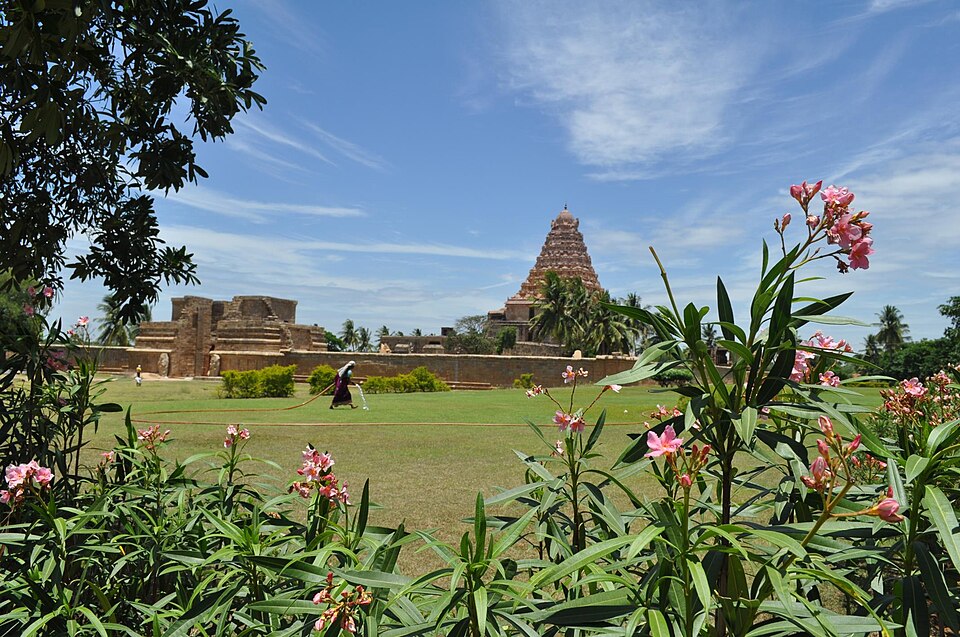
- Rajendra I built the tank Cholagangam at his new capital Gangaikonda Cholapuram, in present-day Ariyalur district of Tamil Nadu, after his campaign of 1019–1022 CE reached the Ganga; the Chola record calls it the liquid pillar of victory, and the title Gangaikonda Chola dates from the same expedition.
- The Brihadisvara temple at Gangaikonda Cholapuram was completed in 1035 CE and is one of the Great Living Chola Temples on the UNESCO World Heritage List; the city remained the Chola capital for roughly 250 years.
- Ashoka's Major Rock Edict V establishes the office of the dhamma-mahamatta, and states that no such officers existed before and that he appointed them thirteen years after his consecration, with duties among the Yonas, Kambojas and Gandharas and towards prisoners, the aged and the bereaved.
- Xuanzang records that Harshavardhana held a great assembly called Moksha every five years at Prayaga, the Ganga–Yamuna confluence, distributing his accumulated treasury to men of all faiths; Harsha ruled from Kanauj from 606 to 647 CE.
- The Junagadh rock inscription of Rudradaman I, of shortly after 150 CE, records that the Sudarshana reservoir was built by the Vaishya Pushyagupta, provincial governor of Chandragupta Maurya, that the Yavana king Tushaspha added conduits under Ashoka, and that Rudradaman rebuilt the breached dam without imposing a tax or forced labour.
Study next
Common traps
- Cross-matching the two lakes by feel, which produces option (b) — the option that is correct on the two non-lake rows and wrong on both lake rows
- Attributing the Sudarshana lake to Ashoka because Rudradaman's inscription mentions work under him — Tushaspha added conduits, but Pushyagupta built the dam under Chandragupta Maurya
- Confusing Rajendra I with his father Rajaraja I — Rajaraja built the Thanjavur Brihadisvara temple and conquered Ceylon, Rajendra built Gangaikonda Cholapuram and the Cholagangam tank
BPSC gives you a closed table with four codes, so the paper actually rewards spotting which row the codes disagree on most — here Sudarshan Lake, where all four options name a different ruler and a single fact settles everything. UPSC almost never hands you that lever: it asks the same attributions one at a time, as an assertion–reason on the Prayag assembly in 2001 or as a flat 'associated with which one of the following' on the Allahabad Pillar in 2006, where knowing three rulers out of four buys you nothing.
Related PYQs
Assertion (A): Harshavardhana convened the Prayag Assembly. Reason (R): He wanted to popularise only the Mahayana form of Buddhism.
- (a) Both A and R are individually true, and R is the correct explanation of A
- (b) Both A and R are individually true, but R is NOT a correct explanation of A
- (c) A is true, but R is false
- (d) A is false, but R is true
Answer(c) A is true, but R is false
Row (c) of this BPSC table, asked directly — UPSC confirms that Harsha did convene the Prayag assembly and then tests whether you know its purpose was open-handed charity to every sect rather than the promotion of Mahayana Buddhism alone.
The Allahabad Pillar inscription is associated with which one of the following?
- (a) Mahapadma Nanda
- (b) Chandragupta Maurya
- (c) Ashoka
- (d) Samudragupta
Answer(d) Samudragupta
The same skill of assigning a layered monument to the right ruler, with the same two Mauryan names as bait: the shaft is an Ashokan pillar but the inscription that matters is Harisena's prashasti of Samudragupta, exactly as the Sudarshana dam bears Ashokan-era work but belongs to Chandragupta Maurya.
Practice
- practice — not a real PYQ
The office of the Dhamma Mahamatra, according to Ashoka's own edicts, was created
- (a)immediately after his consecration
- (b)thirteen years after his consecration
- (c)immediately after the Kalinga war
- (d)in the last year of his reign
Answer(b) thirteen years after his consecration — Major Rock Edict V, which sets out the establishment and duties of these officers, states that no officers of Dhamma existed before and that Ashoka appointed them thirteen years after his consecration. - practice — not a real PYQ
The Sudarshana lake, whose repair is recorded in the Junagadh rock inscription of Rudradaman I, was originally constructed during the reign of
- (a)Ashoka
- (b)Chandragupta Maurya
- (c)Skandagupta
- (d)Kanishka
Answer(b) Chandragupta Maurya — the inscription says the reservoir was built by the Vaishya Pushyagupta, provincial governor of Chandragupta Maurya; conduits were added under Ashoka by the Yavana Tushaspha, and a later breach was repaired in Skandagupta's reign.