
Which one of the following is not related to the Rigvedic period?
- (a)Ghosha
- (b)Gargi
- (c)Apala
- (d)Vishvavara
Answer
Why
Correct — B, Gargi. Gargi Vachaknavi belongs to the Later Vedic and Upanishadic stratum, not to the Rigvedic one, and the question is asking about period, not about eminence. She was the daughter of the sage Vachaknu of the Garga line, from which her patronymic Vachaknavi comes, and the text in which we actually meet her is the Brihadaranyaka Upanishad: in the sixth and the eighth brahmanas of its third chapter she stands up at the brahmayajna convened by King Janaka of Videha and twice interrogates Yajnavalkya, first on what the worlds are woven across like warp and woof, then on the imperishable, the akshara. That Upanishad forms the closing portion of the Shatapatha Brahmana of the Shukla Yajurveda — a Later Vedic composition — and the principal Upanishads are conventionally dated to roughly 800–300 BCE, whereas the core of the Rigveda is placed at roughly 1500–1000 BCE, with Michael Witzel putting its codification between about 1200 and 1000 BCE in the early Kuru kingdom. Several centuries therefore separate Gargi from the other three names, each of whom has an actual Rigvedic hymn against her name: Ghosha, patronymic Kakshivati, is the seer of Rigveda 10.39 and 10.40, two hymns to the Ashvins of fourteen verses each; Apala Atreyi is the seer of Rigveda 8.91, addressed to Indra; and Vishvavara Atreyi is the seer of Rigveda 5.28, addressed to Agni. The Commission said the same thing when it disposed of objections to this question on 31 October 2025 — the Rigveda was composed in the early Vedic period while Gargi belongs to the later Vedic and Upanishadic age, remembered for her disputation in the Upanishads. Note also what is not claimed: no hymn of the Rigveda is attributed to Gargi anywhere in the traditional index of seers, however often popular lists file her beside the rishikas.
Why the others are wrong
- (a)Ghosha — Ghosha is squarely Rigvedic. The traditional index of seers assigns her Rigveda 10.39 and 10.40 — two consecutive hymns to the Ashvins, fourteen verses each — and she carries the patronymic Kakshivati, marking her as of the family of the rishi Kakshivan. She feels like a candidate for the odd one out only because she is the least famous of the four outside the Vedic index itself.
- (c)Apala — Apala is the seer of Rigveda 8.91, a hymn to Indra whose opening verse has a young woman find soma by the water and press it for the god. She is styled Apala Atreyi, of the Atri lineage. Her presence in the samhita is exactly as secure as Ghosha's, so nothing in the period test touches her; only her relative obscurity makes her tempting.
- (d)Vishvavara — Vishvavara Atreyi is the seer of Rigveda 5.28, a short hymn to Agni in six verses whose first line shows her going eastward with offerings and ghee — a woman performing the fire ritual herself. Book 5 is the Atri mandala, so the patronymic and the hymn's placement corroborate each other. She is the most commonly discarded name here simply because she is the least often revised.
Concept
Indian historians split the Vedic age in two, and the split is defined by texts rather than by dynasties. The Early Vedic or Rigvedic period, roughly 1500–1000 BCE, produced only one text, the Rigveda samhita, and is set in the Sapta-Sindhu — the Indus system and the Punjab — among semi-nomadic pastoralists organised in jana and tribal assemblies. The Later Vedic period, roughly 1000–600 BCE, produced everything else: the Samaveda, Yajurveda and Atharvaveda, the Brahmanas, the Aranyakas and the Upanishads, and it belongs geographically to the eastward push into the Ganga–Yamuna doab and then to Kosala and Videha, with iron, settled agriculture, larger kingdoms and an increasingly elaborate sacrificial system. Women appear in both halves, but in different roles and different books. In the Rigveda they appear as rishikas, seers to whom whole hymns are ascribed — Lopamudra, Ghosha, Apala, Vishvavara, Vak Ambhrini, Sikta. In the Upanishads they appear as disputants in philosophical dialogue — Gargi Vachaknavi and Maitreyi. Tradition labels both groups brahmavadini, women who pursue knowledge of Brahman rather than domesticity, and it is that single shared label, spanning six or eight centuries, that makes this question workable as a trap.
Do not rank these four by fame; rank them by source text. Ask of each name, in which book do I actually meet her? Ghosha, Apala and Vishvavara are met inside the Rigveda samhita itself, as the named seers of specific hymns — 10.39 and 10.40 to the Ashvins, 8.91 to Indra, 5.28 to Agni. Gargi is met in the Brihadaranyaka Upanishad, which hangs off the Shatapatha Brahmana of the Shukla Yajurveda, not off the Rigveda at all. That is the single discriminating fact, and it is decisive on its own. Two supporting cues point the same way. The patronymics: Kakshivati and the two Atreyis are Rigvedic family names, and Book 5 is the Atri mandala, so Vishvavara's hymn sits where her lineage says it should. The geography: the Rigveda's world is the north-west, while Gargi's debate takes place at the court of Janaka of Videha, deep in the eastern Ganga plain — the Mithila of modern north Bihar — a region the Rigveda barely knows and which only enters the story in the Later Vedic eastward expansion. The trap works in the opposite direction from most odd-one-out questions. Gargi is by a wide margin the best-known of the four, so a candidate hunting for the outsider instinctively strikes the least familiar name, usually Vishvavara, and loses the mark to her own general knowledge.
Key facts
- Ghosha, patronymic Kakshivati, is named in the traditional index of seers as the rishika of Rigveda 10.39 and 10.40, two consecutive hymns to the Ashvins of fourteen verses each.
- Apala Atreyi is the rishika of Rigveda 8.91, a hymn to Indra, and Vishvavara Atreyi of Rigveda 5.28, a hymn to Agni in six verses — both Atri-lineage names, and Book 5 of the Rigveda is the Atri mandala.
- Gargi Vachaknavi, daughter of the sage Vachaknu of the Garga line, questions Yajnavalkya in the sixth and eighth brahmanas of the third chapter of the Brihadaranyaka Upanishad, at the brahmayajna of King Janaka of Videha; her name also occurs in the Ashvalayana Grihya Sutra.
- Dating places the core of the Rigveda at about 1500–1000 BCE, with Witzel putting its codification at roughly 1200–1000 BCE in the early Kuru realm, while the principal Upanishads are dated to about 800–300 BCE — a separation of several centuries.
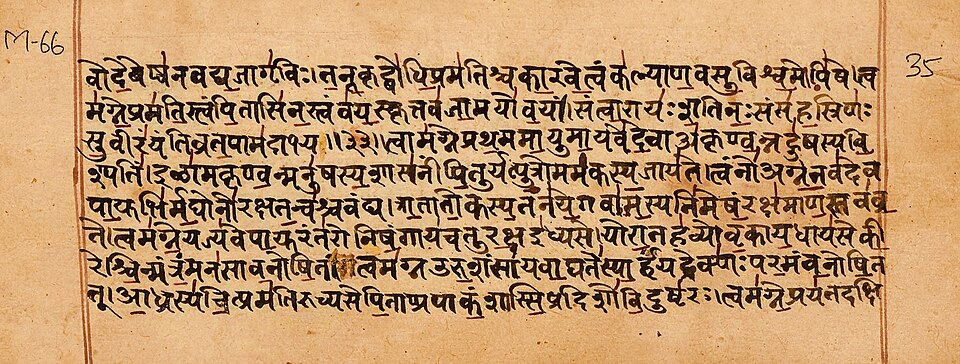
- Thirty Rigveda manuscripts held at the Bhandarkar Oriental Research Institute, Pune — written in Sharada and Devanagari on birch bark and paper, the oldest dated 1464 CE — were added to UNESCO's Memory of the World International Register in 2007.
Study next
Common traps
- Striking the least familiar name instead of the one that fails the period test — Vishvavara and Apala are far less famous than Gargi but are securely inside the Rigveda samhita
- Treating the single word brahmavadini as a period label; it covers Rigvedic seers and Upanishadic philosophers alike, six to eight centuries apart
- Assuming Gargi composed Rigvedic hymns because popular lists print her name beside the rishikas — no hymn of the Rigveda is ascribed to her
BPSC asks period placement as a bare odd-one-out — four proper names, no context, one mark — so it is decided entirely by whether you have already filed each name under Early or Later Vedic, and there is no way to reason it out in the hall. UPSC prefers the same distinction turned inside out: in 1995 it used Gargi as the distractor and asked positively which woman was a brahmavadini who composed Vedic hymns, and in 2024 it tested the Upanishads by their date relative to the Puranas instead of naming anybody at all.
Related PYQs
Who among the following was a Brahmavadini who composed some hymns of the Vedas?
- (a) Lopamudra
- (b) Gargi
- (c) Leelavati
- (d) Savitri
Answer(a) Lopamudra
The same discrimination with the sides reversed — UPSC asks who did compose Vedic hymns and plants Gargi as the trap, because she is known from the Upanishads and not from the Rigveda samhita; Lopamudra, by contrast, has verses in Rigveda 1.179.
Consider the following statements: 1. There are no parables in Upanishads. 2. Upanishads were composed earlier than the Puranas. Which of the statements given above is/are correct?
- (a) 1 only
- (b) 2 only
- (c) Both 1 and 2
- (d) Neither 1 nor 2
Answer(b) 2 only
Tests the other half of the same idea — where the Upanishads sit in time. Fixing the principal Upanishads at roughly 800–300 BCE, well after the Rigvedic core, is precisely what makes Gargi the odd name out in the BPSC question.
Practice
- practice — not a real PYQ
The philosophical debate between Gargi Vachaknavi and Yajnavalkya is recorded in which text?
- (a)Chandogya Upanishad
- (b)Brihadaranyaka Upanishad
- (c)Aitareya Brahmana
- (d)Taittiriya Samhita
Answer(b) Brihadaranyaka Upanishad — the exchange occurs in the sixth and eighth brahmanas of its third chapter, at the brahmayajna held by King Janaka of Videha; the Brihadaranyaka forms the closing portion of the Shatapatha Brahmana of the Shukla Yajurveda. - practice — not a real PYQ
Which one of the following pairs of a Rigvedic woman seer and the deity of the hymn ascribed to her is correctly matched?
- (a)Ghosha — Rudra
- (b)Apala — Indra
- (c)Vishvavara — Varuna
- (d)Lopamudra — Ashvins
Answer(b) Apala — Indra — Apala Atreyi is the seer of Rigveda 8.91, addressed to Indra. Ghosha's hymns, Rigveda 10.39 and 10.40, are to the Ashvins, not Rudra; Vishvavara's Rigveda 5.28 is to Agni, not Varuna; and Lopamudra's verses in Rigveda 1.179 are the Agastya dialogue, not an Ashvins hymn.