
Why oil is not stored in galvanized iron pot?
- (a)It produce toxic compound
- (b)It reduced quality of oil
- (c)Corrosion observed
- (d)All of above
Answer
Why
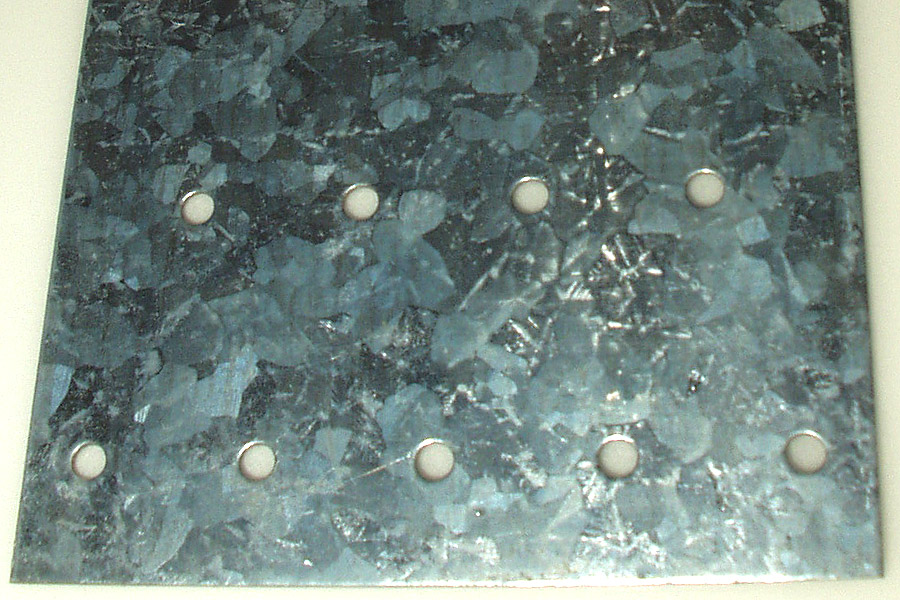
Correct — D, All of above. Galvanised iron is ordinary iron or mild steel carrying a metallic zinc coat, usually laid down by hot-dipping the cleaned and pickled article in a bath of molten zinc at about 450 °C, which bonds a series of iron–zinc alloy layers metallurgically on to the base metal. Zinc is chosen because it is anodic to iron — the standard electrode potential of the Zn²⁺/Zn couple is −0.76 V against −0.44 V for Fe²⁺/Fe — so in any corrosion cell the zinc is consumed first and the iron underneath survives. That is sacrificial (cathodic) protection, and it is why GI sheets roof houses and GI buckets outlast plain iron ones. But the very reactivity that makes zinc a good sacrificial anode disqualifies it as a container for edible oil, because zinc is a chemically active metal and edible oil is not the inert medium it looks like. Stored oil slowly hydrolyses, so it always carries free fatty acids — the trade measures them as the acid value, in milligrams of KOH per gram — and free fatty acids are weak carboxylic acids. With the traces of moisture that oil also picks up, they attack the coating: Zn + 2RCOOH → (RCOO)₂Zn + H₂, yielding zinc soaps such as zinc stearate, zinc oleate and zinc palmitate. Those are precisely the 'toxic zinc salt' of the Commission's own published remark on this question, so option (a) is true. They dissolve and disperse into the oil, cloud it and taint it, so option (b) is true. And once the sacrificial coat has been locally eaten away the iron beneath is bared and rusts, while the iron ions released are classic pro-oxidant catalysts that accelerate the peroxidation of the oil into rancidity — which is the corrosion and discolouration the Commission's remark ends on, so option (c) is true as well. Three printed effects, not one of them false: the only complete option is (d).
Why the others are wrong
- (a)It produce toxic compound — True, but only one-third of the story, so it cannot be the answer to a question that also offers 'All of above'. The zinc soaps formed are a genuine food-safety hazard — zinc is an essential trace metal, with a US Recommended Dietary Allowance of 11 mg a day for adult men and 8 mg for adult women, yet toxic effects such as nausea, cramps and vomiting are reported above roughly 50 mg in one oral dose, and sustained high intake induces copper deficiency. A candidate who stops at (a) has read the chemistry correctly and the option list carelessly.
- (b)It reduced quality of oil — Also true and also incomplete. Metal contact degrades oil on two fronts: the zinc soaps themselves cloud it and impart a metallic off-taste, and the iron exposed after the coating is breached releases Fe²⁺/Fe³⁺, which decompose lipid hydroperoxides in Fenton-type reactions and so speed rancidity, off-odour and darkening. It is the option a food-technology student gravitates to, and it is exactly the trap the item is built on.
- (c)Corrosion observed — True as well, and the one the Commission names last: its remark ends with 'corrosion and discolouration of the pot'. The acid attack strips zinc, exposes iron, and rust follows. The reason (c) fails as the answer is arithmetic, not chemical — it accounts for damage to the vessel but says nothing about the toxic salt or the spoilt oil, both of which the Commission also asserts.
Concept
A container is never chemically neutral; it is a reagent that happens to be shaped like a pot. Galvanising exists to solve one specific problem — atmospheric rusting of iron — and it solves it by putting a more reactive metal on the outside so that the more reactive metal corrodes instead. Zinc exposed to air forms zinc oxide, which then takes up carbon dioxide to form a dull grey zinc carbonate patina that seals the surface; the American Galvanizers Association puts the recommended maximum continuous service temperature of hot-dip galvanised steel at 200 °C, above which the zinc peels at the intermetallic layer. All of that protection is designed against air and rainwater. Nothing in it protects against an organic acid medium, and this is the general principle the question tests: a coating is protective only against the environment it was engineered for. Food-contact metals are therefore chosen for inertness rather than for strength or cheapness — tin-plated steel for cans, austenitic stainless steel of Type 304 (roughly 18% chromium and 8% nickel, which grows a passive chromium-oxide film), lacquered or anodised aluminium, or plain glass and glazed earthenware. Galvanised steel belongs to the other list — roofing sheets, water buckets, culverts, transmission towers — and Indian households have always stored oil in glass, stoneware or tinned vessels for exactly this reason.
Two moves get you to (d) safely. First, treat an 'All of above' option as an instruction to hunt for one false statement rather than to pick the best statement. Read (a), (b) and (c) as three separate true-or-false claims. If even one is false, 'All of above' collapses and you choose among the rest; if none is false, the answer is forced. Here none is false, and the Commission's own remark asserts all three in a single sentence — toxic zinc salt, reduced oil quality, corrosion and discolouration. Second, the single discriminating fact is that edible oil is not a pure, neutral triglyceride. It carries free fatty acids from ongoing hydrolysis, and free fatty acids are acids: the interaction is acid-on-metal, not oil-on-metal. Miss that one fact and the whole item looks like a trick, because pure triglyceride would indeed sit inertly in a zinc-lined pot. Grasp it and every branch follows mechanically — acid plus zinc gives a zinc salt (toxic), the salt goes into the oil (quality), the stripped zinc bares the iron (corrosion). Note also the scoring arithmetic. BPSC's booklet awards +1 for a correct answer and, under its instruction 9, deducts −1/3 for a wrong one, so on an 'All of above' item where you can positively verify two of the three sub-claims and cannot fault the third, the expected value strongly favours marking (d) rather than leaving it blank.
Key facts
- Hot-dip galvanising immerses cleaned, pickled steel in molten zinc at about 450 °C, forming a metallurgical bond through a graded series of iron–zinc alloy layers; the American Galvanizers Association caps continuous service at 200 °C, above which the coating peels at the intermetallic layer.
- Zinc protects sacrificially because it is anodic to iron: E° for Zn²⁺/Zn is −0.76 V against −0.44 V for Fe²⁺/Fe. Exposed zinc weathers to zinc oxide and then to zinc carbonate, the dull grey patina that seals a galvanised surface.
- The reaction the Commission describes is Zn + 2RCOOH → (RCOO)₂Zn + H₂, producing zinc soaps — zinc stearate, zinc oleate, zinc palmitate. Its published remark reads that the Zn coating reacts with the oil's free fatty acids and moisture to form a toxic zinc salt that reduces oil quality and corrodes and discolours the pot.
- Zinc is an essential trace metal — the US Recommended Dietary Allowance set by the Food and Nutrition Board of the National Academies is 11 mg a day for adult men and 8 mg for adult women, with a tolerable upper limit of 40 mg; the 15 mg figure that still circulates is the superseded older US RDA — but oral doses above roughly 50 mg produce toxic effects, sustained intake near 100 mg per day lowers HDL, raises LDL and induces copper deficiency, and inhaling freshly formed zinc-oxide fume while welding galvanised metal causes metal fume fever, the 'zinc chills'.
- Free fatty acid content, reported as acid value in mg KOH per gram, is the standard trade index of edible-oil quality; refined oils are held to a far lower acid value than cold-pressed kachi ghani grades, which is why an unrefined oil in a galvanised vessel degrades faster than a refined one.
Study next
Common traps
- Rejecting 'All of above' on principle because it feels like a cheap option — here all three sub-claims are independently true and the Commission asserts every one of them
- Assuming oil is chemically inert. It is not: hydrolysis continuously frees fatty acids, so oil in storage is mildly acidic and attacks reactive metals
- Confusing galvanising with tinning. Tin is cathodic to iron and is used for food cans precisely because it is unreactive; zinc is anodic and reactive, which is what makes it protective outdoors and unusable for food
BPSC asks applied everyday chemistry in plain, sometimes ungrammatical one-liners — a kitchen or workshop observation with a causal 'why', frequently closed with 'All of above' so the mark turns on checking three claims rather than on recalling one name. UPSC almost never asks it this way. It embeds the same chemistry in a consumer-awareness frame — what a 'no trans-fat' label really tells the buyer, what bisphenol A in food packaging is, what anodising actually deposits — and asks you to judge statements rather than complete a list.
Related PYQs
Aluminium surfaces are often “anodized”. This means the deposition of a layer of
- (a) chromium oxide
- (b) aluminium oxide
- (c) nickel oxide
- (d) zinc oxide
Answer(b) aluminium oxide
The same idea from the other side — corrosion protection by engineering a surface layer on a metal. Anodising grows a passive aluminium-oxide film that is chemically inert; galvanising bonds a reactive zinc film that protects by being consumed. Knowing which kind of layer you have is exactly what tells you whether the vessel can safely hold oil.
What is Bisphenol A (BPA)?
- (a) A medical test for detecting cancer
- (b) A test for testing the use of drugs to improve performance by athletes
- (c) A chemical used for the development of food-packaging materials
- (d) A special type of alloy steel
Answer(c) A chemical used for the development of food-packaging materials
The identical underlying concept — migration of a chemical from the container into the food it holds. BPA leaches from polycarbonate and epoxy can linings just as zinc leaches from a galvanised pot into oil; both questions reward understanding that packaging is chemically in play, not merely a passive wrapper.
Practice
- practice — not a real PYQ
Galvanisation protects iron from rusting because zinc
- (a)forms an unreactive alloy with iron that water cannot penetrate
- (b)is more electropositive than iron and so corrodes in its place
- (c)is a poor conductor of electricity and breaks the corrosion circuit
- (d)reacts with atmospheric nitrogen to form a protective nitride film
Answer(b) is more electropositive than iron and so corrodes in its place — with E° of −0.76 V for Zn²⁺/Zn against −0.44 V for Fe²⁺/Fe, zinc is the anode of the pair and is sacrificed first; protection therefore continues even where the coating has been scratched through. - practice — not a real PYQ
Which one of the following metals is used to coat the steel of food cans, chiefly because it is unreactive towards food?
- (a)Zinc
- (b)Tin
- (c)Magnesium
- (d)Cadmium
Answer(b) Tin — tin-plated steel ('tinplate') is used for food cans because tin is cathodic to iron and chemically unreactive towards foodstuffs. Zinc and magnesium are both anodic and reactive and are used for sacrificial protection outdoors, not for food contact; cadmium is a toxic heavy metal.