
Which compound is used for increase of octane rating?
- (a)Trimethyl hexane
- (b)Tetramethyl Oxide
- (c)Tetraethyllead
- (d)Triethyl toluene
Answer
Why
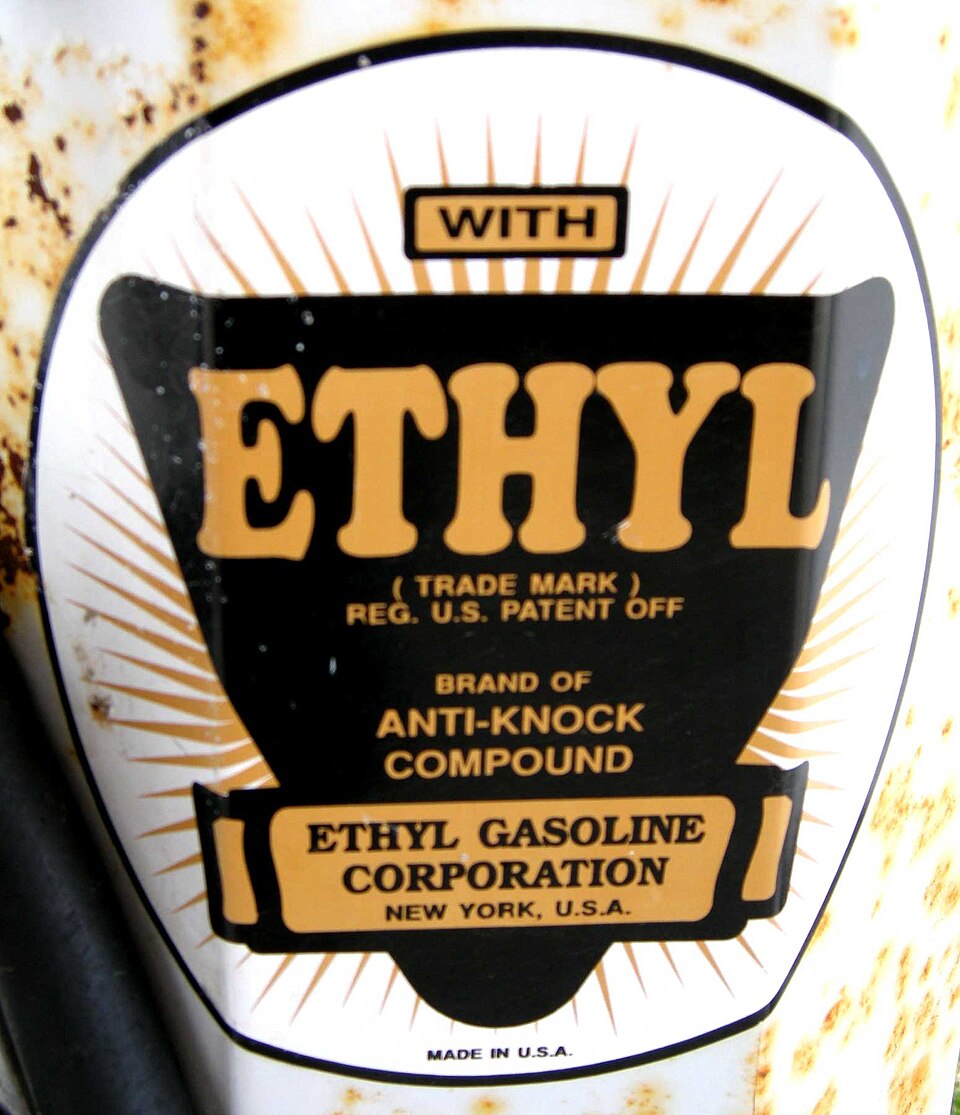
Correct — C, Tetraethyllead. Tetraethyllead, Pb(C₂H₅)₄, is the classical anti-knock additive of the petrol age. It was first synthesised by Carl Jacob Löwig in 1853, but it sat unused for seventy years until Thomas Midgley Jr., working in General Motors' research laboratory, found on 9 December 1921 that a tiny dose of it stopped engines knocking. Octane rating measures a fuel's ability to withstand compression without auto-igniting — the higher the number, the more the fuel can be squeezed before it detonates on its own instead of waiting for the spark. The scale is defined against two reference hydrocarbons: 2,2,4-trimethylpentane, called iso-octane, is fixed at 100 and n-heptane at 0, so a petrol rated 91 knocks like a blend of 91 parts iso-octane to 9 parts n-heptane. Tetraethyllead raises that number because it is thermally fragile: at combustion temperatures its lead–carbon bonds break and the finely divided lead and lead oxide formed mop up the peroxide and hydroperoxide radicals that drive the pre-flame chain reaction. Kill the chain carriers and the end-gas cannot self-ignite ahead of the flame front, so the charge burns smoothly from the spark. The commercial appeal was that a fraction of a gram per litre lifted the octane number by several points — far cheaper than rebuilding the fuel itself — which is why leaded petrol dominated for over fifty years and let compression ratios, and with them power and efficiency, rise. It was also, in hindsight, one of the most damaging products of the twentieth century: lead is a cumulative neurotoxin, especially of the developing brain, and it poisons the platinum-group catalysts in a catalytic converter, so lead and modern emission control cannot coexist. Phase-out began in the 1970s; India banned leaded petrol in March 2000, and UNEP declared the worldwide end of leaded petrol for cars on 30 August 2021 after Algeria, the last producer, stopped sales in July 2021. Note therefore that the question's present tense preserves a textbook association, not current Indian practice.
Why the others are wrong
- (a)Trimethyl hexane — The cleverest decoy on the paper, because it is chemically half right. Branched alkanes genuinely resist knock far better than straight chains — that is the whole point of refinery isomerisation — and trimethylhexanes are real C₉ isomers. But no trimethylhexane is a fuel additive, and the octane-100 reference compound is 2,2,4-trimethylPENTANE, a C₈. One syllable separates the option from the fact the candidate half-remembers.
- (b)Tetramethyl Oxide — No compound of this name is used as a fuel additive, and the name does not parse in standard nomenclature — the simplest methyl ether is dimethyl ether, (CH₃)₂O. Its pull is that it sits one syllable from two real things: tetramethyllead, which genuinely was used as an anti-knock agent alongside tetraethyllead, and MTBE (methyl tert-butyl ether), the ether that helped replace lead after the phase-out.
- (d)Triethyl toluene — A true fact wrapped in a false name. Toluene itself is a standard octane booster — an aromatic with an octane number well above 100, blended into racing fuels and supplied naturally in refinery reformate, which is one reason reforming replaced lead. But the booster is plain toluene; 'triethyl toluene' is not a fuel chemical in commercial use, and adding fictitious alkyl groups to a real compound is a recurring BPSC construction.
Concept
Knocking is what a petrol engine does when the unburnt end-gas ahead of the advancing flame front reaches its own auto-ignition temperature and explodes on its own. Instead of one smooth pressure rise there are colliding pressure waves, heard as a metallic pinging, and sustained knock burns pistons and wrecks bearings. Because a higher compression ratio squeezes the charge harder, it extracts more work from each unit of fuel — but it also makes knock more likely, so knock resistance is the ceiling on engine efficiency. Octane rating is the number that measures that resistance. It is not a measure of energy content or of power: high-octane petrol does not carry more joules, it simply refuses to detonate under greater compression, which is why putting premium fuel in a low-compression engine buys nothing. Two laboratory numbers are quoted. The Research Octane Number is measured in a variable-compression test engine at 600 rpm; the Motor Octane Number uses the same engine at 900 rpm with a preheated charge and variable ignition timing, a harsher test, and typically comes out 8 to 12 numbers lower. India, Europe and most of the world advertise RON; the United States, Canada and Mexico advertise the Anti-Knock Index, (R+M)/2, which is 4 to 6 numbers lower for the identical fuel — the reason American '87 regular' and Indian '91 petrol' are much closer than they look.
The reasoning here is elimination by reality, not by chemistry. Three of the four names are not compounds you can buy: 'Tetramethyl Oxide' and 'Triethyl toluene' do not name anything in commercial fuel use, and while trimethylhexanes exist, none is an additive. Only one option names a real, famous and specific fuel chemical, and it is the single most notorious additive in the history of the motor car. When BPSC offers one recognisable name among three plausible-sounding constructions, the recognisable name is almost always the key — the paper is testing recall of a named compound, not your ability to invent a mechanism. The one discriminating fact is that the anti-knock agent is an organo-LEAD compound. Fix 'lead' to 'anti-knock' and every distractor collapses at once, because not one of them contains a metal. Two honesty notes are worth carrying into the exam hall. First, the question is written in the present tense although tetraethyllead has been illegal in Indian petrol since March 2000 and worldwide since 2021 — answer the textbook association, not the current market. Second, do not confuse the additive with the reference: iso-octane defines octane 100 and is itself sometimes blended as a booster, but it is a yardstick first and an additive second, whereas tetraethyllead was only ever an additive.
Key facts
- Octane rating is defined by two reference hydrocarbons: 2,2,4-trimethylpentane (iso-octane) is assigned 100 and n-heptane 0, so the rating equals the percentage of iso-octane in the iso-octane/n-heptane blend that knocks identically in the test engine.
- Research Octane Number is measured at 600 rpm in a variable-compression engine; Motor Octane Number at 900 rpm with a preheated mixture, and runs about 8 to 12 numbers lower. The USA, Canada and Mexico advertise the Anti-Knock Index, (R+M)/2, which is 4 to 6 numbers below the RON quoted elsewhere for the same petrol.
- Tetraethyllead, Pb(C₂H₅)₄, was synthesised by Carl Jacob Löwig in 1853; Thomas Midgley Jr. discovered its anti-knock action at General Motors on 9 December 1921. The same chemist later developed the CFC refrigerant Freon, making him responsible for both leaded petrol and ozone-depleting chlorofluorocarbons.
- India banned leaded petrol in March 2000; the UN Environment Programme declared the global end of leaded petrol for cars on 30 August 2021, after Algeria — the last country still producing it — halted sales in July 2021.
- Modern octane boosters are MTBE, ETBE, toluene and iso-octane itself, plus ethanol, which raises octane but lowers energy content per litre. In India the regular grade is 91 RON while IS 2796:2017 specifies a separate premium grade at 95 RON; premium fuels were widely on sale before this exam — IndianOil XP95 and XP100, BPCL Speed 97, HPCL poWer 99, and Indian economy cars, running compression ratios under 10:1, gain nothing from higher grades.
Study next
Common traps
- Confusing the reference with the additive: iso-octane (2,2,4-trimethylpentane) defines octane 100; tetraethyllead is what was added to reach a higher number
- Reading a high octane number as more energy or more power — it measures only resistance to auto-ignition, and premium petrol in a low-compression engine gives no benefit
- Answering in the present tense without noticing that tetraethyllead has been banned in India since March 2000 and globally since 2021; the question tests the historical association
BPSC puts the whole item in a single clause and hides the difficulty in the option list — one genuine compound set against three invented or misnamed ones, so the mark turns on recognising a name rather than on reasoning. UPSC almost never asks 'which compound'; it asks about the consequence instead. Its 2012 item took leaded petrol as already banned and asked which sources of lead poisoning remain, and its fuel questions typically test emission control, refinery products or calorific value rather than the identity of an additive.
Related PYQs
Lead, ingested or inhaled, is a health hazard. After the addition of lead to petrol has been banned, what still are the sources of lead poisoning? 1. Smelting units 2. Pens and pencils 3. Paints 4. Hair oils and cosmetics Select the correct answer using the codes given below :
- (a) 1, 2 and 3 only
- (b) 1 and 3 only
- (c) 2 and 4 only
- (d) 1, 2, 3 and 4
Answer(b) 1 and 3 only
The same subject picked up one step later in the story. BPSC asks which compound was added to petrol; UPSC takes the ban on that very compound as its premise and asks what other lead pathways survive it. Answering both needs the one fact that anchors this card — the anti-knock additive was an organo-lead compound, tetraethyllead.
Match List I (Industrial processes) with List II (Industry with which associated) and select the correct answer using the codes given below the Lists: List I I. Cracking II. Smelting III. Hydrogenation IV. Vulcanization List II A) Rubber B) Petroleum C) Copper D) Edible fats Codes:
- (a) I-C, II-B, III-A, IV-D
- (b) I-B, II-C, III-D, IV-A
- (c) I-B, II-C, III-A, IV-D
- (d) I-C, II-B, III-D, IV-A
Answer(b) I-B, II-C, III-D, IV-A
Tests the refinery half of the same concept. Cracking — with reforming and isomerisation alongside it — is how a refinery turns heavy fractions into branched and aromatic molecules that resist knock; those processes are precisely what allowed high octane to be achieved without tetraethyllead once lead was banned.
Practice
- practice — not a real PYQ
In the octane rating scale, the compound assigned an octane number of 100 is
- (a)n-heptane
- (b)2,2,4-trimethylpentane (iso-octane)
- (c)Tetraethyllead
- (d)Toluene
Answer(b) 2,2,4-trimethylpentane (iso-octane) — it is fixed at 100 by definition, while n-heptane is fixed at 0. Tetraethyllead is an additive, not a reference, and toluene is an aromatic booster whose octane number lies above 100. - practice — not a real PYQ
Leaded petrol was phased out worldwide chiefly because tetraethyllead
- (a)lowered the calorific value of petrol
- (b)is a cumulative neurotoxin and destroys the catalyst in catalytic converters
- (c)made engines knock at high compression ratios
- (d)corroded the fuel tanks of modern vehicles
Answer(b) is a cumulative neurotoxin and destroys the catalyst in catalytic converters — lead damages the developing nervous system and poisons the platinum-group metals in a three-way catalyst, so leaded fuel is incompatible with emission control. India banned it in March 2000 and UNEP declared the global end on 30 August 2021.