
In which year, the Nalanda University was re-established in Bihar?
- (a)2005
- (b)2007
- (c)2008
- (d)2014
Answer
Why
Correct — D, 2014. The revived Nalanda University began its first academic session on 1 September 2014, admitting just 15 students into two schools — the School of Historical Studies and the School of Ecology and Environment Studies — from temporary premises at Rajgir in Nalanda district, with a Bihar State Tourism Development Corporation hotel serving as the first hostel. The Commission said exactly this when it disposed of objections to the item: 'The University started functioning in 2014.' Getting to 2014 rather than to an earlier year needs care, because the revival ran through four distinct milestones and each carries its own date. President A. P. J. Abdul Kalam proposed reviving Nalanda on 28 March 2006, addressing a joint session of the Bihar Vidhan Mandal. In 2007 the Bihar Legislative Assembly passed a bill of its own for the new university, and the second East Asia Summit at Cebu in January that year carried the project into the East Asia Summit process, with the Nalanda Mentor Group under Amartya Sen taking shape in the same phase. Parliament then passed the Nalanda University Bill, 2010 — Rajya Sabha on 21 August 2010, Lok Sabha on 26 August 2010 — and it received Presidential assent on 21 September 2010 and was brought into force on 25 November 2010. Teaching began in 2014, and the permanent 455-acre Rajgir campus was inaugurated only on 19 June 2024. Notice what the option set itself does: it offers neither 2010 nor 2024, which removes the statutory reading and the campus reading, and leaves the year the university actually opened its doors.
Why the others are wrong
- (a)2005 — No step in the documented revival falls in 2005. The earliest event on record is 28 March 2006, when President A. P. J. Abdul Kalam put the idea of reviving Nalanda to a joint session of the Bihar Vidhan Mandal. This option is there for the candidate who remembers only that the proposal belongs to 'the mid-2000s' and rounds down; the year carries no Act, no summit decision and no admission.
- (b)2007 — The most defensible wrong answer, and the one to beat. 2007 is a genuine landmark year: the Bihar Legislative Assembly passed its own bill for the new university, the second East Asia Summit at Cebu in January 2007 brought the revival into the East Asia Summit process, and the Nalanda Mentor Group chaired by Amartya Sen belongs to this phase. But a state bill and a summit endorsement produce a plan, not a university — the institution itself was created by a Central Act three years later and admitted its first students seven years later.
- (c)2008 — The split-the-difference decoy, parked between the proposal years and the Act. No milestone in the university's own account of its founding is dated 2008 — no statute, no admission, no inauguration. The Mentor Group was still deliberating through this period; the enabling legislation came only in 2010 and the first academic session in 2014, so 2008 is the year in which nothing that mattered happened.
Concept
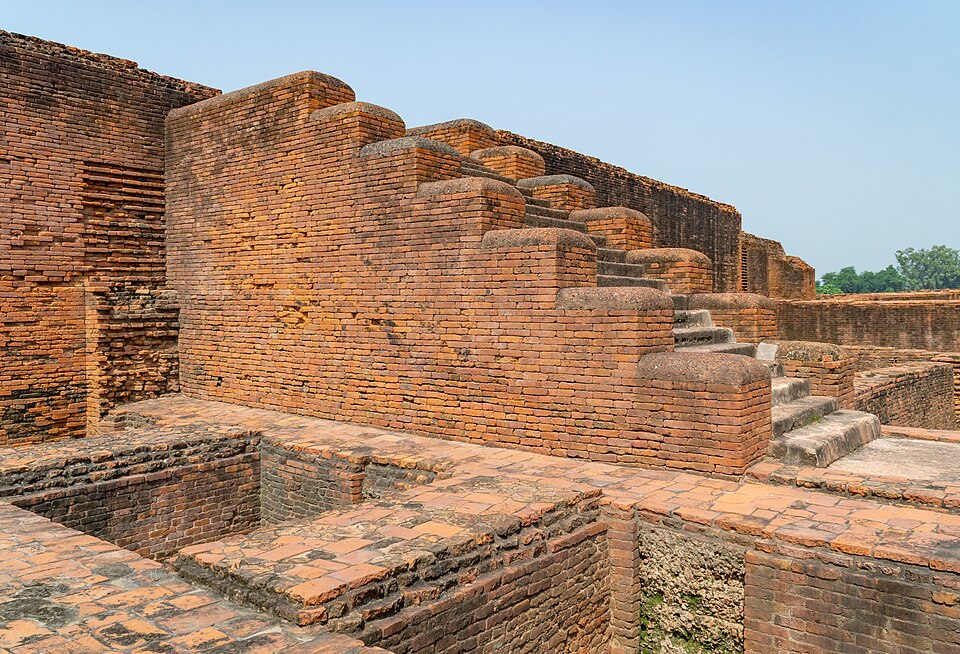
Two different institutions share the name Nalanda, and this question turns on recognising that the second one is a modern creation. The ancient Nalanda Mahavihara was a Buddhist monastic university in Magadha, built under the Gupta emperor Kumaragupta I around 427 CE, which ran for roughly eight centuries until it was ransacked around 1200 CE — the attack traditionally attributed to Muhammad Bakhtiyar Khalji. Xuanzang studied there under Shilabhadra in the 630s and 640s, Yijing spent about a decade there a generation later, and Harsha is recorded as endowing it with the revenue of 100 villages. Its excavated remains, roughly 12 hectares of brick monasteries, stupas and temples, were inscribed on the UNESCO World Heritage List in 2016 as the 'Archaeological Site of Nalanda Mahavihara at Nalanda, Bihar'. The modern Nalanda University is not that institution's legal continuation: it is a new central body created by the Nalanda University Act, 2010, declared an Institution of National Importance, placed under the Ministry of External Affairs rather than the education ministry, with the President of India as its Visitor and with backing from the member countries of the East Asia Summit. Nobel laureate Amartya Sen was its first Chancellor, followed by Singapore's former foreign minister George Yeo. 'Re-establishment' therefore describes an intent, not a legal continuity — which is precisely why the examinable date is the date on which the new body began to work.
Every 'when was X revived or established' question about a modern institution carries at least four candidate dates, and a candidate who has not separated them is guessing. For Nalanda they are: the proposal (28 March 2006), the political endorsement (2007 — the Bihar Assembly bill and the East Asia Summit at Cebu), the statute (the Act of 2010, assented on 21 September, in force from 25 November), and the start of teaching (1 September 2014). A fifth date, the inauguration of the permanent Rajgir campus on 19 June 2024, is the one most students have actually seen in the news. So read the option list before you reason: 2010 is absent and 2024 is absent. Their absence removes the two readings a well-informed candidate is most likely to reach for, and it signals that the examiner means the year the university began to function — which is what the Commission itself wrote when it rejected the objections. The single discriminating fact is the first academic session: 1 September 2014, 15 students, temporary premises at Rajgir. The trap is 2007, and it is a strong one, because a state legislature really did pass a bill that year and an international summit really did back the idea. Neither of those brought a university into existence, and neither admitted a student.
Key facts
- The revived Nalanda University began its first academic session on 1 September 2014 with 15 students in the School of Historical Studies and the School of Ecology and Environment Studies, at temporary premises in Rajgir; a Bihar State Tourism Development Corporation hotel provided the first hostel.
- The Nalanda University Bill, 2010 was passed by the Rajya Sabha on 21 August 2010 and the Lok Sabha on 26 August 2010, received Presidential assent on 21 September 2010, and was brought into force on 25 November 2010; the President of India is the university's Visitor and Amartya Sen was its first Chancellor, succeeded by George Yeo.
- The revival was proposed on 28 March 2006 by President A. P. J. Abdul Kalam in an address to a joint session of the Bihar Vidhan Mandal; the Bihar Legislative Assembly passed a bill for the new university in 2007, the year the second East Asia Summit at Cebu carried the project into the East Asia Summit process.
- The permanent Rajgir campus, about 455 acres and designed by Pritzker laureate B. V. Doshi's firm Vastu Shilpa Consultants, was inaugurated by Prime Minister Narendra Modi on 19 June 2024 in the presence of dignitaries from all ten ASEAN members; it is the first campus in India built to a 'net zero' energy, water and waste strategy.
- The ancient Nalanda Mahavihara was built under Kumaragupta I around 427 CE and destroyed around 1200 CE; its excavated ruins of about 12 hectares were inscribed on the UNESCO World Heritage List in 2016 (property 1502, criteria iv and vi, 23-hectare core with a 57.88-hectare buffer zone).
Study next
Common traps
- Answering 2010 by reflex because that is the year of the Nalanda University Act — legally the right creation date, but it is not among the options and the item asks when the university began to function
- Picking 2007 because the East Asia Summit and the Bihar Legislative Assembly both acted that year — endorsement and a state bill are not establishment
- Confusing the 19 June 2024 inauguration of the Rajgir campus with the founding of the university; the campus is a decade younger than the first classroom
BPSC asks this as flat date recall about a Bihar institution — one line, four years, ten seconds — and it draws freely on state-level milestones such as a Bihar Assembly bill or a Rajgir campus that a national paper would never test. UPSC has never asked for the revival year; when Nalanda surfaces in UPSC Prelims it is the ancient mahavihara, embedded in a matching set on seats of learning and Buddhist sites, or reached indirectly through Xuanzang and Yijing. Expect BPSC to want the year and UPSC to want the significance.
Related PYQs
Which of the following pairs are correctly matched? I. Lothal: Ancient dockyard II. Sarnath: First Sermon of Buddha III. Rajgir: Lion capital of Asoka IV. Nalanda: Great seat of Buddhist learning Select the correct answer using the codes given below: Codes:
- (a) I, II, III and IV
- (b) III and IV
- (c) I, II and IV
- (d) I and II
Answer(c) I, II and IV
Item IV — 'Nalanda: Great seat of Buddhist learning' — is exactly the identity the 2014 university was created to revive. UPSC tests what Nalanda was, BPSC tests when it was brought back, and both reward knowing the mahavihara rather than the modern brand. The set also disposes of Rajgir, the town where the new university now sits: the lion capital is at Sarnath, not Rajgir.
Which one of the following pairs is correctly matched?
- (a) Vikramsila Monastery : Uttar Pradesh
- (b) Hemkund Gurudwara : Himachal Pradesh
- (c) Udayagiri Caves : Maharashtra
- (d) Amaravati Buddhist Stupa : Andhra Pradesh
Answer(d) Amaravati Buddhist Stupa : Andhra Pradesh
Option (a) is wrong precisely because Vikramshila — Nalanda's sister mahavihara, founded by the Palas — stands in Bhagalpur district of Bihar, not Uttar Pradesh. Same Magadhan monastic-university tradition, same geography, and the same demand that a candidate place Bihar's great Buddhist seats of learning correctly.
Practice
- practice — not a real PYQ
The Act of Parliament under which the present Nalanda University was constituted was passed in the year
- (a)2006
- (b)2007
- (c)2010
- (d)2014
Answer(c) 2010 — the Nalanda University Bill was passed by the Rajya Sabha on 21 August and the Lok Sabha on 26 August 2010, received Presidential assent on 21 September 2010 and came into force on 25 November 2010. Teaching began only in 2014. - practice — not a real PYQ
Nalanda University, an Institution of National Importance at Rajgir, functions under which Union Ministry?
- (a)Ministry of Education
- (b)Ministry of External Affairs
- (c)Ministry of Culture
- (d)Ministry of Tourism
Answer(b) Ministry of External Affairs — the university was conceived as an East Asia Summit project with member countries as partners, so it is administered by the MEA rather than by the education ministry, which is what makes it unusual among Institutions of National Importance.