
Which of the following is the state animal of Bihar?
- (a)Cow
- (b)Bull
- (c)Buffalo
- (d)Horse
Answer
Why
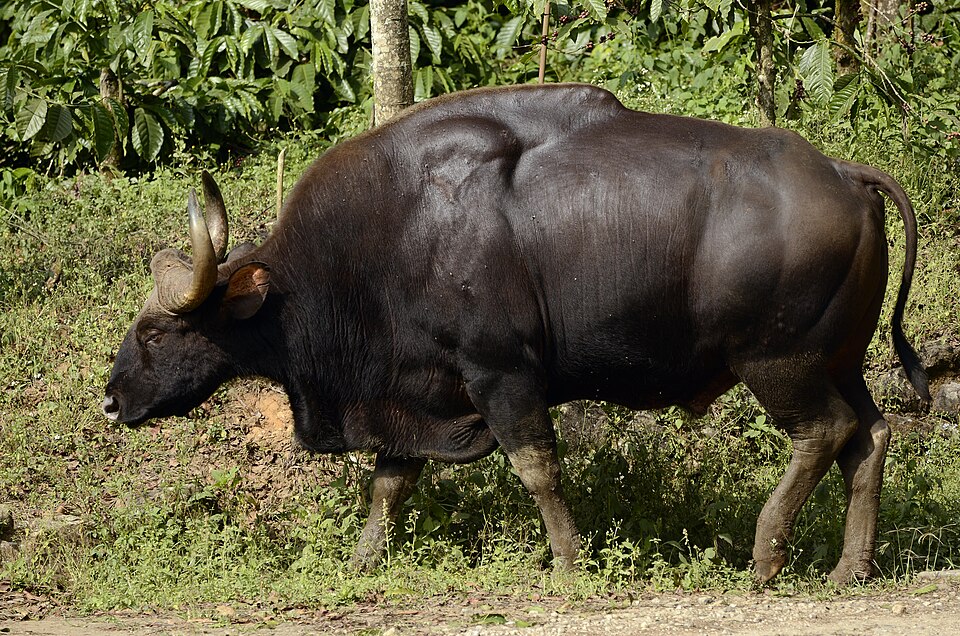
Correct — B, Bull. But read that option the way the Commission itself reads it, because the printed word is loose and the animal has a proper name. Bihar's officially designated state animal is the GAUR, Bos gaurus, commonly called the Indian bison. Disposing of candidate objections to this very question on 31 October 2025, BPSC recorded that 'Bull' here means the wild ox — the male gaur — and that the official name is Gaur. So the key stands at (b), and nothing in the paper points to a domestic bull or a plough ox; every published list of Indian state animals prints Bihar : Gaur, and that is how you should carry it into the next exam. The gaur is the largest living bovid on earth: head-and-body length 250–330 cm, a tail of 70–105 cm and a shoulder height of 142–220 cm, averaging about 188 cm in males and 168 cm in females, with males roughly one-fourth larger and heavier than females. It is unmistakable in the field — a high convex ridge on the forehead between the horns, a pronounced dorsal ridge that can leave the shoulders 12 cm higher than the rump, a heavy dewlap on throat and chest, and pale white or tan 'stockings' on the lower legs. It is listed as Vulnerable on the IUCN Red List, is on CITES Appendix I, and carries Schedule I protection under the Wildlife (Protection) Act, 1972 — the same absolute bar on hunting that protects the tiger. In Bihar the gaur is found chiefly in the Valmiki Tiger Reserve of West Champaran, so questions 114 and 115 of this paper are in truth about the same forest.
Why the others are wrong
- (a)Cow — The instinctive pick, because Bihar is a major cattle-rearing State and the cow is culturally central. But no Indian State names the cow its state animal. The designation is not restricted to wild species — Arunachal Pradesh's state animal is the mithun or gayal, a domesticated bovine — so the reason the cow fails here is simply that no State has chosen it, not that a domestic animal could not be chosen. Note too that the key's word is 'Bull', not 'Cow' — the paper is pointing at a male wild ox, and the gap between the two options is deliberate.
- (c)Buffalo — The most defensible wrong answer, because India genuinely has a wild bovine called a buffalo — Bubalus arnee, the wild water buffalo, IUCN Endangered and Schedule I exactly like the gaur. A candidate who correctly senses that the answer must be a wild bovid can land here. But the wild buffalo is the state animal of Chhattisgarh, not Bihar, and its Indian strongholds lie in Assam and Chhattisgarh.
- (d)Horse — No Indian State designates a horse as its state animal, and the horse is not a wild Indian species, so it falls outside the category altogether. It is filler, completing a quartet of familiar farm animals, and should be struck first. Its presence is itself a hint: when every option is domestic livestock, the examiner is using a loose common name to stand in for a wild species.
Concept
State symbols are administrative designations rather than statutory categories: each State government adopts an animal, a bird, a tree and a flower as emblems of its natural heritage, and the choices are almost always wild native species, not domesticated ones. Bihar's set is worth memorising as a block, because BPSC asks all four. The state animal is the gaur, Bos gaurus. The state bird is the house sparrow, Passer domesticus — a pointed choice, since the sparrow is an ordinary urban bird whose decline the designation was meant to publicise. The state tree is the peepal or sacred fig, Ficus religiosa. The state flower is the kachnar, Bauhinia variegata — not the marigold, which several coaching lists print in error. Around these sit Bihar's conservation flagships: the Gangetic dolphin, India's national aquatic animal, protected in the Vikramshila Gangetic Dolphin Sanctuary near Bhagalpur, and the tigers of Valmiki. Notice how the gaur ties the symbols back to the map — Bihar's state animal survives in the State essentially only inside Bihar's only national park, so the emblem and the protected-area question answer each other.
Two separate things are happening in this item and it pays to pull them apart. The examinable fact is simple: Bihar's state animal is the gaur, and of the four printed options the only one that can denote a wild ox is 'Bull'. The complication is the wording. 'Bull' on its own normally means a male domestic bovine, and a student who takes the option at face value walks away believing Bihar honours a plough animal — which contradicts every reference list in print. BPSC anticipated that objection and answered it in writing, so the honest way to teach the card is to argue the key and name the animal correctly in the same breath. In the hall, the reliable move is to ask which option could possibly denote a wild species. Cow and horse cannot, because no State designates either. Buffalo can, because Bubalus arnee is genuinely wild — but it belongs to Chhattisgarh. Bull can, because the gaur is routinely called the Indian bison or the wild ox, and its domesticated descendant the mithun is literally farmed as cattle in the North-East. That chain reaches (b) without having to trust the loose wording at all.
Key facts
- Bihar's state animal is the gaur (Bos gaurus), the Indian bison; BPSC's own key remark of 31 October 2025 states that 'Bull' in the option means the wild ox or male gaur and that the official name is Gaur.
- The gaur is the largest living bovid — shoulder height 142–220 cm, averaging 188 cm in males and 168 cm in females, head-and-body 250–330 cm with a 70–105 cm tail, and males about one-fourth larger and heavier than females.
- Field marks: a high convex ridge on the forehead between the horns, a dorsal ridge leaving the shoulders up to 12 cm higher than the rump, a heavy dewlap, and pale white or tan 'stockings' on the lower legs; in Bihar it is found chiefly in the Valmiki Tiger Reserve, West Champaran.
- Conservation status: IUCN Vulnerable, CITES Appendix I, and Schedule I of the Wildlife (Protection) Act, 1972, which bars hunting absolutely — the same tier of protection as the tiger.
- The domesticated descendant of the gaur is the gayal or mithun (Bos frontalis), common in Assam, Manipur and Nagaland and the state animal of Arunachal Pradesh — the source of the loose 'wild ox' vocabulary in the option.
- Bihar's other symbols: state bird the house sparrow (Passer domesticus), state tree the peepal (Ficus religiosa), state flower the kachnar (Bauhinia variegata). Goa also names the gaur; Chhattisgarh names the wild water buffalo (Bubalus arnee).
Study next
Common traps
- Taking 'Bull' literally and concluding that Bihar's state animal is a domestic bull or ox — the Commission itself says the official name is Gaur
- Choosing 'Buffalo' because the wild water buffalo is a real Schedule I wild bovine — but it is Chhattisgarh's state animal, not Bihar's
- Confusing the gaur with the mithun or gayal (Bos frontalis), its domesticated descendant and the state animal of Arunachal Pradesh
BPSC asks state symbols flat and often — state animal, bird, tree, flower — and these are near-guaranteed Bihar-specific marks in every cycle, occasionally with the loose common name used here instead of the scientific one. UPSC has never asked 'the state animal of X'; when it touches the gaur or the wild buffalo it asks about Schedule I protection, IUCN status or habitat, testing the ecology and the law rather than the emblem.
Related PYQs
According to the Wildlife (Protection) Act, 1972, which of the following animals cannot be hunted by any person except under some provisions provided by law? 1. Gharial 2. Indian wild ass 3. Wild buffalo Select the correct answer using the code given below:
- (a) 1 only
- (b) 2 and 3 only
- (c) 1 and 3 only
- (d) 1, 2 and 3
Answer(d) 1, 2 and 3
The legal frame behind Bihar's emblem — the wild buffalo in this list sits in Schedule I exactly as the gaur does, so the same absolute hunting ban covers both, and the item drills the distinction between India's wild bovines and their domestic look-alikes.
A sandy and saline area is the natural habitat of an Indian animal species. The animal has no predators in that area but its existence is threatened due to the destruction of its habitat. Which one of the following could be that animal ?
- (a) Indian wild buffalo
- (b) Indian wild ass
- (c) Indian wild boar
- (d) Indian gazelle
Answer(b) Indian wild ass
The same confusion the BPSC option exploits, run in reverse — every choice is a farmyard word ('buffalo', 'ass', 'boar') attached to a genuinely wild Indian species, and the mark goes to whoever can separate the common name from the animal it actually denotes.
Practice
- practice — not a real PYQ
The Gaur, the state animal of Bihar, is also commonly known as the
- (a)Indian bison
- (b)Nilgai
- (c)Wild yak
- (d)Mithun
Answer(a) Indian bison — Bos gaurus is the largest living bovid and is universally called the Indian bison. Careful with (d): the mithun or gayal (Bos frontalis) is the domesticated descendant of the gaur, not the gaur itself. - practice — not a real PYQ
Besides Bihar, which one of the following States has also adopted the Gaur as its state animal ?
- (a)Goa
- (b)Kerala
- (c)Odisha
- (d)Gujarat
Answer(a) Goa — Goa's state animal is also the gaur (Bos gaurus). Gujarat's is the Asiatic lion, and Kerala's is the Indian elephant.