
The two volcanic Islands in the Indian Territory are -
- (a)Kavaratti and New Moore
- (b)Bitra and Kavaratti
- (c)Pamban and Barren
- (d)Narcondam and Barren
Answer
Why
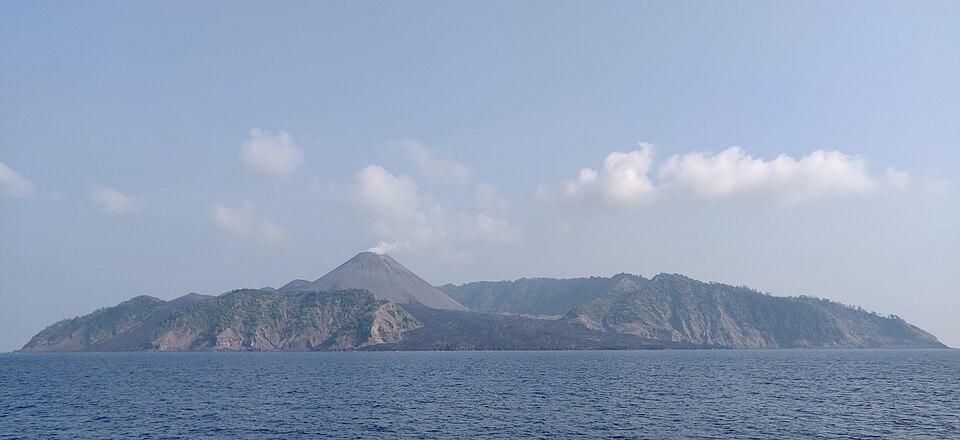
Correct — D, Narcondam and Barren. Both lie in the Andaman group in the Bay of Bengal, and both are volcanic for the same reason: the Indian Plate is being subducted beneath the Burma plate, and the melt generated along that subduction zone has built a chain of volcanoes running from Sumatra through the Andamans to Myanmar. Barren Island is the only confirmed active volcano in the Indian subcontinent, and the only active one along that entire Sumatra-to-Myanmar chain. It is an uninhabited cone of 8.34 sq km rising to 353–354 m, about 138 km north-east of Port Blair. Its recorded history opens with an eruption in 1787 and continues through 1789, 1795, 1803–04 and 1852; then came nearly a century and a half of dormancy, broken by a six-month eruption in 1991 that caused considerable damage. It has been restless ever since — lava fountains confirmed in January 2017, activity through 2019, and from 2022 an almost constant state of eruption, with a further eruption recorded on 22 September 2025, nine days after this paper was written. Narcondam is the quieter twin: 7.6 sq km, rising to 710 m, 256 km north-east of Port Blair. Textbooks generally describe it as dormant, and it was not known to have been active in recent times until reports of mud and smoke on 8 June 2005 — but the Geological Survey of India classifies it as an active volcano, so it should never be called extinct. Apart from a small police detachment it is uninhabited, it is notified as the Narcondam Island Wildlife Sanctuary, and it is the sole home of the endemic Narcondam hornbill (Rhyticeros narcondami), a threatened bird numbering between 300 and 650 individuals.
Why the others are wrong
- (a)Kavaratti and New Moore — Two islands that could hardly be less volcanic. Kavaratti is a coral atoll and the capital of Lakshadweep — 4.22 sq km with a 4.96 sq km lagoon, about 360 km west of the Malabar coast. New Moore, also called South Talpatti or Purbasha, was a low silt bar that surfaced in the Bay of Bengal after the Bhola cyclone of November 1970, was claimed by both India and Bangladesh, and went under water around March 2010.
- (b)Bitra and Kavaratti — Both are Lakshadweep coral atolls. Bitra, in the Aminidivi group, is a 0.187 sq km atoll with a lagoon and the smallest of Lakshadweep's populated islands (271 people in the 2011 Census). Picking this means reading 'island in Indian territory' as 'Indian island I have heard of' — Lakshadweep is a reef-built archipelago with no volcanism at all.
- (c)Pamban and Barren — The designed near-miss, because half of it is right. Barren belongs; Pamban does not. Pamban is the 96.6 sq km island carrying Rameswaram in Ramanathapuram district, Tamil Nadu, about 2 km off the mainland and separated from Sri Lanka's Mannar Island by the Palk Strait — a low, sandy, coral-fringed island reached by the Pamban bridge opened on 24 February 1914.
Concept
Islands in Indian waters come from three quite different processes, and the question is really asking you to sort by process rather than by name. The first is volcanic: the Andaman and Nicobar chain is the emergent crest of a submarine ridge thrown up where the Indian Plate dives beneath the Burma plate, an arc that continues north into the Arakan Yoma of Myanmar and south to Sumatra. Barren and Narcondam stand slightly east of the main chain as separate volcanic cones on that arc. The second is biogenic: the Lakshadweep islands are coral atolls, built up by reef organisms on the crest of a submerged ridge, with a lagoon enclosed by a reef rim and no volcanic activity. The third is continental or depositional: Pamban is a low fragment of the continental shelf off the Tamil Nadu coast, and New Moore was simply an accumulation of silt. The governing principle is that a volcano needs a magma source, which in practice means an active plate boundary — and India's only one inside its own waters is the Andaman arc.
Start by reading the option list as a piece of test construction rather than as geography. Barren appears in two of the four options, (c) and (d), which is a strong signal that the examiner has used it as an anchor and is really asking only for its partner. That halves the problem to Pamban against Narcondam. Pamban is Rameswaram — a place any candidate can picture, flat, sandy, temple-and-bridge country on the south-east coast — while Narcondam is a remote cone in the Andaman Sea best known to birdwatchers. Neither of the remaining options survives a single principle: Lakshadweep is a coral archipelago, so Kavaratti and Bitra are ruled out on genesis alone, and New Moore was a sandbar that no longer exists above water. If you would rather reason from the map than from the option pattern, the check is the same one every time — volcanoes cluster on plate margins, and the only plate margin in Indian territory is the Andaman arc, so both answers must come from there.
Key facts
- Barren Island: 8.34 sq km, highest point 353–354 m, about 138 km north-east of Port Blair, uninhabited; the only confirmed active volcano in the Indian subcontinent and the only active one along the volcanic chain from Sumatra to Myanmar
- Barren's eruption record: first recorded 1787, then 1789, 1795, 1803–04 and 1852; nearly a century and a half dormant; a six-month eruption in 1991; lava fountains in January 2017 with activity to 2019; an almost constant state of eruption since 2022, including an episode on 22 September 2025
- Narcondam: 7.6 sq km, rising to 710 m, 256 km north-east of Port Blair; usually described as dormant, with mud and smoke reported on 8 June 2005, but classified as an active volcano by the Geological Survey of India — so never described as extinct
- Narcondam Island Wildlife Sanctuary protects the endemic Narcondam hornbill, Rhyticeros narcondami, whose population is put at 300 to 650 birds; the island's only residents are a police detachment
- Why the distractors fail: Barren is the product of the Indian Plate subducting beneath the Burma plate, while Kavaratti (4.22 sq km, capital of Lakshadweep) and Bitra (0.187 sq km, the smallest populated island of Lakshadweep) are coral atolls, Pamban (96.6 sq km, Ramanathapuram district) is a shelf island, and New Moore was a silt bar that emerged after the November 1970 Bhola cyclone and vanished around March 2010
Study next
Common traps
- Calling Narcondam extinct — the Geological Survey of India classifies it as an active volcano even though textbooks usually describe it as dormant
- Falling for 'Pamban and Barren' because Barren is right — the examiner deliberately plants the correct anchor in two options and makes the partner the real question
- Assuming any famous Indian island might be volcanic — Lakshadweep is entirely coral, and New Moore was a silt bar that went under water around March 2010
BPSC asks for the pair by name, and puts the difficulty in the pairing itself by including a half-right option — you either know both islands or you lose the mark. UPSC asks about the same island through statements judged separately: in 2018 it printed three claims about Barren, and expected the candidate to keep the 'only active volcano' claim while rejecting the other two on distance from Port Blair and on eruption history since 1991.
Related PYQs
Consider the following statements : i. The Barren Island volcano is an active volcano located in the Indian territory. 2. Barren Island lies about 140 km east of Great Nicobar. 3. The last time the Barren Island volcano erupted was in 1991 and it has remained inactive since then. Which of the statements given above is/are correct ?
- (a) 1 only
- (b) 2 and 3
- (c) 3 only
- (d) 1 and 3
Answer(a) 1 only
The same island seven years earlier, and the closest match in the whole store — statement 1 is the exact fact BPSC keys, while statements 2 and 3 fail on the two details this card stresses: Barren lies about 138 km north-east of Port Blair, not east of Great Nicobar, and it has erupted repeatedly since 1991.
Volcanic eruptions do not occur in the
- (a) Baltic Sea
- (b) Black Sea
- (c) Caribbean Sea
- (d) Caspian Sea
Answer(a) Baltic Sea
The principle underneath the BPSC question, asked in the negative: volcanism follows active plate margins and is absent from stable shield areas. Apply it to India and both answers fall out — the Andaman arc sits on the Indian–Burma subduction zone, while the Lakshadweep atolls and Pamban sit on stable ground with no magma source.
Practice
- practice — not a real PYQ
Barren Island, the only confirmed active volcano in the Indian subcontinent, is located in :
- (a)The Arabian Sea, in the Lakshadweep group
- (b)The Andaman Sea, about 138 km north-east of Port Blair
- (c)The Gulf of Mannar, off Rameswaram
- (d)The Bay of Bengal, off the Sundarbans delta
Answer(b) The Andaman Sea, about 138 km north-east of Port Blair — an uninhabited 8.34 sq km cone rising to about 354 m on the Andaman volcanic arc, where the Indian Plate subducts beneath the Burma plate. Lakshadweep in the Arabian Sea is entirely coral, Rameswaram and the Gulf of Mannar sit on the stable continental shelf, and the Sundarbans is a purely deltaic environment. - practice — not a real PYQ
The Narcondam hornbill is endemic to a single island belonging to which group?
- (a)Lakshadweep Islands
- (b)Andaman and Nicobar Islands
- (c)Islands of the Gulf of Kachchh
- (d)Islands of the Sundarbans
Answer(b) Andaman and Nicobar Islands — Narcondam lies 256 km north-east of Port Blair, rises to 710 m, and is notified as the Narcondam Island Wildlife Sanctuary; between 300 and 650 of the birds survive there and nowhere else on earth. Lakshadweep, the Gulf of Kachchh islands and the Sundarbans have no hornbill endemic to a single island.