
Which of the following is the place of confluence of the Alaknanda and Bhagirathi?
- (a)Vishnuprayag
- (b)Karnaprayag
- (c)Rudraprayag
- (d)Devprayag
Answer
Why
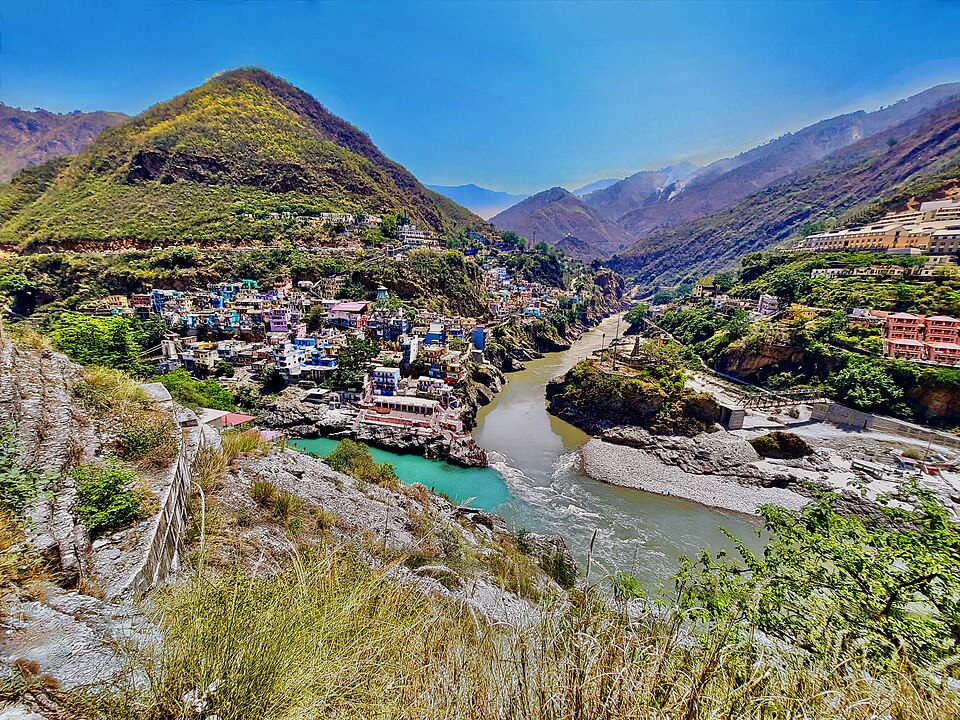
Correct — D, Devprayag. Devprayag, at about 830 m in Tehri Garhwal district of Uttarakhand, is the last and lowest of the Panch Prayag, and the only one of the five where the Alaknanda meets the Bhagirathi. What makes it the confluence worth knowing is what happens below it: from that point the combined stream is no longer called either name — it becomes the Ganga. All five Panch Prayag are confluences on the Alaknanda, so the Alaknanda in the question stem is a constant and tells you nothing; only the second river separates them. Going downstream, Vishnuprayag is Alaknanda + Dhauliganga, Nandaprayag is Alaknanda + Nandakini, Karnaprayag is Alaknanda + Pindar, Rudraprayag is Alaknanda + Mandakini, and Devprayag is Alaknanda + Bhagirathi. The two streams that meet here arrive from different valley lines of the Garhwal Himalaya. The Bhagirathi, about 205 km long, rises at Gaumukh at the snout of the Gangotri glacier at roughly 3,892 m. The Alaknanda rises at the foot of the Satopanth and Bhagirath Kharak glaciers at about 3,880 m and comes down past Badrinath and Joshimath. Which of the two is 'the Ganga' depends on what you are measuring: in Hindu tradition the Bhagirathi is the source stream, while in hydrology the Alaknanda is taken as the source stream because it contributes much the larger share of the flow. Devprayag town itself is built above the meeting point and holds the temple of Raghunathji — huge stone blocks, pyramidal in form, capped by a white cupola.
Why the others are wrong
- (a)Vishnuprayag — The uppermost of the Panch Prayag, in Chamoli district about 12 km from Joshimath, where the Dhauliganga joins the Alaknanda — not the Bhagirathi. It tempts candidates who remember only that the Panch Prayag are five Alaknanda confluences and reach for the one whose name sounds most senior, or who assume the Ganga must be named at the highest point.
- (b)Karnaprayag — Also in Chamoli district, and the confluence of the Alaknanda with the Pindar, the river fed by the Pindari glacier; the place takes its name from Karna of the Mahabharata. It is a genuine prayag on the correct river, which is exactly what makes it a usable distractor — but the joining stream is the Pindar, not the Bhagirathi.
- (c)Rudraprayag — The strongest trap on the list, because it is the prayag immediately upstream of Devprayag — being one place out in the sequence lands you here. At Rudraprayag the Alaknanda is joined by the Mandakini, the river that comes down from Kedarnath; the district itself is named after the town.
Concept
A prayag is a river confluence, and in Hindu sacred geography a confluence is a place of special merit, so India's prayags are pilgrimage sites as much as landforms. The Panch Prayag are the five confluences of the Alaknanda in Uttarakhand, visited in sequence along the Char Dham route. Physically, they are the points where tributaries draining separate glacier-fed valleys of the Garhwal Himalaya break into the Alaknanda's trunk gorge; because these are steep, narrow, high-energy valleys, each confluence is a sharp junction between two visibly different waters rather than the broad braided meeting seen in the plains. The naming convention matters as much as the geography: the river is Alaknanda above Devprayag and Ganga below it, so 'where the Ganga begins' and 'where the Alaknanda ends' are the same question. Note the separate word Prayagraj — the Ganga–Yamuna confluence far downstream in the plains — which belongs to a different set entirely and is not one of the Panch Prayag.
The reasoning here is elimination by second river, not recall of five town names. Because every one of the Panch Prayag is an Alaknanda confluence, the word Alaknanda in the stem carries no information; the entire question is which prayag takes the Bhagirathi. Two of the five names help you directly — Nandaprayag shares its stem with the Nandakini, and Devprayag is the divine one, where the river finally becomes the Ganga. For the rest, a physical check settles it without memorising anything. The Dhauliganga, Nandakini, Pindar and Mandakini are all inner-Garhwal tributaries that come off ranges close to the Alaknanda's own valley, so they join it high up in Chamoli and Rudraprayag districts. The Bhagirathi is not that kind of stream at all: it is a full-sized river in its own right, running its own 205 km down a parallel valley from Gangotri, and two rivers of that size can only meet low down where their valleys converge. Devprayag, at about 830 m in Tehri Garhwal, is far the lowest of the five — which is precisely what you would predict.
Key facts
- The Panch Prayag in downstream order: Vishnuprayag (Alaknanda + Dhauliganga, Chamoli, about 12 km from Joshimath), Nandaprayag (+ Nandakini, Chamoli), Karnaprayag (+ Pindar, Chamoli), Rudraprayag (+ Mandakini, Rudraprayag district) and Devprayag (+ Bhagirathi, Tehri Garhwal)
- Below Devprayag the combined stream is called the Ganga; the town stands at about 830 m and holds the Raghunathji temple, built of huge stones, pyramidal, capped by a white cupola
- Bhagirathi: about 205 km, rising at Gaumukh at the snout of the Gangotri glacier at roughly 3,892 m — in Hindu faith, history and culture the source stream of the Ganga
- Alaknanda: rises at the foot of the Satopanth and Bhagirath Kharak glaciers at about 3,880 m and flows past Badrinath and Joshimath — in hydrology the source stream of the Ganga, because it contributes significantly more of the flow than the Bhagirathi
- Two confluences that are not Panch Prayag but are regularly confused with them: the Bhagirathi–Bhilangana junction at Tehri, historically called Ganesh Prayag, where the old town was submerged by the Tehri dam; and the Triveni Sangam at Prayagraj, the Ganga–Yamuna confluence out in the plains
Study next
Common traps
- Answering Rudraprayag — it is the prayag immediately above Devprayag, and the river joining there is the Mandakini from Kedarnath, not the Bhagirathi
- Treating 'Alaknanda' in the stem as a clue — all five Panch Prayag are Alaknanda confluences, so only the name of the second river discriminates between them
- Confusing Devprayag with the Triveni Sangam at Prayagraj, which is the Ganga–Yamuna confluence in the plains and not one of the Panch Prayag at all
BPSC asks it as flat one-to-one recall — name the confluence — with all four options taken from the same five-item list, so partial memory scores nothing and a one-step slip in the sequence costs a third of a mark. UPSC seldom asks a prayag by name; it tests the same Garhwal headwater map sideways, through dam sites (Tehri, 2008) or glacier-to-river pairings (Bandarpunch–Yamuna, Milam–Mandakini, 2019).
Related PYQs
On which one of the following rivers is the Tehri Hydropower Complex located?
- (a) Alaknanda
- (b) Bhagirathi
- (c) Dhauliganga
- (d) Mandakini
Answer(b) Bhagirathi
The same four-river Garhwal set, tested through a dam instead of a confluence — its option list is literally the Alaknanda plus three of the streams that join it at the Panch Prayag. Tehri sits on the Bhagirathi at its junction with the Bhilangana, upstream of where that river reaches Devprayag.
Consider the following pairs: Glacier — River 1. Bandarpunch : Yamuna 2. Bara Shigri : Chenab 3. Milam : Mandakini 4. Siachen : Nubra 5. Zemu : Manas Which of the pairs given above are correctly matched?
- (a) 1, 2 and 4
- (b) 1, 3 and 4
- (c) 2 and 5
- (d) 3 and 5
Answer(a) 1, 2 and 4
The same skill one step further upstream — knowing which Himalayan headstream comes out of which glacier. Pair 3 is the planted error precisely because the Mandakini, the Rudraprayag river of this BPSC question, does not come from the Milam glacier; get the headwater map right and both questions fall together.
Practice
- practice — not a real PYQ
At which of the Panch Prayag does the Mandakini join the Alaknanda?
- (a)Nandaprayag
- (b)Karnaprayag
- (c)Rudraprayag
- (d)Vishnuprayag
Answer(c) Rudraprayag — the Mandakini comes down from Kedarnath and meets the Alaknanda here, and the district takes its name from the town. Of the others, Nandaprayag takes the Nandakini, Karnaprayag the Pindar, and Vishnuprayag the Dhauliganga — every one of the five is an Alaknanda confluence, so only the second river ever distinguishes them. - practice — not a real PYQ
The Bhagirathi river rises at :
- (a)Gaumukh, at the snout of the Gangotri glacier
- (b)The Satopanth glacier
- (c)The Milam glacier
- (d)The Pindari glacier
Answer(a) Gaumukh, at the snout of the Gangotri glacier — at about 3,892 m, and in Hindu tradition the source of the Ganga. The Satopanth glacier, with the Bhagirath Kharak, feeds the Alaknanda instead; the Pindari glacier feeds the Pindar, which joins at Karnaprayag; and the Milam glacier lies in Kumaon and feeds the Gori Ganga.