
Which of the following is the fluid part of the blood ?
- (a)Plasma
- (b)WBC
- (c)RBC
- (d)Blood platelets
Answer
Why
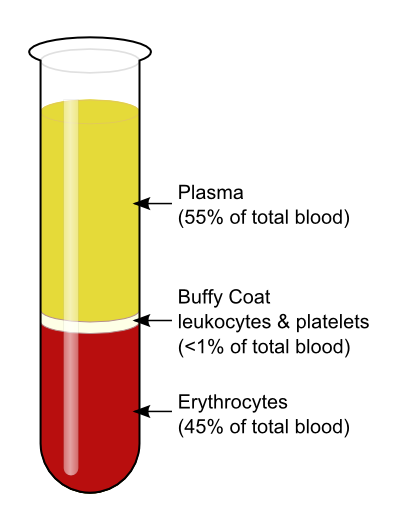
Correct: A, Plasma. Blood is classed as a fluid connective tissue, and like every connective tissue it has a matrix in which cells sit. In blood the matrix is liquid, and that liquid is plasma. Spin a sample in a centrifuge and it separates cleanly: about 55 per cent of the volume is a straw-coloured supernatant, the plasma, and about 45 per cent is a packed red column of cells at the bottom, with a thin greyish buffy coat of white cells and platelets at the boundary. Plasma is roughly 90 to 92 per cent water; the remaining 6 to 8 per cent is plasma proteins (fibrinogen, which makes clotting possible, globulins, which carry antibodies, and albumin, which maintains the osmotic balance that keeps water inside the vessels) together with dissolved glucose, amino acids, lipids, mineral ions such as sodium, potassium, calcium and bicarbonate, hormones, dissolved gases and nitrogenous wastes like urea. Everything else offered in the question is a formed element, that is, a cell or a cell fragment suspended in that liquid rather than part of it. One term worth separating now: serum is plasma from which fibrinogen and the clotting factors have been removed, which is what remains as the pale fluid above a clot.
Why the others are wrong
- (b)WBC: White blood cells, or leucocytes, are true nucleated cells (the least numerous of the formed elements at roughly 6,000 to 8,000 per cubic millimetre) and are the body's immune patrol. They are suspended in the plasma and carried by it, but they are cells, not fluid.
- (c)RBC: Red blood cells are the most numerous formed element, about 5 to 5.5 million per cubic millimetre, biconcave and, in mammals, without a nucleus so that they can pack in more haemoglobin. They give blood its colour and are what settles to the bottom on centrifugation: the packed cell volume, precisely the fraction that is not plasma.
- (d)Blood platelets: Platelets, or thrombocytes, are cell fragments budded off from megakaryocytes in the bone marrow, numbering roughly 1.5 to 3.5 lakh per cubic millimetre, and they initiate clotting. Being fragments rather than whole cells makes them the most plausible wrong choice for 'fluid part', but they are still particulate matter suspended in plasma.
Concept
Blood is a connective tissue whose extracellular matrix happens to be liquid, and the division into plasma and formed elements is the organising idea of the whole topic. An adult carries about five litres of it. The formed elements are erythrocytes, leucocytes and thrombocytes, all produced in the red bone marrow; red cells live about 120 days and are broken down in the spleen, sometimes called the graveyard of red blood cells, while most white cells survive only days. Plasma does the transport work that cells cannot: it carries digested nutrients from the intestine to the tissues, hormones from the endocrine glands to their targets, carbon dioxide and urea to the lungs and kidneys, and heat around the body. Its protein content also makes it the medium of clotting and of humoral immunity.
The question is decided by the word 'fluid'. Three of the four options are formed elements (two cells and one cell fragment) and only one is a liquid, so a candidate who has the plasma-versus-formed-elements split in mind cannot go wrong. The most useful mental image is the centrifuged tube: straw-coloured liquid on top, red column below, thin buffy coat between. If the term is confused with something else, note the two commonest mix-ups. Plasma in physics means an ionised gas, the fourth state of matter, and has nothing to do with blood. Plasma in biology is not the same as serum: plasma still contains fibrinogen, serum does not, which is why blood collected without an anticoagulant yields serum while blood collected with one yields plasma.
Key facts
- Plasma is about 55 per cent of blood volume; the formed elements make up the remaining 45 per cent, a figure measured clinically as the haematocrit or packed cell volume
- Plasma is 90-92 per cent water; plasma proteins are 6-8 per cent and comprise fibrinogen (clotting), globulins (antibodies) and albumin (osmotic balance)
- Approximate counts per cubic millimetre in an adult: red cells 5-5.5 million, platelets 1.5-3.5 lakh, white cells 6,000-8,000
- Serum is plasma minus fibrinogen and the other clotting factors; red cells live about 120 days and are destroyed in the spleen
- An adult human has roughly five litres of blood, and all three formed elements are produced in the red bone marrow
Study next
Common traps
- Confusing plasma with serum: serum has lost fibrinogen and the clotting factors, plasma has not
- Confusing blood plasma with the physicist's plasma, the ionised fourth state of matter
- Treating platelets as 'fluid' because they are fragments rather than whole cells; they are still suspended particles
BPSC asks school-level biology in one line, with a single technical word in the stem doing all the work: here 'fluid'. UPSC takes the same syllabus and turns it into a discrimination test: which statement about normal blood is correct, why an AB individual is a universal recipient, what proportion of blood volume the cells occupy: questions that need the numbers, not just the vocabulary.
Related PYQs
With reference to the blood in a normal person, which one of the following statements is correct?
- (a) Compared to arteries, veins are less numerous and hold less of the body’s blood at any given time
- (b) Blood cells constitute about 70 % of the total volume of the blood
- (c) White Blood Cells (WBC) are made by lymph nodes only
- (d) The blood has more platelets than WBC
Answer(d) The blood has more platelets than WBC
The same composition of blood, asked as a statement test: its option (b) fails precisely because cells are about 45 per cent of blood volume and plasma the other 55 per cent, which is the fact the BPSC question rests on.
A person with ‘AB’ blood group is sometimes called a universal recipient because of the
- (a) lack of antigen in his blood
- (b) lack of antibodies in his blood
- (c) lack of both antigens and antibodies in his blood
- (d) presence of antibodies in his blood
Answer(b) lack of antibodies in his blood
Turns on the plasma-versus-cells split in a clinical setting: the ABO antigens sit on the red cells while the antibodies float in the plasma, so the AB individual's plasma carries neither anti-A nor anti-B.
Practice
- practice, not a real PYQ
Which plasma protein is chiefly responsible for the clotting of blood ?
- (a)Albumin
- (b)Globulin
- (c)Fibrinogen
- (d)Haemoglobin
Answer(c) Fibrinogen: converted to insoluble fibrin during clotting; albumin maintains osmotic balance, globulins carry antibodies, and haemoglobin is inside red cells, not in plasma. - practice, not a real PYQ
Serum differs from plasma in that serum lacks
- (a)water and mineral ions
- (b)fibrinogen and the clotting factors
- (c)glucose and amino acids
- (d)hormones and enzymes
Answer(b) fibrinogen and the clotting factors: serum is what is left after blood has clotted, so those proteins have been consumed.