
Which country became the first to bring soil from the dark side of the moon in June 2024 ?
- (a)China
- (b)USA
- (c)India
- (d)France
Answer
Why
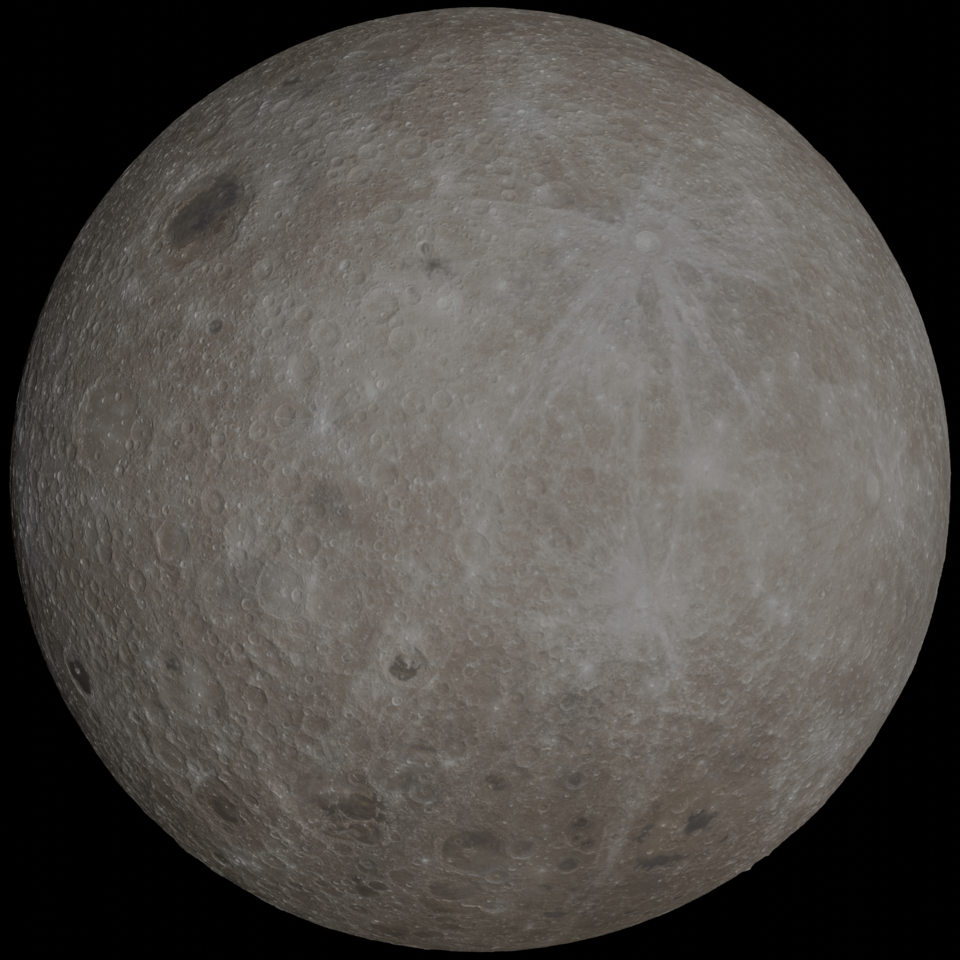
Correct: A, China. The mission was Chang'e-6, and it returned the first samples ever collected from the far side of the Moon. It lifted off on a Long March 5 on 3 May 2024, its lander touched down on 1 June 2024 in the southern mare of the Apollo crater inside the South Pole-Aitken basin, it collected 1,935.3 grams of lunar material by drilling and scooping, and the return capsule came down at Siziwang Banner in Inner Mongolia on 25 June 2024, roughly fifty-three days after launch. Every gram of Moon rock previously held on Earth (the American Apollo hauls and the Soviet Luna returns alike) had come from the near side, so this was a first for any country and not merely a first for China. The stem's phrase 'dark side of the moon' is popular usage rather than astronomy, and understanding why is the most valuable thing on this card. The Moon is tidally locked to the Earth: it takes almost exactly as long to turn once on its axis as it takes to complete one orbit, so the same hemisphere faces us permanently. That produces a far side, never visible from Earth, but not a dark one, because over a lunar month it receives just as much sunlight as the near side does. Being permanently out of sight is an engineering problem rather than a lighting one, since a craft down there has no line of sight to Earth. China solved it by first parking a relay satellite, Queqiao-2, launched on 20 March 2024, and routing all of Chang'e-6's communications through it.
Why the others are wrong
- (b)USA: USA: the country holding by far the most lunar material, since the Apollo programme brought back roughly 380 kilograms of rock and soil between 1969 and 1972, a total no other nation has approached. That very success is why the option is tempting. But every one of those samples was collected on the near side, and no American mission has ever returned material from the far side, so the specific claim in the stem does not belong to the United States.
- (c)India: India: a genuinely strong recent lunar record, and the option most likely to catch an Indian candidate on patriotic instinct. Chandrayaan-3 achieved a soft landing near the lunar south pole in August 2023, a first of its own kind, and Chandrayaan-1's Moon Impact Probe reached the surface in 2008. But all of these were orbiters, landers and rovers; India has flown no sample-return mission of any kind and has never brought lunar material to Earth.
- (d)France: France: has no independent lunar landing or sample-return programme at all. France is a leading space power within Europe, through the European Space Agency, the national agency CNES and the Ariane launch vehicles, but its lunar involvement is in instruments and cooperation rather than in landing craft, and it has never returned material from any body in the solar system.
Concept
Bringing material back from another world is a far harder thing than landing on it, which is why the sample-return club is so small. A lander must survive a descent; a sample-return mission must additionally collect material, lift off again from a body with its own gravity, rendezvous or fly home, and survive re-entry. The lunar far side raises the difficulty further, because the Moon's own bulk blocks radio contact with Earth, so any far-side mission has to be preceded by a relay satellite placed where it can see both the landing site and the Earth. China built that infrastructure deliberately and in sequence: Queqiao-1 in May 2018, then Chang'e-4 in January 2019 for the first soft landing on the far side in the Von Kármán crater region with the Yutu-2 rover, then Chang'e-5 in December 2020 returning 1,731 grams from near Mons Rumker on the near side, then Queqiao-2 in March 2024, and finally Chang'e-6. The science reason for going to the far side is that the two hemispheres are strikingly unalike (the far side has a thicker crust and very few of the dark basaltic maria that cover much of the near side) and material from the South Pole-Aitken basin, the largest impact basin on the Moon, bears directly on why.
Two of the four options can be removed on general knowledge before any recall of 2024 news. France has no lunar landing programme, and India, for all its recent successes, has never flown a sample-return mission: Chandrayaan-3 put a lander and a rover on the surface and left them there. That reduces the question to the United States against China, and the discriminator is not who has returned the most Moon rock but who has returned any of it from the far side. The American total is far larger and far older, and it is entirely near-side. Recognising that the stem's real content is 'far side', not 'Moon soil', is the whole move. It is also worth being unbothered by the wording 'dark side'. Examiners write it because it is the phrase in general use, and the far side is what they mean; do not let the mismatch with the astronomy make you doubt the question. The date in the stem, June 2024, is a further anchor, because it matches the capsule's return on 25 June rather than the landing on 1 June: a distinction a stricter question could exploit.
Key facts
- Chang'e-6 launched on a Long March 5 on 3 May 2024, landed on 1 June 2024 in the southern mare of the Apollo crater within the South Pole-Aitken basin, and its capsule returned to Siziwang Banner in Inner Mongolia on 25 June 2024: a mission of about 53 days.
- It brought back 1,935.3 grams of material collected by drilling and scooping: the first samples ever retrieved from the lunar far side, all previous samples having come from the near side.
- China's earlier far-side first was Chang'e-4, which made the first soft landing on the far side in the Von Karman crater region on 3 January 2019 and deployed the Yutu-2 rover.
- Chang'e-5 returned 1,731 grams from near Mons Rumker on the near side in December 2020, the first lunar sample return since the Soviet Luna programme of the 1970s.
- A far-side mission cannot talk to Earth directly, so China flew relay satellites first: Queqiao-1 in May 2018 for Chang'e-4, and Queqiao-2 on 20 March 2024 for Chang'e-6.
- 'Dark side' is a misnomer. The Moon is tidally locked, spinning once on its axis in about the time it takes to orbit the Earth once, so the same face is always turned towards us: the far side is unseen, not unlit, and receives as much sunlight as the near side.
Study next
Common traps
- Taking 'dark side' literally. The far side is not permanently dark; it is permanently turned away from Earth, and it receives as much sunlight as the near side over a lunar month.
- Choosing the United States because it has the most Moon rock. Volume is not the claim being made: the Apollo returns, large as they were, all came from the near side.
- Crediting India because Chandrayaan-3 landed successfully in 2023. That mission carried a lander and a rover and had no capability to bring anything back.
BPSC asks space as a one-line current-affairs first (which country, which mission, which month) with a twelve-month window and the option list filled with countries that have a plausible space programme, so the mark turns on holding one headline with its date. UPSC asks the physics or the programme behind the headline instead: whether the Moon keeping one face towards Earth is correctly explained by its rotation period, or which country a named lunar mission belonged to. The same news item therefore has to be filed twice, once as a fact with a date and once as the mechanism that makes it interesting.
Related PYQs
Selene-1, the lunar orbiter mission belongs to which one of the following?
- (a) China
- (b) European Union
- (c) Japan
- (d) USA
Answer(c) Japan
The identical question type sixteen years earlier: a named lunar mission, and four countries to attach it to. Selene-1 belonged to Japan, and the skill being tested is the same one this question needs: keeping a mental list of which national programme flew which probe, rather than guessing by which country seems most active.
Assertion (A): The same face of the Moon is always presented to the Earth. Reason (R): The Moon rotates about its own axis in 23½ days which is about the same time that it takes to orbit the Earth.
- (a) Both A and R are individually true and R is the correct explanation of A
- (b) Both A and R are individually true but R is not the correct explanation of A
- (c) A is true but R is false
- (d) A is false but R is true
Answer(c) A is true but R is false
The physics under the phrase 'dark side'. The same face of the Moon really is always turned towards the Earth, but the reason given in that question is wrong on the number, which is exactly the tidal-locking idea that creates a far side in the first place, and the reason a relay satellite is needed to reach it.
Match List–I with List–II : List—I (Space Mission) a. Cassini-Huygens b. Juno c. Artemis d. VERITAS List—II (Exploration) 1. Jupiter 2. Saturn and its rings 3. Venus 4. Human Space-flight—Moon to Mars Select the correct answer using the codes given below.
- (a) a b c d 2 1 4 3
- (b) a b c d 3 1 4 2
- (c) a b c d 2 3 4 1
- (d) a b c d 3 1 2 4
Answer(a) a b c d 2 1 4 3
The 69th tested space missions as a match-list of probe against target: Cassini-Huygens to Saturn, Juno to Jupiter, Artemis to the Moon-to-Mars programme, VERITAS to Venus. The 70th then asked which country achieved a specific lunar first. BPSC clearly expects a working index of current space missions, and asks it in whichever format suits the paper.
What is the primary objective of the Lunar Trailblazer mission?
- (a) To detect and map water on the Moon’s surface
- (b) To create a 3D model of the entire Moon
- (c) To test new lunar rovers
- (d) More than one of the above
Answer(a) To detect and map water on the Moon’s surface
The following year the 71st asked the objective of a named lunar mission rather than its nationality, keeping the same twelve-month current-affairs window. Read together, the two papers show that a BPSC candidate needs mission name, sponsoring country and stated purpose for every lunar mission in the news.
Practice
- practice, not a real PYQ
The Chang'e-6 mission collected its samples from which lunar feature ?
- (a)Mare Tranquillitatis on the near side
- (b)The Apollo crater within the South Pole-Aitken basin on the far side
- (c)The Von Karman crater on the near side
- (d)Mons Rumker on the far side
Answer(b) the Apollo crater within the South Pole-Aitken basin on the far side. Von Karman was Chang'e-4's landing region and is also on the far side, while Mons Rumker was Chang'e-5's near-side site: the two names are swapped in the wrong options. - practice, not a real PYQ
Why does the same side of the Moon always face the Earth ?
- (a)The Moon does not rotate on its own axis at all
- (b)The Moon's period of rotation is almost equal to its period of revolution around the Earth
- (c)The far side of the Moon is permanently in the Earth's shadow
- (d)The Moon's axis of rotation points directly at the Earth
Answer(b) its period of rotation is almost equal to its period of revolution: this is tidal locking, or synchronous rotation. The Moon does rotate; option (a) is the commonest misconception, and option (c) confuses the far side with a shadowed side.