
In which city of Bihar the recently inaugurated National Dolphin Research Centre is located ?
- (a)Patna
- (b)Darbhanga
- (c)Gaya
- (d)Munger
Answer
Why
Correct: A, Patna. The National Dolphin Research Centre was inaugurated on Monday 4 March 2024 by the Chief Minister of Bihar, Nitish Kumar, at Patna, on the bank of the Ganga, and was reported at the time as the first facility of its kind in Asia devoted to the Gangetic dolphin. Its stated purpose is to bring scientists and researchers together to study the animal in its own habitat rather than in captivity (its food habits, its behaviour and its adaptation to a changing river) and to train fishermen so that dolphins stop being killed accidentally in nets, which is one of the principal causes of mortality. Patna is a deliberate choice rather than a default one: the Ganga runs through the city, Bihar holds one of the two largest riverine dolphin populations in India, and a centre studying a river animal has been placed beside the river it studies. There is one specific way a well-prepared candidate can go wrong here, and it is worth naming in advance. Bihar's other and older dolphin institution is the Vikramshila Gangetic Dolphin Sanctuary, notified on 7 August 1991 over a sixty-kilometre stretch of the Ganga from Sultanganj to Kahalgaon, and that lies in Bhagalpur district, which is not among the four options at all. A candidate who has revised Bihar's dolphin geography will reach for Bhagalpur, fail to find it, and then guess between the remaining names. The distinction to hold is simple: the protected habitat is at Bhagalpur, the research institution is at Patna.
Why the others are wrong
- (b)Darbhanga: Darbhanga: a major city of north Bihar and the cultural centre of Mithila, but it does not stand on the Ganga. It lies in the northern plain drained by the Bagmati and Kamla systems, well away from the main stem where Gangetic dolphins live, so it would be an odd place to site a research centre on a river animal that occurs only in the Ganga and its larger tributaries.
- (c)Gaya: Gaya: in south Bihar, on the Phalgu, a river that is seasonal and runs largely dry for much of the year. It is one of Bihar's great religious and tourist centres, with Bodh Gaya nearby, and that prominence is what puts it on the list. It has no Gangetic dolphin habitat of any kind, since a dolphin needs a deep perennial channel and the Phalgu offers none.
- (d)Munger: Munger: the strongest wrong answer, and the only one a candidate can defend on geography. Munger does stand on the Ganga, does lie inside the dolphin's range, and sits close to the stretch of river protected as the Vikramshila sanctuary. It is a real dolphin district. But the National Dolphin Research Centre was not built there, and Munger's own wildlife association is with the Bhimbandh sanctuary in the Kharagpur hills rather than with dolphin research.
Concept
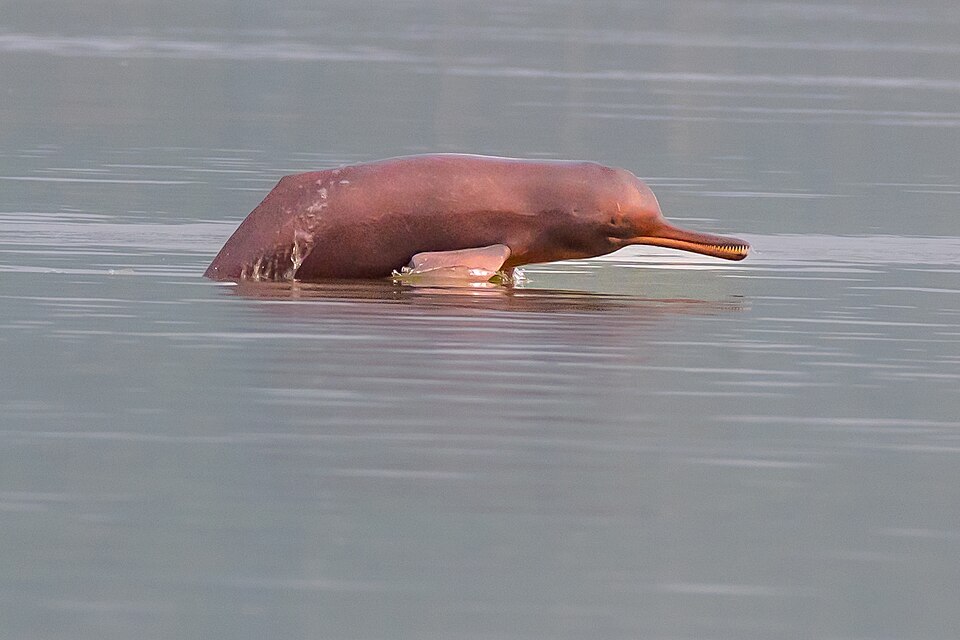
The Gangetic or Ganges river dolphin, Platanista gangetica gangetica, is one of only five river dolphin species in the world, and it is the reason Bihar figures so heavily in India's freshwater conservation policy. It lives exclusively in fresh water (it cannot survive in the sea) and it is effectively blind, navigating and hunting entirely by echolocation, emitting ultrasonic clicks that bounce off fish in water far too silty for eyes to be of any use. It is a mammal, so it must surface every thirty to a hundred and twenty seconds to breathe through the blowhole on top of its head, and the sound of that breath gives it its local name, susu. Females are larger than males and produce a single calf only once every two or three years, which makes the population very slow to recover from losses. Its legal and conservation standing is a standard examination package: Schedule I of the Wildlife (Protection) Act, 1972, Endangered on the IUCN Red List, Appendix I of CITES, and India's national aquatic animal, a status conferred at the first meeting of the National Ganga River Basin Authority chaired by the Prime Minister on 5 October 2009.
Two independent routes reach the answer, and it is worth having both because current-affairs recall can fail. The first is memory of the March 2024 news. The second is pure geography, and it is nearly as reliable. A research centre on a river dolphin has to be on the dolphin's river, and only two of the four options stand on the Ganga at all. Darbhanga belongs to the northern plain drained by the Bagmati and Kamla, and Gaya sits on the seasonal Phalgu, so both can be struck out without knowing anything about the centre itself. That leaves Patna against Munger, and between a state capital that hosts the state's universities, its administration and its scientific institutions, and a district town, a national research centre goes to the capital. The trap to disarm before it fires is Bhagalpur. It is the district a well-read candidate associates with Bihar and dolphins, because the Vikramshila sanctuary is there, but a sanctuary is a protected stretch of river and a research centre is a building full of scientists, and here they are in different districts. Bhagalpur is not even on the option list, which is itself the clue.
Key facts
- The National Dolphin Research Centre was inaugurated on 4 March 2024 by Bihar Chief Minister Nitish Kumar at Patna, on the bank of the Ganga, and was reported as the first dedicated centre of its kind in Asia.
- The Gangetic dolphin is India's national aquatic animal, a status conferred at the first meeting of the National Ganga River Basin Authority, chaired by the Prime Minister, on 5 October 2009.
- The Wildlife Institute of India describes Platanista gangetica gangetica as one of the five river dolphin species in the world; it lives only in fresh water, is essentially blind, hunts by echolocation and must surface every 30 to 120 seconds to breathe: the sound of that breath giving it the local name susu.
- Its protection status is Schedule I of the Wildlife (Protection) Act, 1972, Endangered on the IUCN Red List, and Appendix I of CITES.
- Bihar's protected dolphin habitat is a different place entirely: the Vikramshila Gangetic Dolphin Sanctuary, notified on 7 August 1991 over a 60 km stretch of the Ganga from Sultanganj to Kahalgaon in Bhagalpur district.
- Project Dolphin was announced by the Prime Minister on 15 August 2020 and 5 October is observed as National Dolphin Day; a nationwide riverine dolphin survey carried out in 2021-23, whose results were released in March 2025, estimated about 6,327 animals, with Uttar Pradesh and Bihar holding the largest numbers.
Study next
Common traps
- Reaching for Bhagalpur. The Vikramshila Gangetic Dolphin Sanctuary is in Bhagalpur, but the research centre is in Patna, and Bhagalpur is not even among the options.
- Assuming any large Bihar city will do. Only Patna and Munger among the four stand on the Ganga; Darbhanga and Gaya are not on the dolphin's river at all.
- Confusing the Gangetic dolphin with the Irrawaddy dolphin or with marine dolphins. The Gangetic dolphin is strictly a freshwater animal and cannot survive in the sea.
BPSC asks Bihar's institutions by their district, pins them to a recent inauguration, and fills the option list with other well-known Bihar cities, so the mark turns on remembering a single place name attached to a single month. It also, as here, leaves the district a candidate half-expects off the list entirely. UPSC never asks where an Indian research centre was opened; it asks the species instead (whether the Gangetic dolphin is the national aquatic animal, what is driving its numbers down, or whether a given dolphin is correctly paired with a given river) so the same news item has to be prepared as ecology for one exam and as geography for the other.
Related PYQs
Which one of the following is the national aquatic animal of India?
- (a) Saltwater crocodile
- (b) Olive ridley turtle
- (c) Gangetic dolphin
- (d) Gharial
Answer(c) Gangetic dolphin
The status that makes this centre a national institution rather than a state one. The Gangetic dolphin is India's national aquatic animal, and that designation (conferred in 2009) is why a research centre devoted to a single river mammal carries the word 'National' in its name.
Other than poaching, what are the possible reasons for the decline in the population of Ganges River Dolphins? 1. Construction of dams and barrages on rivers 2. Increase in the population of crocodiles in rivers 3. Getting trapped in fishing nets accidentally 4. Use of synthetic fertilizers and other agricultural chemicals in crop-fields in the vicinity of rivers Select the correct answer using the code given below.
- (a) 1 and 2 only
- (b) 2 and 3 only
- (c) 1, 3 and 4 only
- (d) 1, 2, 3 and 4
Answer(c) 1, 3 and 4 only
The problem the centre exists to work on. UPSC keys dams and barrages, accidental entanglement in fishing nets, and agricultural chemicals as the causes of decline, and training fishermen to avoid accidental kills is one of the research centre's own stated tasks.
Consider the following statements regarding the ‘Gangetic Dolphin’ : 1. The Gangetic River Dolphin has been categorized as ‘endangered’ under the IUCN’s Red List. 2. It does not have a crystalline eye lens rendering it effectively blind. 3. Navigation and hunting are carried out using echolocation. 4. It has been recognized as India’s National Aquatic Animal. Which of the above statements are correct?
- (a) Only 1, 2 and 4
- (b) Only 2, 3 and 4
- (c) Only 1, 3 and 4
- (d) All of the above
Answer(d) All of the above
BPSC asked the same animal from the biology side a year earlier, running through its IUCN status, its blindness, its use of echolocation and its status as India's national aquatic animal in a single four-statement question. The 70th then asked where Bihar had built a centre to study it. Between the two papers the Gangetic dolphin has been examined as species, as conservation status and as state infrastructure.
Practice
- practice, not a real PYQ
The Vikramshila Gangetic Dolphin Sanctuary is located in which district of Bihar ?
- (a)Patna
- (b)Munger
- (c)Bhagalpur
- (d)Buxar
Answer(c) Bhagalpur: notified in 1991 over a roughly 60 km stretch of the Ganga between Sultanganj and Kahalgaon. It is named after the ruins of the Pala-period Vikramshila monastery nearby. - practice, not a real PYQ
The Gangetic dolphin locates its prey mainly by
- (a)keen eyesight in clear water
- (b)echolocation using ultrasonic sound
- (c)a highly developed sense of smell
- (d)detecting electric fields produced by fish
Answer(b) echolocation using ultrasonic sound: the animal is effectively blind, and the Ganga's water is far too silty for vision to be useful, so it navigates and hunts entirely by the returning echoes of its own clicks.