
Ramkrishna Mission was founded by
- (a)Vidyasagar in 1899
- (b)Swami Vivekanand in 1899
- (c)Swami Vivekanand in 1897
- (d)More than one of the above
Answer
Why
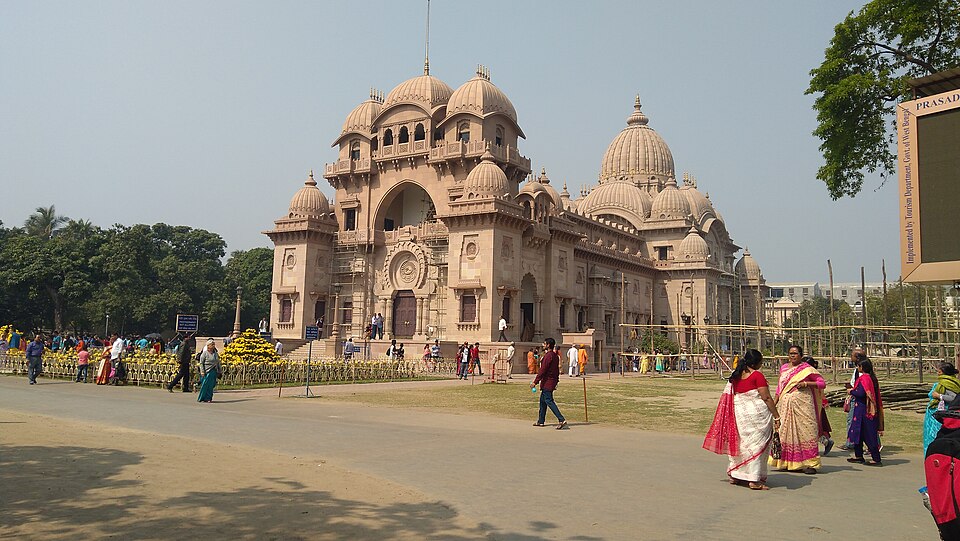
Correct: C, Swami Vivekanand in 1897. Every option here bundles a person with a year, so an option is right only if both halves are right, and only one clears that bar. The Ramakrishna Mission was founded in 1897 by Swami Vivekananda, four years after the address at the Parliament of Religions in Chicago in 1893 that had made his name in the West. The organisation's own headquarters states the year without qualification: Belur Math's account of its work opens 'Right from 1897, when Ramakrishna Mission was founded, it has conducted extensive relief operations for the victims of natural disasters.' Vivekananda named the body for his guru, Sri Ramakrishna (1836-1886), and gave it the motto atmano mokshartham jagat hitaya cha: 'for one's own salvation and for the welfare of the world', which made service to humanity a form of worship and produced the hospitals, schools, rural development centres and relief operations the Mission is now known for. The 1899 printed in option (b) is not a random wrong year, and that is what makes this question worth studying rather than merely answering. 1899 is the year of Belur Math, the Mission's permanent headquarters. The Order's own record lists its four successive homes in order: Baranagore Math from 1886 to 1892, Alambazar Math from 1892 to 1898, the Old Math from 1898 to 1899, and then Belur, described as 'the fourth and permanent abode of the Ramakrishna Order'. So 1897 belongs to the Mission and 1899 to its headquarters, and the examiner has put the second date next to the right man to see whether the candidate can separate an organisation from its address.
Why the others are wrong
- (a)Vidyasagar in 1899: Vidyasagar in 1899: false in both halves. Ishwar Chandra Vidyasagar (1820-1891) was a Sanskrit scholar, educationist and reformer of nineteenth-century Bengal, remembered for the campaign behind the Hindu Widows' Remarriage Act of 1856 and for his work in women's education. He died in 1891, six years before the Ramakrishna Mission came into being, and had no association with it whatever. The year attached to him is wrong as well, which makes this the weakest option on the list.
- (b)Swami Vivekanand in 1899: Swami Vivekanand in 1899: the right founder with the wrong year, and easily the most dangerous option here. 1899 is when Belur Math, on the west bank of the Hooghly in Howrah district, became the permanent headquarters of the Order, the fourth home after Baranagore, Alambazar and the Old Math. A candidate who has read the words 'Vivekananda', 'Belur Math' and '1899' together and stored them as one fact will pick this and lose the mark to a two-year gap.
- (d)More than one of the above: More than one of the above: an option that is correct only when at least two of the three preceding options are true at the same time, so the way to settle it is to count, not to feel. Option (a) fails on both the person and the year. Option (b) fails on the year. Option (c) is true. Exactly one true statement is not 'more than one', so this option is excluded by the arithmetic of the other three rather than by any fact about the Mission.
Concept
The Ramakrishna Mission belongs to the wave of socio-religious reform organisations that reshaped Indian public life in the nineteenth century, and examiners test that wave as a table of body, founder and year. Raja Rammohan Roy's Brahmo Sabha of 1828 in Calcutta, which grew into the Brahmo Samaj, attacked idolatry, priestly authority and sati. Dayananda Saraswati founded the Arya Samaj in 1875, calling for a return to the Vedas. Jyotirao Phule's Satyashodhak Samaj worked against caste hierarchy in western India, and Gopal Krishna Gokhale's Servants of India Society trained full-time public workers. The Ramakrishna Mission, founded in 1897, differs from most of these in an important way that is itself examinable: it is primarily a monastic order devoted to service rather than a pressure group seeking legislation. It ran relief and institutions instead of campaigning for statutes, and it stayed deliberately outside politics. It is also legally paired with the Ramakrishna Math: the two are separate in law and finance but function as twin organisations from the same headquarters, which is why questions can be built on the distinction between the Math, the Mission and Belur Math the place.
Two habits answer this question, and both generalise. The first is to split a compound option. Each choice here names a person and a year, and a single failure in either half kills the whole option, so settle the easier half first. The person is easier: Vidyasagar is not associated with the Ramakrishna Mission at any date, which removes option (a) at once and reduces the question to 1897 against 1899. The second habit is the discipline that 'More than one of the above' demands. That option is not a hedge and should never be chosen because two answers look plausible; it is correct only when you can name at least two of the other options that are true simultaneously. Count them here and exactly one survives, so the option fails. On the substance, the discriminator is Mission against Math. The Ramakrishna Mission is an organisation founded in 1897; Belur Math is the headquarters it moved into in 1899. BPSC repeatedly builds year decoys out of a genuinely adjacent event rather than an invented one, so the defence is to store each date with its neighbour (1893 Chicago, 1897 Mission, 1899 Belur Math) instead of memorising one figure in isolation.
Key facts
- Belur Math, the Order's own headquarters, states the founding year directly: 'Right from 1897, when Ramakrishna Mission was founded, it has conducted extensive relief operations…'
- The Order's four successive homes, in its own record: Baranagore Math 1886-1892, Alambazar Math 1892-1898, the Old Math 1898-1899, and Belur Math from 1899 as 'the fourth and permanent abode', which is where the 1899 decoy comes from.
- The headquarters campus at Belur in Howrah district, West Bengal, covers about forty acres on the western bank of the Hooghly, an hour's drive from Kolkata.
- The motto, formulated by Vivekananda himself, is atmano mokshartham jagat hitaya cha: 'for one's own salvation and for the welfare of the world'.
- Swami Vivekananda (1863-1902) was the chief disciple of Sri Ramakrishna (1836-1886). His address at the Parliament of Religions in Chicago in 1893 came four years before the Mission was founded, and his birth anniversary, 12 January, is observed in India as National Youth Day.
- Ishwar Chandra Vidyasagar (1820-1891), named in option (a), died six years before the Mission existed; his reform work lay in widow remarriage and in women's education in Bengal.
Study next
Common traps
- Collapsing 1897 and 1899 into one date. The Ramakrishna Mission was founded in 1897; Belur Math became its permanent headquarters in 1899.
- Treating 'More than one of the above' as a safe hedge when two options look attractive. It is correct only when at least two of the other options are simultaneously true, and here only one is.
- Judging a compound option on the half you recognise. Option (b) names the right founder and is still wrong, because the year attached to him is not the year of the founding.
BPSC asks the reform movements as compound one-line options that fuse a person with a year, then plants a genuinely adjacent date as the decoy (here 1899, the year of Belur Math rather than of the Mission) and closes the list with 'More than one of the above' to punish hedging. UPSC handles the same syllabus as multi-statement sets across several organisations at once, where one statement carries a deliberately false founding year and the mark depends on evaluating each line separately rather than recognising a famous name.
Related PYQs
Consider the following statements: I. Arya Samaj was founded in 1835. II. Lala Lajpat Rai opposed the appeal of Arya Samaj to the authority of Vedas in support of its social reform programmes. III. Under Keshab Chandra Sen, the Brahmo Samaj campaigned for women’s education. IV. Vinoba Bhave founded the Sarvodaya Samaj to work among refugees. Which of these statements are correct?
- (a) I and II
- (b) II and III
- (c) II and IV
- (d) III and IV
Answer(d) III and IV
The same trick with a different organisation. Statement I fails only because the founding year of the Arya Samaj is printed wrong, exactly as option (b) here fails only on the year of the Ramakrishna Mission. Both questions reward a candidate who has stored the reform bodies as founder-plus-year pairs rather than as names.
Who among the following was associated as Secretary with Hindu Female School which later came to be known as Bethune Female School?
- (a) Annie Besant
- (b) Debendranath Tagore
- (c) Ishwar Chandra Vidyasagar
- (d) Sarojini Naidu
Answer(c) Ishwar Chandra Vidyasagar
What Vidyasagar actually did, which is the fastest way to eliminate option (a). His work was in Bengal's women's education and widow remarriage, and he died in 1891: six years before the Ramakrishna Mission existed, so no date could have attached him to it.
Match List–I with List–II : List—I a. Servants of India Society b. Tattwabodhini Sabha c. Atmiya Sabha List—II 1. Debendranath Tagore 2. Gopal Krishna Gokhale 3. Ram Mohan Roy 4. Keshab Chandra Sen Select the correct answer using the codes given below.
- (a) a b c 2 1 3
- (b) a b c 2 4 3
- (c) a b c 1 2 3
- (d) a b c 1 4 3
Answer(a) a b c 2 1 3
The 69th ran the same association drill as a match-list (Servants of India Society to Gokhale, Tattwabodhini Sabha to Debendranath Tagore, Atmiya Sabha to Rammohan Roy) with Keshab Chandra Sen planted as the surplus name. Whether BPSC prints it as a match-list or as a single compound option, the underlying demand is identical: know which reformer founded which body.
Which one of the following is not correctly matched? Person Associated with
- (a) James Augustus Hicky - Calcutta Chronicle
- (b) Dayananda Saraswati - Satyarth Prakash
- (c) Ramaswamy Naicker - Justice Party
- (d) Jyotirao Phule - Satyashodhak Samaj
Answer(a) James Augustus Hicky - Calcutta Chronicle
The year after this paper, the 71st asked the same material as a find-the-wrong-pairing question, again over nineteenth-century figures and the bodies and books tied to them. Between the two editions, BPSC has tested reformer-to-organisation matching in three different formats in three consecutive papers.
Practice
- practice, not a real PYQ
Belur Math, the headquarters of the Ramakrishna Math and Ramakrishna Mission, is located on the bank of which river ?
- (a)Damodar
- (b)Hooghly
- (c)Mahananda
- (d)Ajay
Answer(b) Hooghly: the campus of about forty acres lies on the western bank of the Hooghly at Belur in Howrah district, West Bengal, roughly an hour from Kolkata. - practice, not a real PYQ
National Youth Day is observed in India on 12 January to mark the birth anniversary of
- (a)Raja Rammohan Roy
- (b)Ishwar Chandra Vidyasagar
- (c)Swami Vivekananda
- (d)Dayananda Saraswati
Answer(c) Swami Vivekananda: born 12 January 1863, the founder of the Ramakrishna Mission and the chief disciple of Sri Ramakrishna.