
Consider the following statements regarding the ‘Gangetic Dolphin’ : 1. The Gangetic River Dolphin has been categorized as ‘endangered’ under the IUCN’s Red List. 2. It does not have a crystalline eye lens rendering it effectively blind. 3. Navigation and hunting are carried out using echolocation. 4. It has been recognized as India’s National Aquatic Animal. Which of the above statements are correct?
- (a)Only 1, 2 and 4
- (b)Only 2, 3 and 4
- (c)Only 1, 3 and 4
- (d)All of the above
Answer
Why
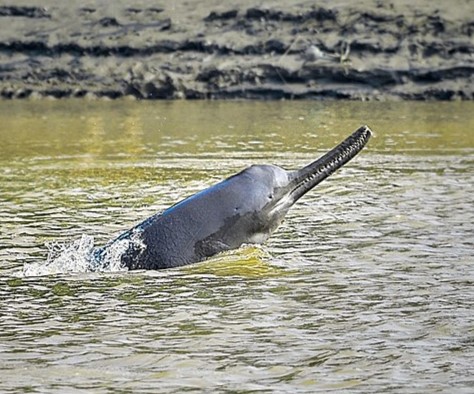
Correct: D, All of the above. Every one of the four statements survives a check against the Wildlife Institute of India, the MoEFCC's own autonomous institute: though one of them needs a careful word about how it is phrased. Statement 1: WII's species page records that Ganges river dolphins "are listed as Endangered in IUCN red list", citing the 2022 assessment of Platanista gangetica (Kelkar, Smith, Alom, Dey, Paudel and Braulik, IUCN Red List of Threatened Species 2022, e.T41756A50383346): Endangered exactly, one rung below Critically Endangered and one above Vulnerable. The same page supplies the number that makes the category intelligible: "Their population is estimated to be less than 2000 individuals." It also records Schedule I of the Wild Life (Protection) Act, 1972 and Appendix I of CITES, and the species additionally sits on Appendix II of the Convention on Migratory Species. Statement 2 is the one to be precise about. WII's National Mission for Clean Ganga species page states that "the Gangetic dolphins can only live in freshwater and are essentially blind", and that functional claim (the animal cannot form an image and is effectively blind) is what statement 2 asserts and what makes it correct. The mechanism the stem supplies, the absence of a crystalline eye lens, is the standard scientific account of why, but it deserves an honest flag: no government page reachable while building this card uses the words 'crystalline lens'. WII writes "essentially blind"; WWF-India's species page writes "generally blind". So take the blindness as government-sourced and the lens detail as the textbook explanation behind it, rather than as an official form of words. Either way statement 2 is not the false one in the set: the eye is tiny, lacks the image-forming optics other cetaceans carry, and registers little more than the direction and intensity of light in water so silt-laden that sight would buy nothing. Statement 3: the same WII page says they "hunt by emitting ultrasonic sounds waves that bounce off of fish and other prey", and WII's Endangered Species Recovery Programme page credits them with "a highly developed bio sonar system that facilitates them to hunt for fish even in murky waters": echolocation therefore does both the jobs the statement names, orientation and prey capture. The behaviour matches the anatomy: the animal habitually swims on one side with a flipper trailing the muddy bottom, sweeping the bed for prey it will never see. Statement 4: "Indian ministry of environment and forests declared Ganges river dolphin as National aquatic animal in 2009": the decision was taken at the first meeting of the National Ganga River Basin Authority, chaired by the Prime Minister, on 5 October 2009, with formal notification following in May 2010. That same date was later adopted as National Dolphin Day, announced on 25 March 2022 after the 67th meeting of the Standing Committee of the National Board for Wild Life and first observed on 5 October 2022, a year before this paper. Nothing in the set is false, so (d) is the answer.
Why the others are wrong
- (a)Only 1, 2 and 4: Drops statement 3, the echolocation claim, but that is the single best-attested fact about the animal, and the option is self-defeating because it keeps statement 2. WII describes a "highly developed bio sonar system" and says the dolphins hunt by emitting ultrasonic sound waves that bounce off prey. A candidate who accepts that the dolphin is blind but doubts that sound alone can steer it has not joined the two halves of one adaptation: a blind predator in a turbid river either has a non-visual sense or it starves. Note too that the statement claims echolocation for navigation as well as hunting, and WII's wording covers both: orientation in murky water is the same acoustic problem as finding a fish in it.
- (b)Only 2, 3 and 4: Drops statement 1, the IUCN category. This is usually not ignorance but over-correction: candidates who know the species is rare (WII puts the population below 2,000) assume the Red List must have it as Critically Endangered and reject the milder-sounding 'endangered'. The formal 2022 assessment of Platanista gangetica (e.T41756A50383346) is Endangered, and WII repeats that classification, so statement 1 stands exactly as written. Rarity and Red List category are not the same measurement: the category is set by quantified criteria on population size, decline rate and range, not by how scarce a species feels, which is why a Schedule I animal on CITES Appendix I can still be assessed one rung below the top.
- (c)Only 1, 3 and 4: Drops statement 2, the blindness claim, presumably because 'does not have a crystalline eye lens' reads like an over-specific piece of anatomy that an exam paper is unlikely to have got right. The functional core of it is government-sourced: WII's own description of the species is that they are "essentially blind", and WWF-India's says "generally blind". The lensless eye is the standard scientific explanation for that blindness rather than an official form of words, but nothing in the statement contradicts what WII prints, and the tiny eye plainly lacks the image-forming optics other cetaceans carry, which is exactly why the ultrasonic sense in statement 3 had to evolve so far. Rejecting statement 2 while accepting statement 3, as this option does, leaves you with a sighted animal that navigates by sonar for no reason.
Concept
The Ganges river dolphin, Platanista gangetica gangetica, locally the susu, is one of only five river dolphin species in the world and an obligate freshwater cetacean: it cannot survive in the sea. WII records its range across the Ganga and Brahmaputra basins of India, Nepal and Bangladesh. Living in water too turbid for sight, it has traded eyes for sound: a slit-like blowhole on the crown of the head working as a nostril, a long tooth-lined snout, and an acoustic sense refined enough to find fish it will never see. It surfaces every 30 to 120 seconds to breathe, and the puffing sound of that breath gives it its Hindi name. Females are larger than males and a female produces one calf every two to three years, a reproductive rate so slow that a population knocked down does not bounce back inside a policy cycle. India protects it at the highest level available (Schedule I of the Wild Life (Protection) Act, 1972) and it is on Appendix I of CITES and Appendix II of the Convention on Migratory Species; WII puts the surviving population below 2,000 individuals. Because it needs deep, continuously flowing water, it is a flagship for the health of the whole river: barrages, sand mining and net entanglement hurt it before they visibly hurt anything else. That flagship status is what has given it a policy apparatus of its own: the Vikramshila Gangetic Dolphin Sanctuary on the Bhagalpur reach of the Ganga since 1991, the National Aquatic Animal designation of 2009, Project Dolphin announced on 15 August 2020, and National Dolphin Day on 5 October since 2022.
The difficulty here is psychological rather than factual. Four statements, all true, with 'All of the above' sitting at (d), and candidates are trained to believe that examiners never make everything correct, so they hunt for a flaw and manufacture one. Notice how the option set is engineered to feed that instinct: (a), (b) and (c) each drop exactly one statement, so whichever single line you happen to distrust, an option is waiting for you. That symmetry is a signal in itself. Work statement by statement instead, and only reject a line if you can name the fact that contradicts it. Statements 3 and 4 are textbook and go straight in. Statement 1 is the one people talk themselves out of, so fix the exact word: the IUCN category is Endangered, one rung below Critically Endangered, and it has been so since the assessment was refreshed in 2022: the Red List is a graded ladder, not a synonym for 'rare'. Statement 2 is the one people distrust because of its unusual anatomical phrasing, so test the consequence rather than the mechanism: if you already accept statement 3, that the animal navigates and hunts by sound, then a functionally blind eye is not a surprising claim but the reason echolocation exists at all. Statements 2 and 3 corroborate each other; rejecting one while keeping the other, which is what options (a) and (c) each do, is internally inconsistent, and spotting that inconsistency kills two of the three wrong options without knowing a single fact. Once all four hold, (d) is forced. The one genuine imprecision on the paper is in the examiner's wording rather than the biology: 'crystalline eye lens' is the textbook explanation for the blindness rather than the phrase government sources use, and it is not enough to make the statement false.
Key facts
- IUCN status: Endangered: assessment of Platanista gangetica by Kelkar et al., IUCN Red List of Threatened Species 2022, e.T41756A50383346; also Schedule I of the Wild Life (Protection) Act, 1972 and Appendix I of CITES
- Declared India's National Aquatic Animal in 2009: taken at the first meeting of the National Ganga River Basin Authority, chaired by the Prime Minister, on 5 October 2009
- WII: the species is "essentially blind" and hunts "by emitting ultrasonic sounds waves that bounce off of fish and other prey", using what WII calls a highly developed bio sonar system
- One of only five river dolphin species in the world; obligate freshwater; must surface to breathe every 30–120 seconds through a slit-like blowhole on the crown; the breathing sound gives it the name 'susu'; females are larger than males and bear one calf every 2–3 years
- WII on abundance: 'Their population is estimated to be less than 2000 individuals': the figure behind the Endangered listing; the animal also swims on one side with a flipper trailing the muddy bottom, sweeping the bed for prey
- Honest limit on statement 2: WII says the species is 'essentially blind' and WWF-India says 'generally blind'; no government page reachable for this card uses the words 'crystalline lens', so treat that anatomy as the standard scientific explanation rather than as an official form of words
- Policy timeline: Vikramshila sanctuary 7 August 1991; National Aquatic Animal decided 5 October 2009 and notified May 2010; Project Dolphin announced 15 August 2020; National Dolphin Day announced 25 March 2022 (67th meeting of the Standing Committee of the NBWL) and first observed 5 October 2022
- Vikramshila Gangetic Dolphin Sanctuary, notified 7 August 1991, protects a 60 km stretch of the Ganga from Sultanganj to Kahalgaon in Bhagalpur district, Bihar: India's only protected area created for the species
- India's first rangewide survey (2021–23, results released March 2025) estimated about 6,327 riverine dolphins; Uttar Pradesh and Bihar held the largest numbers, and Project Dolphin's second rangewide estimation began at Bijnor on 17 January 2026: both dates fall after this 2023 paper
Study next
Common traps
- Upgrading the IUCN status to 'Critically Endangered': the Ganges river dolphin is assessed Endangered
- Rejecting 'All of the above' on instinct; on this question every statement is independently verifiable and the option is correct
- Confusing the Ganges river dolphin with the Irrawaddy dolphin of Chilika Lake, or with the Indus river dolphin, which was separated as Platanista minor and survives in India only in a small Beas population
BPSC builds these as four-statement blocks in which everything is true, betting that candidates will flinch at 'All of the above', so the discipline is to verify each line rather than to judge the set. UPSC rarely gives a free 'all correct'; it puts one deliberately false item into the list, as in 2014 when 'increase in the population of crocodiles' was slipped among genuine causes of dolphin decline, or asks the same fact as a single crisp recall, as in 2015 on the national aquatic animal.
Related PYQs
Which one of the following is the national aquatic animal of India?
- (a) Saltwater crocodile
- (b) Olive ridley turtle
- (c) Gangetic dolphin
- (d) Gharial
Answer(c) Gangetic dolphin
Statement 4 of this BPSC question, asked by UPSC as a standalone one-liner. The same 2009 designation is being tested; BPSC simply buries it inside a four-statement block instead of asking it directly.
Other than poaching, what are the possible reasons for the decline in the population of Ganges River Dolphins? 1. Construction of dams and barrages on rivers 2. Increase in the population of crocodiles in rivers 3. Getting trapped in fishing nets accidentally 4. Use of synthetic fertilizers and other agricultural chemicals in crop-fields in the vicinity of rivers Select the correct answer using the code given below.
- (a) 1 and 2 only
- (b) 2 and 3 only
- (c) 1, 3 and 4 only
- (d) 1, 2, 3 and 4
Answer(c) 1, 3 and 4 only
The same species in the same multi-statement format, and the perfect contrast in examiner habit: UPSC planted one false item (crocodile predation is not a recognised driver) where BPSC planted none. Read both and you learn to test each statement on its own evidence rather than guessing how many are meant to be true.
The species which are in danger of extinction are known as?
- (a) Vulnerable
- (b) Rare
- (c) Endangered
- (d) Extinct
Answer(c) Endangered
BPSC returned in 2025 to the exact vocabulary that statement 1 turns on: the IUCN ladder and what 'Endangered' formally means. Knowing that Vulnerable, Endangered and Critically Endangered are distinct rungs, not synonyms, is what stops you from rejecting statement 1 here.
Practice
- practice, not a real PYQ
The Vikramshila Gangetic Dolphin Sanctuary protects which stretch of the Ganga?
- (a)Buxar to Ara
- (b)Sultanganj to Kahalgaon in Bhagalpur district
- (c)Patna to Mokama
- (d)Kahalgaon to Farakka
Answer(b) Sultanganj to Kahalgaon in Bhagalpur district: a 60 km stretch notified on 7 August 1991, India's only protected area created for the Ganges river dolphin. - practice, not a real PYQ
Under which Schedule of the Wild Life (Protection) Act, 1972 is the Ganges river dolphin protected?
- (a)Schedule I
- (b)Schedule II
- (c)Schedule III
- (d)Schedule IV
Answer(a) Schedule I: the highest level of protection under the Act, as recorded by the Wildlife Institute of India; the species is also on Appendix I of CITES.