
Which one of the following is not correctly matched? Person Associated with
- (a)James Augustus Hicky - Calcutta Chronicle
- (b)Dayananda Saraswati - Satyarth Prakash
- (c)Ramaswamy Naicker - Justice Party
- (d)Jyotirao Phule - Satyashodhak Samaj
Answer
Why
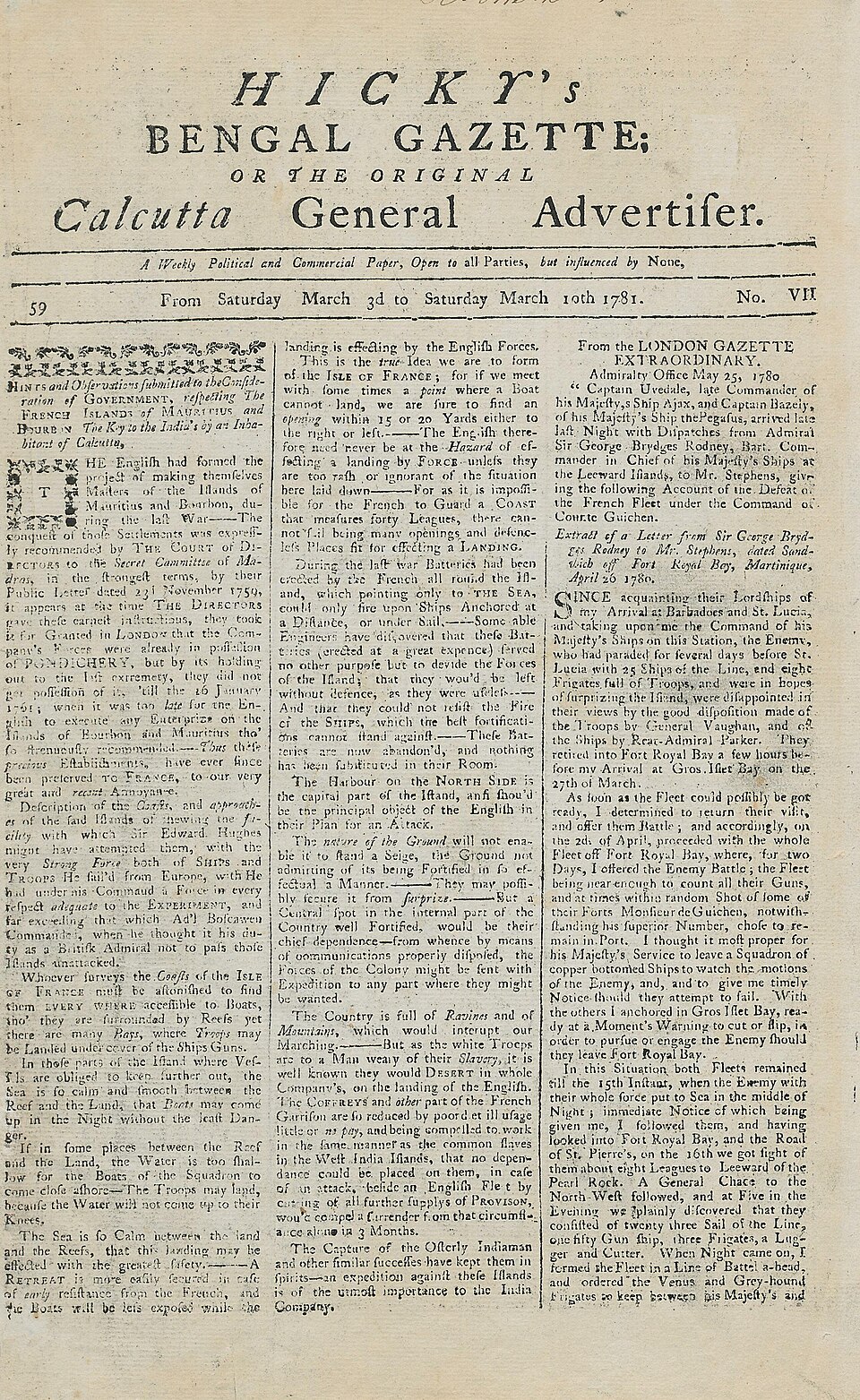
Correct — A, James Augustus Hicky - Calcutta Chronicle. This is the pair that does not hold. Hicky's paper was Hicky's Bengal Gazette, or the Original Calcutta General Advertiser: an English-language weekly he founded on 29 January 1780 from 67 Radha Bazar, Calcutta, printed every Saturday, sold at one rupee, with a circulation put at about four hundred copies a week. It was the first newspaper printed anywhere in Asia. It ran barely two years and ceased on 30 March 1782, when the East India Company seized its types and printing press. The Calcutta Chronicle is a different paper by different men. The Calcutta Chronicle and General Advertiser was founded by two Englishmen, Daniel Stuart and Joseph Cooper, who began printing it on 26 January 1786 from the Chronicle Printing Press in Council House Street; it survived four years until 1790, when the Company withdrew its licence on the ground that its contents had been 'highly disrespectful to the government'. Six years separate the two launches, and Hicky's paper had already been shut down four years before the Chronicle appeared, so he cannot have been behind it. The reason the pair looks plausible is worth naming, because it is the whole design of the question: both titles end the same way. Hicky renamed his sheet on 18 November 1780 — the day his Company-backed rival the India Gazette launched — from Hicky's Bengal Gazette; or, Calcutta General Advertiser to Hicky's Bengal Gazette; or the Original Calcutta General Advertiser, precisely to assert that he had come first. So Hicky's own masthead did carry the words 'Calcutta' and 'General Advertiser', and the paper he never touched is 'The Calcutta Chronicle and General Advertiser'. The word that decides the question is the one in the middle: Gazette, not Chronicle. Notice what kind of error this is, because recognising the type saves time elsewhere in the paper. Nothing in the pair is invented: James Augustus Hicky is real, the Calcutta Chronicle is real, and both belong to the same decade and the same city. Exactly one noun has been substituted inside an otherwise true statement. Had the examiner wanted a genuine pair for Hicky the second column would read Bengal Gazette; had he wanted a genuine pair for the Calcutta Chronicle it would read Daniel Stuart and Joseph Cooper. Neither is on offer. The other three pairs are all sound, and each is fixable to a date.
Why the others are wrong
- (b)Dayananda Saraswati - Satyarth Prakash — Correctly matched, so it cannot be the answer. The Satyarth Prakash, 'The Light of Truth', was written in Hindi by Swami Dayananda Saraswati and published in 1875 by the Star Press at Benares; he revised it in 1882, and it has since been translated into more than twenty languages. The same year, 1875, he founded the Arya Samaj. This is the safest pair in the set and the one a candidate should verify first, because clearing it narrows the hunt to the remaining three.
- (c)Ramaswamy Naicker - Justice Party — Correctly matched, and the pair most often wrongly rejected. The Justice Party, formally the South Indian Liberal Federation, was founded at Madras on 20 November 1916 by T. M. Nair and Theagaroya Chetty, with C. Natesa Mudaliar; E. V. Ramaswamy Naicker did not found it but was one of its presidents, and it was dissolved on 27 August 1944 when he converted it into the Dravidar Kazhagam. Candidates who read the column head 'Associated with' as 'founded' strike this pair out and lose the mark.
- (d)Jyotirao Phule - Satyashodhak Samaj — Correctly matched. Jyotirao Phule founded the Satyashodhak Samaj, the Truth-Seekers' Society, at Poona on 24 September 1873, alongside Savitribai Phule, who headed its women's section; it campaigned for the rights of women, peasants and Dalits and disbanded in the 1930s as its leaders moved into the Congress. The confusion candidates sometimes import here is with the Marathi paper Din Bandhu of the same circle, which was not Phule's own founding.
Concept
The early Calcutta press is a small, tightly dated world, and that is exactly what makes it examinable. The idea of an Indian newspaper was floated in 1768 by the Dutch adventurer William Bolts, who was deported by the East India Company before he could print anything; James Augustus Hicky, an eccentric Irishman who had already served two years in jail for debt, was the first to actually execute it, in January 1780. His slogan was 'Open to all Parties, but influenced by None', and he used the sheet to accuse Governor-General Warren Hastings of corruption and Chief Justice Elijah Impey of taking bribes. After four trials in June 1781 the Supreme Court at Fort William convicted him of libel and jailed him, and by March 1782 the Company had taken his press. Rivals crowded in fast: the Company-friendly India Gazette on 18 November 1780, and by 1786 four weeklies and a monthly magazine were appearing in Calcutta, among them the Calcutta Chronicle. Every one of these titles was published at the Company's pleasure and several were closed by it — the pattern that hardens into formal law with the Censorship of Press Act of 1799, the Licensing Regulations of 1823, Metcalfe's liberalisation of 1835 and the Vernacular Press Act of 1878. Because these papers were founded within a few years of one another in the same city, their titles overlap heavily: Bengal Gazette, India Gazette, Calcutta Gazette, Calcutta Chronicle and General Advertiser. Learning the founder without the exact title is what this question punishes.
A 'not correctly matched' item is answered by confirmation, not by suspicion. Prove the three you can and the fourth is the answer, even if you cannot say what its right partner should have been. Here all three of the others carry a hard date: Satyarth Prakash 1875, Satyashodhak Samaj 24 September 1873, Justice Party 1916 to 1944. If those three come back clean, option A is the answer whether or not you can name Hicky's actual paper. Two failure modes are worth naming because the paper is built on them. The first is the near-title. Hicky's masthead literally read 'Calcutta General Advertiser', and the Chronicle's full title is 'The Calcutta Chronicle and General Advertiser'; a candidate matching on the words 'Calcutta' and 'Advertiser' will accept the pair. The single discriminating word is Gazette. The second failure mode is over-reading the column head. It says 'Associated with', not 'Founded by'. Periyar did not found the Justice Party — T. M. Nair and Theagaroya Chetty did, in 1916 — but he presided over it and converted it into the Dravidar Kazhagam in 1944, so the association is real and the pair is correct. A candidate who applies a 'founder' test to option C will mark two pairs wrong and then have to guess between them, which under this paper's minus-one-third rule is a losing trade.
Key facts
- Hicky's Bengal Gazette, or the Original Calcutta General Advertiser — founded 29 January 1780 by James Augustus Hicky at 67 Radha Bazar, Calcutta; the first newspaper printed in Asia; a weekly issued on Saturdays at one rupee with a circulation of roughly four hundred; it ceased on 30 March 1782 after the East India Company seized its types and press.
- The Calcutta Chronicle and General Advertiser — a separate paper founded by Daniel Stuart and Joseph Cooper, first printed on 26 January 1786 at the Chronicle Printing Press in Council House Street; it ran four years until 1790, when the Company withdrew its licence for contents 'highly disrespectful to the government'.
- Hicky's slogan was 'Open to all Parties, but influenced by None'. He accused Warren Hastings of corruption and Chief Justice Elijah Impey of taking bribes; after four trials in June 1781 the Supreme Court at Fort William convicted him of libel and jailed him. The Company-backed rival India Gazette had launched on 18 November 1780.
- Satyarth Prakash, 'The Light of Truth', was written in Hindi by Dayananda Saraswati and published in 1875 by the Star Press, Benares; the author revised it in 1882 and it has been translated into more than twenty languages. He founded the Arya Samaj in the same year, 1875.
- The Satyashodhak Samaj was founded on 24 September 1873 at Poona by Jyotirao Phule with Savitribai Phule, who led its women's wing, and disbanded in the 1930s; the Justice Party, or South Indian Liberal Federation, was founded at Madras on 20 November 1916 by T. M. Nair and Theagaroya Chetty, counted E. V. Ramaswamy Naicker among its presidents, and was dissolved on 27 August 1944, its successor being the Dravidar Kazhagam.
Study next
Common traps
- Matching on a partial title — Hicky's masthead did carry 'Calcutta' and 'General Advertiser', but his paper was the Bengal Gazette, and the Calcutta Chronicle of 1786 was Daniel Stuart and Joseph Cooper's
- Reading 'Associated with' as 'Founded by' and therefore striking out Periyar and the Justice Party, which T. M. Nair and Theagaroya Chetty founded in 1916 and which Periyar later led
- Assuming a 'not correctly matched' stem always hides an exotic error; here three pairs are textbook-standard and the whole item turns on one substituted noun
BPSC runs this as a compact four-pair grid with a negative stem and no code, mixing one press-history pair with three reform-movement pairs so that a candidate strong on only one of the two areas still has to guess. UPSC has largely retired the bare pair-grid in favour of the numbered 'consider the following pairs' set with a how-many-are-correct answer, but the underlying attribution is identical, and it prefers to test the press with a single sharp question — who started Som Prakash, which journal was Azad's — where the distractors are all real periodicals of the same decade rather than an invented mismatch.
Related PYQs
Who among the following started the newspaper "Shome Prakash"?
- (a) Dayanand Saraswati
- (b) Ishwar Chandra Vidyasagar
- (c) Raja Rammohun Roy
- (d) Surendranath Banerjee
Answer(b) Ishwar Chandra Vidyasagar
The same concept, attributing a nineteenth-century paper to the man behind it, and it even shares a name with the BPSC option set — Dayanand Saraswati is offered here as the wrong founder, exactly as Hicky is offered there against the wrong title.
Which one of the following was a journal brought out by Abul Kalam Azad?
- (a) Al-Hilal
- (b) Comrade
- (c) The Indian Sociologist
- (d) Zamindar
Answer(a) Al-Hilal
Person-to-periodical attribution again, built the same way: all four titles are genuine papers of the period, so the item is decided purely by knowing which masthead belongs to which founder rather than by spotting an invented name.
Practice
- practice — not a real PYQ
The first newspaper to be printed in India was
- (a)The Calcutta Chronicle and General Advertiser
- (b)The India Gazette
- (c)Hicky's Bengal Gazette
- (d)The Bengal Journal
Answer(c) Hicky's Bengal Gazette — James Augustus Hicky began it on 29 January 1780 at Calcutta, and it was the first newspaper printed anywhere in Asia; the India Gazette followed on 18 November 1780 and the Calcutta Chronicle only in January 1786. - practice — not a real PYQ
The Satyashodhak Samaj was founded in 1873 at Poona by
- (a)Gopal Krishna Gokhale
- (b)Jyotirao Phule
- (c)Bal Gangadhar Tilak
- (d)Gopal Baba Walangkar
Answer(b) Jyotirao Phule — he founded the Satyashodhak Samaj on 24 September 1873 at Poona along with Savitribai Phule, who headed its women's wing; it worked for women, peasants and Dalits and disbanded in the 1930s.