
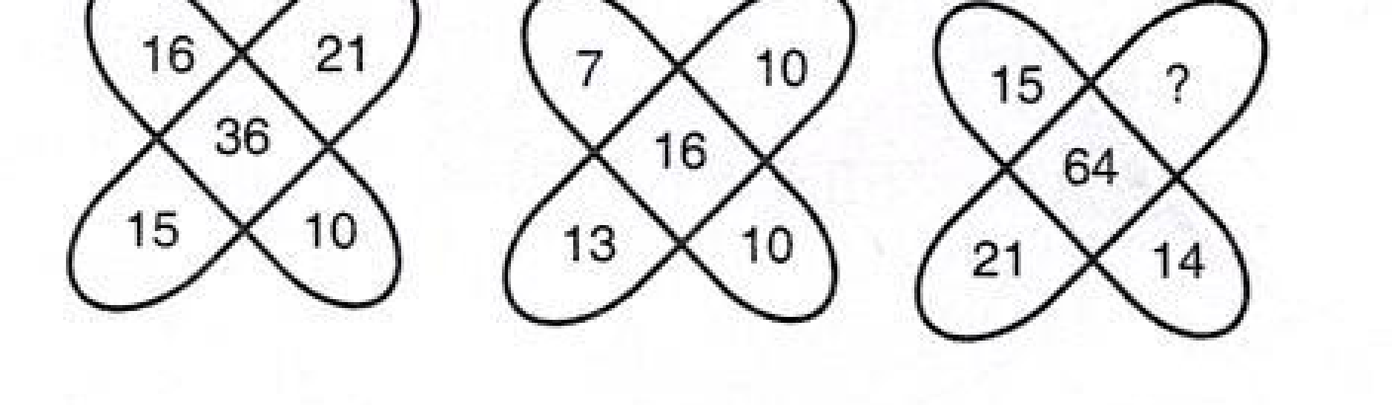
What should come in place of question mark (?) in the following ?
- (a)18
- (b)22
- (c)20
- (d)36
Answer
Why
Correct: B, 22. The rule is: read the two petal pairs in one fixed direction, and the centre is (that difference + 1) squared. Fix the direction as top-right minus top-left for the upper pair and bottom-left minus bottom-right for the lower pair: the two must give the same number. Figure 1: 21 − 16 = 5 and 15 − 10 = 5, so the difference is 5 and the centre should be (5 + 1)² = 36, which is exactly what is printed. Figure 2: 10 − 7 = 3 and 13 − 10 = 3, so the centre should be (3 + 1)² = 16: again exactly what is printed. Figure 3 hands you the centre instead of the petal: 64 = 8², so difference + 1 = 8 and the difference is 7. Check it against the pair you can see: 21 − 14 = 7. ✓ Now apply it upward: ? − 15 = 7, so ? = 22. The same value falls out of an equivalent reading: in every figure the two left-hand petals sum to the two right-hand petals (16 + 15 = 31 = 21 + 10; 7 + 13 = 20 = 10 + 10), and 15 + 21 = 36 = ? + 14 gives ? = 22 again. The two rules are algebraically the same condition, which is why they agree, but the squared-centre version is the stronger one to trust because it uses the centre numbers as well: it reproduces all three centres from the petals alone, and the two complete figures each supply the difference twice over. That is five agreeing constraints across fourteen printed numbers: far too many for a rule that had merely been fitted to one diagram.
Why the others are wrong
- (a)18: 18 − 15 = 3, which would make the centre (3 + 1)² = 16. That is Figure 2's centre, not Figure 3's, and it also contradicts the lower pair of the same diagram, where 21 − 14 = 7. Every wrong option here is the value that would import another figure's centre into this one.
- (c)20: 20 − 15 = 5, which would give a centre of (5 + 1)² = 36: Figure 1's centre. The printed centre is 64, and the bottom pair independently fixes the difference at 7, so 5 cannot be right. This is the closest miss and the option most students settle on.
- (d)36: 36 is simply Figure 1's centre value offered back as a petal. It would make the top difference 36 − 15 = 21 against a bottom difference of 21 − 14 = 7, breaking the equality that both complete diagrams obey, and it would demand a centre of (21 + 1)² = 484.
Concept
A figure-pattern question gives you two or three completed diagrams and one with a gap. The completed ones are not decoration: they are the only evidence for the rule, and a rule is only usable when it reproduces every number in every completed diagram, not just the one you happened to notice. The safe method is therefore fixed: (1) write out the numbers in a consistent positional scheme, such as top-left, top-right, bottom-left, bottom-right, centre; (2) look for an operation that turns the outer numbers into the centre; (3) test it on the second complete figure before touching the third; (4) only then solve for the gap; (5) confirm with a second, independent relation if the diagram offers one. Perfect squares in a centre position (36, 16, 64 here) are a strong hint, because a setter who wants the centre to encode something small usually squares it.
The whole difficulty is that the centre numbers 36, 16 and 64 do not sit in any obvious arithmetic relation to the petals. Sums do not work: 16 + 21 + 15 + 10 = 62, not 36. Products do not work. What does work is noticing that all three centres are perfect squares (6², 4² and 8²) and that the square roots 6, 4 and 8 are each one more than a difference you can find in the petals: 5, 3 and 7. Once you have that, the direction has to be held constant, and this is where candidates lose the question. If you read Figure 1 as 21 − 16 for the top, you must read the bottom as 15 − 10, not 10 − 15; the pattern is a rotational one, not a mirror one. Figure 3 is then unusually kind: it gives the centre, so you can work backwards from 64 to a difference of 7 and confirm that difference against the bottom pair before you ever touch the missing petal. Working backwards from a given centre is a general habit worth carrying into any figure question: the number that looks like the hardest part is often the one that unlocks it.
Key facts
- The rule that fits all three diagrams: centre = (petal difference + 1)², with the difference read in one consistent rotational direction
- Figure 1 (21 − 16 = 5 and 15 − 10 = 5, centre (5 + 1)² = 36; Figure 2) 10 − 7 = 3 and 13 − 10 = 3, centre (3 + 1)² = 16
- Figure 3: centre 64 = 8², so the difference is 8 − 1 = 7, confirmed by 21 − 14 = 7, giving the missing petal 15 + 7 = 22
- An equivalent reading: the two left petals sum to the two right petals in every figure (16 + 15 = 21 + 10; 7 + 13 = 10 + 10; 15 + 21 = 22 + 14)
- Each wrong option is the petal that would give one of the other figures' centres: 18 forces 16, 20 forces 36, and 36 is itself Figure 1's centre value
The rule reproduces all three centres from the petals alone, and the two complete figures each supply the difference twice: five agreeing checks across fourteen printed numbers.
Study next
Common traps
- Fitting a rule to one figure and jumping straight to the gap: a rule must reproduce every completed figure before you use it
- Reading the differences in a mirror direction in one figure and a rotational direction in another; the orientation must be held fixed
- Ignoring the centre number because it looks unrelated: here it is the only thing that pins the difference in the incomplete figure
BPSC puts a small block of pure reasoning at the end of the General Studies paper (a number series, a grid with a missing entry, a figure puzzle) and it recycles the same rule families year after year, so practice transfers directly across editions. UPSC keeps this material out of General Studies Paper I entirely and tests it in CSAT, the qualifying Paper II, which is why a UPSC-only preparation leaves a BPSC candidate short on exactly these marks.
Related PYQs
Select the missing number from the given alternatives : 44 49 37 52 ? 41 58 35 53
- (a) 56
- (b) 77
- (c) 66
- (d) 63
Answer(b) 77
The same task one edition earlier: numbers laid out in a fixed spatial arrangement, a rule to be inferred from the complete rows and then applied to the gap.
Find the missing number from the given alternatives: 28 | 20 | 7 84 | ? | 12 45 | 25 | 9
- (a) 30
- (b) 35
- (c) 20
- (d) 25
Answer(b) 35
The Commission asked it again on the very next paper, with the complete rows once more supplying the rule and the incomplete row supplying the gap: proof that this is a fixed feature of the BPSC paper, not a one-off.
Practice
- practice, not a real PYQ
In a figure puzzle the number in the centre equals (the difference between the two outer numbers + 1)². If the two outer numbers are 12 and 19, what is the centre number ?
- (a)49
- (b)36
- (c)64
- (d)81
Answer(c) 64: the difference is 19 − 12 = 7, so the centre is (7 + 1)² = 8² = 64. - practice, not a real PYQ
Four numbers are placed so that the sum of the left-hand pair equals the sum of the right-hand pair. The left-hand pair is 17 and 23, and one of the right-hand pair is 18. What is the other ?
- (a)20
- (b)22
- (c)24
- (d)26
Answer(b) 22: 17 + 23 = 40, and 40 − 18 = 22.