
Which of the following has highly elongated elliptical orbit ?
- (a)Comet
- (b)Asteroid
- (c)Meteor
- (d)Meteorite
Answer
Why
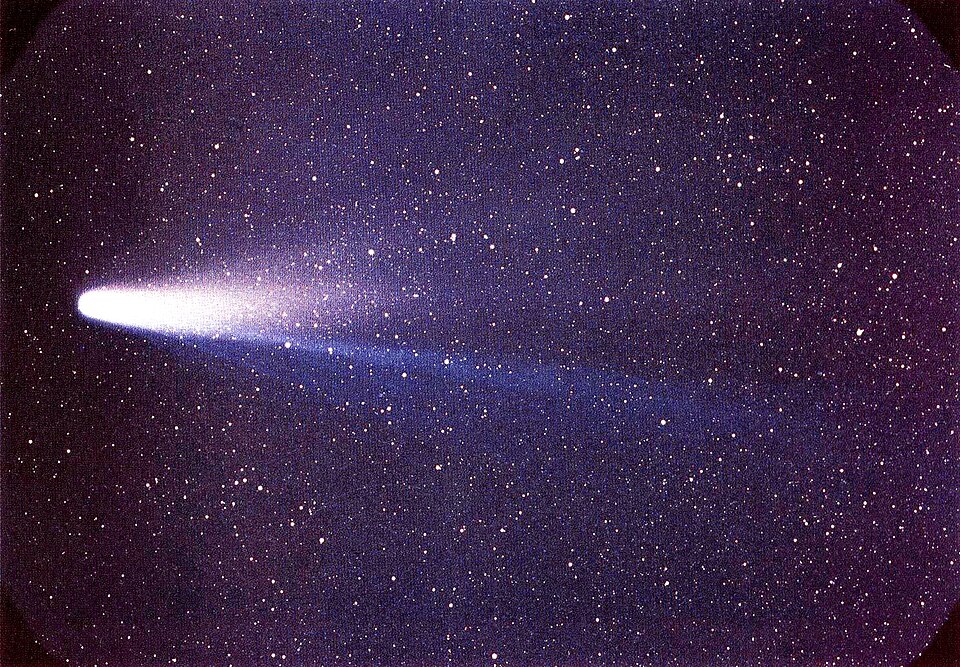
Correct: A, Comet. The standard measure of how stretched an orbit is, is eccentricity: 0 is a perfect circle and 1 is a parabola. Earth's orbit has an eccentricity of about 0.017, effectively a circle; Halley's Comet has an eccentricity of 0.967. The consequences of that number are dramatic and are worth carrying as the mental picture of what 'highly elongated' means. Halley comes in to 0.59 astronomical units at perihelion, closer to the Sun than Venus, and swings out to 35.14 au at aphelion, roughly the distance of Pluto, completing the circuit in 74 to 80 years: it last passed perihelion on 8 February 1986 and is next due on 28 July 2061. Its orbit is also retrograde, inclined at 18 degrees to the ecliptic, and it feeds two annual meteor showers, the Eta Aquariids in early May and the Orionids in late October. This elongation is not incidental to what a comet is; it is the reason a comet behaves as it does. A comet is a body of frozen volatiles: Halley's outgassing was measured by the Giotto probe in March 1986 as roughly 80 per cent water vapour with carbon monoxide and carbon dioxide: held with dust in a nucleus barely 15 km long, the 'dirty snowball' Fred Whipple had predicted. It stays frozen and invisible through most of its long orbit and only develops a coma and a tail in the short stretch near perihelion, when solar heating sublimes the ice. A body on a near-circular orbit would either be permanently cooked or permanently frozen and would never behave this way. The other three options fail for two quite different reasons: asteroids do orbit the Sun, but on low-eccentricity, near-circular paths; and a meteor and a meteorite are not orbiting bodies at all, but two later stages in the life of a fragment that has already left orbit.
Why the others are wrong
- (b)Asteroid: The only other option that actually is a body in solar orbit, which makes it the real distractor. But main-belt asteroids move on near-circular, low-eccentricity paths between the orbits of Mars and Jupiter, staying at a roughly constant distance from the Sun: the opposite of the comet's profile. They are also rocky and metallic rather than icy, and never grow a tail.
- (c)Meteor: A meteor is not an object at all but an event: the streak of light produced when a fragment from space enters the atmosphere and burns up. The body itself, before entry, is a meteoroid, ranging from grains up to about a metre across. Since a meteor is a flash lasting a second or two inside the atmosphere, asking about its orbit is a category error.
- (d)Meteorite: The third stage of the same sequence: a meteorite is what remains of a meteoroid after it has survived ablation in the atmosphere and reached the ground. It is by definition on the surface of a planet, so it has no orbit either. Meteoroid in space, meteor in the sky, meteorite on the ground is the distinction being tested by including two of the three.
Concept
The small bodies of the solar system are classified by composition and by where they are, and the four words in this option set cover two different classification schemes that students routinely merge. On composition and orbit: asteroids are rocky or metallic planetoids concentrated in the main belt between Mars and Jupiter, on low-eccentricity orbits; comets are icy bodies from the Kuiper Belt beyond Neptune or from the far more distant Oort Cloud, thrown onto long, highly eccentric orbits that bring them briefly into the inner solar system. When a comet nears the Sun its ices sublime to form a coma and a tail, and the tail always points away from the Sun because it is pushed by radiation pressure and the solar wind, not trailed behind the direction of travel. The second scheme is about a single fragment's journey: a meteoroid is a small body in space, often debris shed by a comet or chipped off an asteroid; a meteor is the luminous trail it makes on entering the atmosphere; a meteorite is the piece that survives to the ground. About 25 million meteoroids and micrometeoroids enter Earth's atmosphere every day, totalling roughly 15,000 tonnes a year, and only a tiny fraction of that mass reaches the surface.
Two filters solve this question and neither requires an eccentricity value. The first is the category test: the stem asks about an orbit, so ask which of the four options names something that orbits at all. Comets do, asteroids do, and meteors and meteorites do not: the first being an atmospheric event and the second a rock lying on a planet. That reduces the question to two. The second filter is the behaviour test: ask what each of the two survivors does. Asteroids are always there, all the time, on the same track; comets appear, brighten, grow a tail, and disappear for decades or millennia. A body that vanishes for seventy-six years and returns has to be travelling a great deal further out at one end of its orbit than at the other, which is precisely what a highly elongated ellipse means. This is the general habit worth building for astronomy questions: convert a physical description into an observable consequence, because exam options are usually distinguishable by what you would see rather than by a number you must remember. It also protects against the commonest error on this topic, which is not confusing comets with asteroids but confusing meteor with meteoroid with meteorite.
Key facts
- Halley's Comet has an orbital eccentricity of 0.967, with perihelion at 0.59 au (inside Venus's orbit) and aphelion at 35.14 au (about Pluto's distance); Earth's own eccentricity is about 0.017
- Halley's period varies between 74 and 80 years; it last reached perihelion on 8 February 1986 and is next expected on 28 July 2061, and its orbit is retrograde and inclined 18 degrees to the ecliptic
- Halley feeds two annual meteor showers, the Eta Aquariids in early May and the Orionids in late October
- The Giotto probe photographed Halley's nucleus in March 1986 (about 15 km long and 8 km wide) and measured its outgassing as roughly 80 per cent water vapour, confirming Fred Whipple's 'dirty snowball' model
- Meteoroid, meteor and meteorite are three stages of one object: a small body in space (grains up to about a metre), the luminous trail of its atmospheric entry, and the fragment that reaches the ground
- About 25 million meteoroids and micrometeoroids enter Earth's atmosphere daily, amounting to roughly 15,000 tonnes of material a year
Study next
Common traps
- Using 'meteor' where 'meteoroid' is meant; only the meteoroid is a body in space with an orbit
- Assuming a comet's tail streams behind it like smoke: it is pushed outward by radiation pressure and the solar wind, so it points away from the Sun even as the comet recedes
- Treating all asteroids as belt objects on circular orbits; near-Earth asteroids cross planetary orbits, though still far less eccentrically than comets
BPSC asks astronomy as a one-property identification (which body has this orbit, which is a rock on the ground, which is a flash in the sky) and builds the option set out of near-synonyms so that a loose vocabulary loses the mark. UPSC has asked the same content as multi-statement comparison, most directly in its asteroids-versus-comets question, where a plausible but false statement about where comets are found is planted among true ones.
Related PYQs
What is the difference between asteroids and comets? 1. Asteroids are small rocky planetoids, while comets are formed of frozen gases held together by rocky and metallic material. 2. Asteroids are found mostly between the orbits of Jupiter and Mars, while comets are found mostly between Venus and Mercury. 3. Comets show a perceptible glowing tail, while asteroids do not. Which of the statements given above is/are correct?
- (a) 1 and 2 only
- (b) 1 and 3 only
- (c) 3 only
- (d) 1, 2 and 3
Answer(b) 1 and 3 only
Exactly the comparison this question turns on, set out statement by statement (composition, location and the tail) with the false statement being the one that puts comets on a tidy inner-solar-system orbit.
A meteor is
- (a) a rapidly moving star
- (b) a piece of matter which has entered the earth’s atmosphere from outer space
- (c) part of a constellation
- (d) a comet without a tail
Answer(b) a piece of matter which has entered the earth’s atmosphere from outer space
The definition that removes two of the four options here: a meteor belongs to the atmosphere, not to solar orbit, and one of its distractors is even 'a comet without a tail', the same confusion from the other side.
Match List–I with List–II : List—I (Space Mission) a. Cassini-Huygens b. Juno c. Artemis d. VERITAS List—II (Exploration) 1. Jupiter 2. Saturn and its rings 3. Venus 4. Human Space-flight—Moon to Mars Select the correct answer using the codes given below.
- (a) a b c d 2 1 4 3
- (b) a b c d 3 1 4 2
- (c) a b c d 2 3 4 1
- (d) a b c d 3 1 2 4
Answer(a) a b c d 2 1 4 3
The 69th's solar-system slot, asked through missions rather than bodies: the same requirement to keep the objects of the solar system distinct from one another, here by matching each spacecraft to the body it was actually sent to.
Practice
- practice, not a real PYQ
A fragment from space that survives its passage through the atmosphere and reaches the Earth's surface is called a
- (a)Meteoroid
- (b)Meteor
- (c)Meteorite
- (d)Asteroid
Answer(c) Meteorite: the meteoroid is the body in space, the meteor is the luminous trail during entry, and the meteorite is what lands. - practice, not a real PYQ
The tail of a comet always points
- (a)towards the Sun
- (b)away from the Sun
- (c)opposite to its direction of motion
- (d)towards the nearest planet
Answer(b) away from the Sun: radiation pressure and the solar wind drive the tail outward, so it precedes the nucleus as the comet moves away from the Sun.