
Which of the following was the capital of Chera dynasty ?
- (a)Kuravur/Karur
- (b)Kanchipuram
- (c)Madurai
- (d)More than one of the above
Answer
Why
Correct: A, Kuravur/Karur. The booklet's double spelling is its way of rendering Karuvur, the older Tamil form of the name of modern Karur in western Tamil Nadu, and that is where the early historic Cheras had their inland capital. Historians write the name as Vanchi-Karuvur or Vanchi-Karur, in the Kongu country, and the identification is not a literary guess: it rests on excavation. Karur stands on the Amaravati river, and the riverbed and the town have yielded large quantities of Chera copper coins bearing the dynasty's bow-and-arrow emblem, bronze dies for striking punch-marked coins, indicating a Chera mint on the spot, sherds of Roman amphorae, and impure silver portrait coins carrying Tamil-Brahmi legends such as Makkotai, Kollippurai and Kol-Irumporai. Ten miles to the north, at Pugalur, two almost identical Tamil-Brahmi inscriptions of about the second century CE record three generations of Chera rulers granting a rock shelter to a Jain monk. The standard scheme of the three crowned kings of the Tamil country places the Pandyas at Madurai, the Cholas at Uraiyur near Tiruchirappalli, and the Cheras at Vanchi-Karuvur, each with a great port as a second capital: Korkai for the Pandyas, Puhar or Kaveripumpattinam for the Cholas, and Muchiri (Muziris) for the Cheras, with Thondi as a second Chera port. One honest complication a good candidate should know: the Chera family ruled in branches, so 'the' capital is a simplification. The Irumporai or Porai branch ruled from Vanchi-Karur in the Kongu country, while another branch had its headquarters at Muchiri-Vanchi and Thondi on the Kerala coast, and the Vanchi where Chenkuttuvan consecrated the Pattini temple in the Silappadikaram is the coastal one. None of that helps the other options, because neither Kanchipuram nor Madurai was ever a Chera seat.
Why the others are wrong
- (b)Kanchipuram: The Pallava capital, and the wrong period as well as the wrong dynasty. The Pallavas rose in the northern Tamil country after the Sangam age and Kanchipuram was their political and religious centre, later passing to the Cholas. It has no association with the Cheras, whose territory lay in central Kerala and the Kongu country to the west.
- (c)Madurai: The Pandya capital, and the single most confusable option because it belongs to the same Sangam-age triad. Madurai on the Vaigai was the Pandyan seat, and the Pandyas were the Cheras' rivals: one Pandya ruler, 'Thalaiyalanganam' Nedum Chezhian, is recorded as having captured the Chera Mantharam Cheral Irumporai in battle.
- (d)More than one of the above: This needs at least two of the first three to be Chera capitals, and only one is. Kanchipuram was Pallava and Madurai Pandya, so no second option can join Karur. It is worth noting why the option nevertheless feels plausible: the Cheras genuinely did have more than one capital, but the others were Muchiri and Thondi on the Kerala coast, and neither of those is printed here.
Concept
The early historic Tamil country, roughly the second century BCE to the third century CE, was shared by three ruling families known collectively as the muvendar or three crowned kings (Chera, Chola and Pandya) alongside smaller chieftaincies. Their existence is attested from outside as well as within: Ashoka's major rock edicts name the Cholas, Pandyas, Satiyaputras and Keralaputras: 'Kedalaputo', the Cheras: as peoples on his southern border, and Graeco-Roman writers from Pliny the Elder and the Periplus Maris Erythraei to Ptolemy describe trade with the Chera country, which the Periplus calls Keprobotras. The Chera realm covered present-day central Kerala and the Kongu country of western Tamil Nadu, and its strategic asset was the Palakkad Gap, the break in the Western Ghats through which the trade route ran from the Malabar ports along the Noyyal valley to Karur. Its emblem was the bow and arrow, as the Chola's was the tiger and the Pandya's the fish. The Chera king best known to literature is Chenkuttuvan, celebrated in the Silappadikaram of Ilango Adigal for installing the cult of Pattini or Kannaki: a consecration the poem says was attended by Gajabahu of Sri Lanka, which is the peg on which the chronology of the whole period hangs.
The reliable way to hold this material is as a table of three columns rather than as isolated names: dynasty, inland capital, port, emblem. Chera: Vanchi-Karuvur (Karur): Muchiri and Thondi: bow and arrow. Chola: Uraiyur: Puhar (Kaveripumpattinam): tiger. Pandya: Madurai: Korkai: fish. Once the table is in place this question answers itself, because two of the four options are other dynasties' capitals and one of those, Madurai, is in the very same table. Kanchipuram belongs to a later column altogether, the Pallavas, and a candidate who cannot place it will often assume it is Sangam-age simply because it is ancient and Tamil. The composite fourth option then falls out automatically: it requires two Chera capitals among the printed choices, and only one is there. A further point of exam technique is worth noting about the option's odd spelling. 'Kuravur/Karur' looks like a printing error, and a candidate may hesitate for that reason, but transliteration of old Tamil names varies widely (Karuvur, Karur, Vanchi, Vanji) and an unfamiliar spelling of a familiar place should never by itself be treated as a signal that the option is wrong.
Key facts
- The early historic Cheras had their inland capital at Vanchi-Karuvur, modern Karur, on the Amaravati river in the Kongu country of western Tamil Nadu, with ports and coastal capitals at Muchiri (Muziris) and Thondi (Tyndis) in Kerala
- Excavations at Karur have yielded Chera copper coins with the bow-and-arrow emblem, bronze dies indicating a mint, Roman amphora sherds, and silver portrait coins with Tamil-Brahmi legends such as Makkotai and Kol-Irumporai
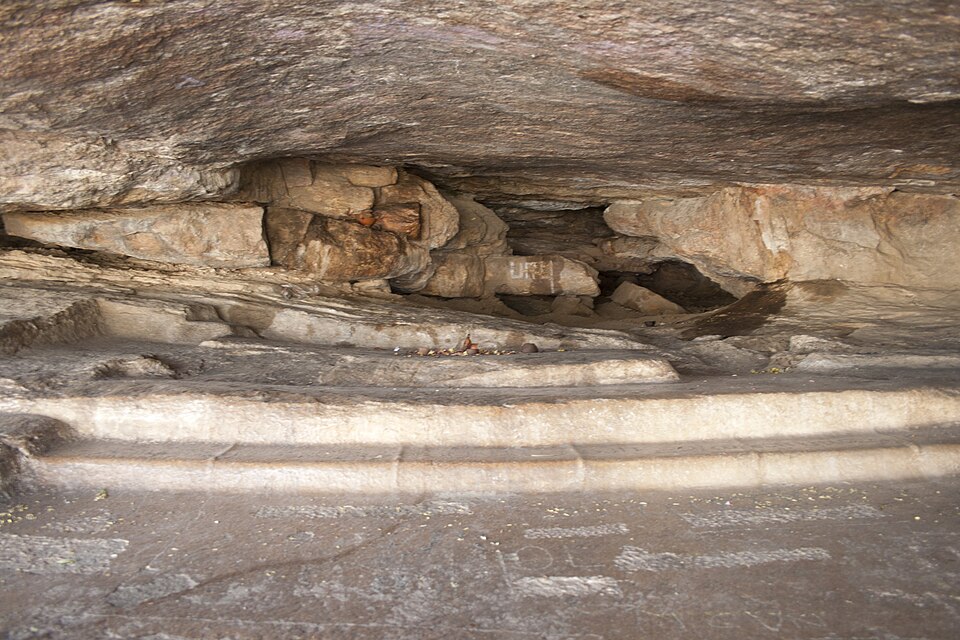
- Two almost identical Tamil-Brahmi inscriptions of about the second century CE at Pugalur, some ten miles north of Karur, record three generations of Chera rulers endowing a rock shelter for a Jain monk
- The three crowned kings and their seats: Chera at Vanchi-Karuvur, Chola at Uraiyur near Tiruchirappalli, Pandya at Madurai; their great ports were Muchiri, Puhar and Korkai
- Ashoka's major rock edicts refer to the Cheras as Keralaputra ('Kedalaputo'); Graeco-Roman sources (Pliny, the Periplus Maris Erythraei and Ptolemy) describe the Chera trade, calling them Keprobotras
- The Cheras controlled the Palakkad Gap and the Noyyal valley route linking the Malabar coast to eastern Tamil Nadu; their dynastic emblem was the bow and arrow
Study next
Common traps
- Assigning Madurai to the Cheras: it is the Pandya capital, and the two dynasties belong to the same triad, which is what makes the swap so easy
- Assuming Kanchipuram is Sangam-age because it is an ancient Tamil city; it is the Pallava capital of a later period
- Rejecting an option because of unfamiliar transliteration: Karuvur, Karur and Vanchi all refer to the same place
BPSC asks ancient south Indian history as a single pairing (dynasty to capital, ruler to title, emblem to family) and fills the options with the neighbouring dynasties' capitals, so partial knowledge is punished rather than rewarded. UPSC prefers the evidence and the connections: which Ashokan edicts name the southern kingdoms, whether a statement about Chola expansion overseas is true, which dynasty built which monument, so the same names have to be attached to sources and sites rather than to a list.
Related PYQs
The Asokan major rock edicts which tell us about the Sangam Kingdom include rock edicts
- (a) I and X
- (b) I and XI
- (c) II and XIII
- (d) II and XIV
Answer(c) II and XIII
The external evidence for the same dynasty: Ashoka's edicts name the Cholas, Pandyas, Satiyaputras and Keralaputras, the Keralaputras being the Cheras whose capital this question asks for.
Consider the following statements: 1. The Cholas defeated Pandya and Chera rulers and established their domination over peninsular India in early medieval times. 2. The Cholas sent an expedition against the Sailendra empire of South-East Asia and conquered some of the areas. Which of these statements is/are correct?
- (a) Only 1
- (b) Only 2
- (c) Both 1 and 2
- (d) Neither 1 nor 2
Answer(c) Both 1 and 2
The same three crowned kings, followed forward in time: the rivalry of Chera, Chola and Pandya that begins in the Sangam age ends with Chola supremacy over both the others.
Match List I with List II List-I List-II Event/Place Connected with Person a) Chola Gangam Lake 1) Chandragupta Maurya b) Appointment of Dharma Mahamatra 2) Harshavardhan c) Assembly at Prayag 3) Rajendra I d) Sudarshan Lake 4) Ashoka Select the correct answer using the codes given below : a b c d
- (a) 3 4 2 1
- (b) 1 4 2 3
- (c) 3 4 1 2
- (d) 2 3 1 4
Answer(a) 3 4 2 1
The same place-to-dynasty discipline one edition later, with a south Indian entry of its own: Chola Gangam, the lake Rajendra I dug beside his new capital, which is the Chola counterpart of Karur in the Chera story.
Practice
- practice, not a real PYQ
Uraiyur, near present-day Tiruchirappalli, was the early capital of which Sangam-age dynasty ?
- (a)Chera
- (b)Chola
- (c)Pandya
- (d)Pallava
Answer(b) Chola: Uraiyur was the Chola inland capital, with Puhar (Kaveripumpattinam) as its port; the Cheras were at Vanchi-Karuvur and the Pandyas at Madurai. - practice, not a real PYQ
The bow and arrow was the dynastic emblem of which of the following ?
- (a)Cholas
- (b)Pandyas
- (c)Cheras
- (d)Pallavas
Answer(c) Cheras: the bow and arrow appears on their coins found at Karur; the tiger was the Chola emblem and the fish the Pandya emblem.