
Which of the following is an iron ore ?
- (a)Bauxite
- (b)Cinnabar
- (c)Pyrite
- (d)Limonite
Answer
Why
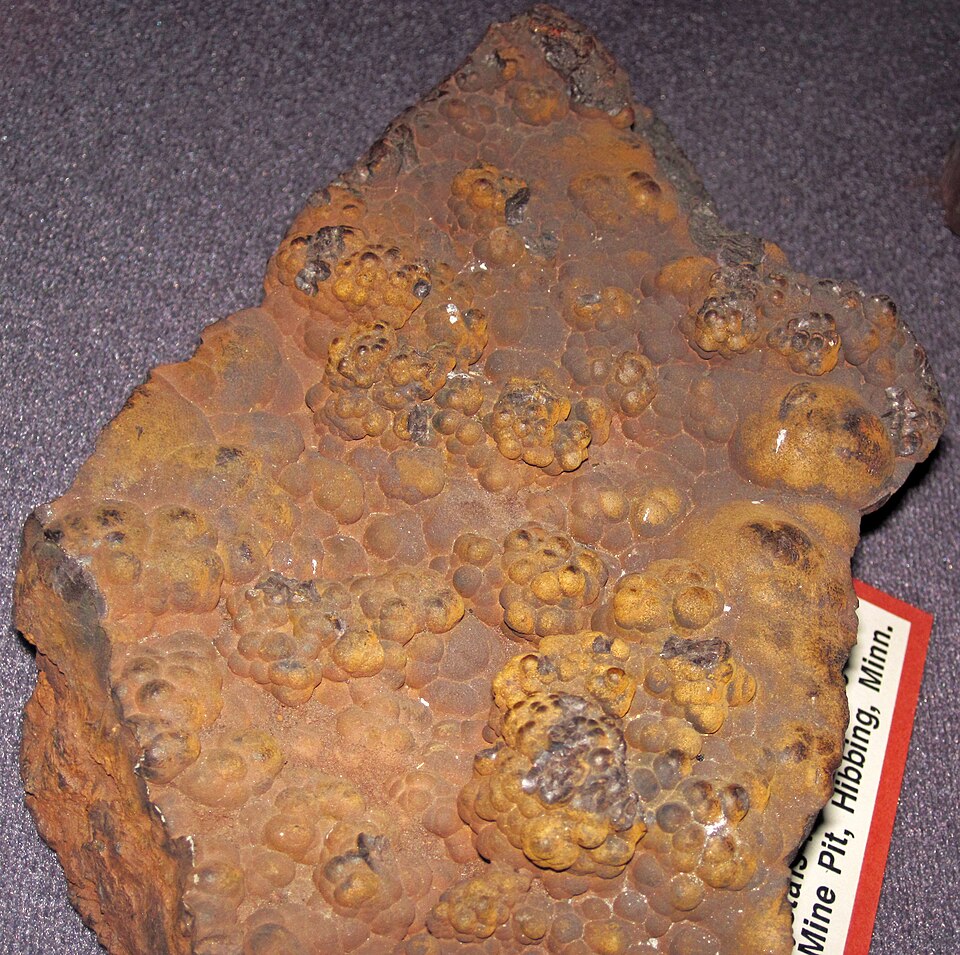
Correct: D, Limonite. Limonite is a hydrated iron oxide, written FeO(OH)·nH₂O, and it is one of the three principal ores from which iron has actually been smelted (the other two being haematite and magnetite) a use documented from at least 400 BC. Strictly, modern mineralogy no longer treats limonite as a single mineral species at all: it is a field name for an intergrown mixture of hydrated iron oxides (goethite, lepidocrocite, akaganeite and jarosite) and telling the components apart needs X-ray diffraction. Its field identifiers are all iron identifiers. It is medium to dark yellowish-brown, it occurs in earthy, concretionary, botryoidal or stalactitic masses rather than in crystals, and it leaves a yellowish-brown streak on unglazed porcelain, which is precisely how a geologist separates it from haematite, whose streak is red, and magnetite, whose streak is black. The name itself records how it forms: 'limonite' is from the Greek leimṓn, 'wet meadow', because it precipitates as bog iron ore in marshes where iron-rich groundwater meets air. It is also the everyday product of iron weathering: the rust on a gate, the brown stain down a rock face and the brown iron cap of a laterite profile are all limonite. In the four-fold classification of iron ores used across Indian geography teaching (magnetite, haematite, limonite, siderite) limonite is squarely on the list, and none of the other three options is.
Why the others are wrong
- (a)Bauxite: Bauxite is the world's main source of aluminium and gallium: a sedimentary rock built mostly from the aluminium minerals gibbsite Al(OH)₃, boehmite and diaspore. It is a real trap because bauxite is dull reddish-brown, and that colour comes from the iron oxides goethite and haematite mixed into it as impurities. But the metal it is worked for is aluminium. The French geologist Pierre Berthier described it at Les Baux in Provence in 1821, and the name bauxite was established from that locality in 1861.
- (b)Cinnabar: Cinnabar is mercury(II) sulphide, HgS, and is the principal ore of mercury. It is unmistakable in a specimen tray (cochineal-red, adamantine, a scarlet streak, Mohs hardness only 2 to 2.5, and an extraordinary specific gravity of about 8.2) and it is the mineral source of the vermilion pigment. It contains no iron whatsoever, so it cannot be an iron ore under any reading.
- (c)Pyrite: The one option that can talk a strong candidate out of the right answer. Pyrite genuinely is an iron mineral: FeS₂, iron(II) disulphide, the most abundant sulphide mineral on Earth. But it is not worked for its iron: the sulphur is the point, and pyrite has been weathered, leached and roasted since the 15th century to make copperas and sulphuric acid, becoming the dominant sulphuric-acid feedstock by the 19th century. Its brass-yellow metallic lustre earned it the name fool's gold. Fittingly, weathering converts pyrite crystals into limonite pseudomorphs: the two minerals are chemically linked, but only one goes to the blast furnace.
Concept
An ore is not simply a mineral that contains a metal. A mineral is called an ore only when the metal can be won from it at a profit and in a form industry can actually use, which turns on grade, ease of reduction and what impurities ride along. Iron makes the distinction sharply. The four minerals taught as iron ores are magnetite (Fe₃O₄, which works out to about 72% iron by formula weight), haematite (Fe₂O₃, about 70%), limonite (hydrated iron oxide, variable and lower) and siderite (FeCO₃, about 48%). Three are oxides and one a carbonate, and every one of them reduces cleanly with carbon in a blast furnace. Pyrite carries more iron per tonne than siderite does, yet it is not on the list, because it is a sulphide: sulphur carried into steel makes the metal crack when worked hot, and driving it off costs more than the iron recovered is worth. So pyrite is mined for sulphur, and any iron is a by-product.
Two moves settle this without recalling a list. First, strike out the options by metal: bauxite is the standard ore of aluminium and cinnabar the standard ore of mercury, so neither is competing for iron at all. That leaves two iron-bearing minerals, limonite and pyrite. Second, ask which of the two is actually smelted for iron, and here the chemistry decides. Blast-furnace iron comes from oxides and carbonates, and limonite is an oxide; pyrite is a sulphide and belongs on the sulphur list, not the iron list. The trap is a genuine one rather than a careless one. Pyrite has iron in its formula, is named after iron in every textbook as 'iron pyrites', and a candidate reasoning purely from chemistry will read FeS₂ and tick (c). What the examiner is testing is the economic definition of an ore, not the presence of an element. Note also that the stem says 'an iron ore', not 'the chief iron ore', so it is not asking for haematite or magnetite; it is asking which of these four belongs to the family at all.
Key facts
- Limonite is FeO(OH)·nH₂O: now treated as a field term for a mixture of hydrated iron oxides (goethite, lepidocrocite, akaganeite, jarosite) rather than one mineral species; it forms as bog iron ore in marshes and as the iron cap of laterite profiles.
- Streak test on unglazed porcelain separates the three iron oxides at a glance: limonite yellowish-brown, haematite red, magnetite black.
- Iron content by formula weight of the four classic iron ores: magnetite Fe₃O₄ about 72%, haematite Fe₂O₃ about 70%, siderite FeCO₃ about 48%, limonite variable and lower because of its water content.
- Pyrite FeS₂ is the most abundant sulphide mineral and the original 'fool's gold'; its name is from Greek pyritēs lithos, 'stone which strikes fire', because it sparks against steel. It has been the feedstock for copperas and sulphuric acid for centuries.
- Bauxite was named in 1821 by Pierre Berthier after Les Baux, Provence; cinnabar HgS has a scarlet streak and a specific gravity of about 8.2, among the heaviest of common minerals.
- Bihar has no working iron-ore field of its own: the Singhbhum iron belt of the old undivided Bihar, including the Tata Steel mine at Noamundi, has lain in Jharkhand since the reorganisation of 2000.
Study next
Common traps
- Picking pyrite because FeS₂ visibly contains iron. An ore is defined by what is economically extracted from it, and pyrite is extracted for sulphur; its sulphur is precisely what disqualifies it as an iron feed.
- Reading bauxite's rusty-red colour as iron content worth mining. The redness is a goethite-and-haematite impurity in what is otherwise an aluminium hydroxide rock.
- Confusing limonite with laterite. Limonite is a mineral aggregate; laterite is a weathered soil-and-rock profile in which limonite is commonly the iron-bearing component.
BPSC keeps this at the one-line identification level: 'which of the following is an iron ore', 'cinnabar is the ore of which metal', and rewards a memorised mineral-to-metal list you can run in a few seconds. UPSC almost never asks it bare: it wraps the same knowledge inside a matching list (mineral to element, or ore to producing State) or inside a process question about what happens in a blast furnace, so the same fact has to be usable in more than one direction.
Related PYQs
Match List I (Naturally occurring substances) with List II (Elements) and select the correct answer using the codes given below the Lists: List I I. Diamond II. Marble III. Sand IV. Ruby List II A) Calcium B) Silicon C) Aluminium D) Carbon Codes:
- (a) I-C, II-A, III-B, IV-D
- (b) I-D, II-B, III-A, IV-C
- (c) I-B, II-A, III-C, IV-D
- (d) I-D, II-A, III-B, IV-C
Answer(d) I-D, II-A, III-B, IV-C
Exactly the same skill, set out as a matching list: read a naturally occurring mineral or substance and name the element it actually yields: ruby to aluminium here, limonite to iron in the BPSC stem.
Consider the following statements: Coke is one of the materials of the charge added to blast furnace for the production of steel/iron. Its function is to I. Act as a reducing agent. II. Remove silica associated with the iron ore. III. Function as fuel, to supply heat. IV. Act as an oxidizing agent. Of these statements:
- (a) I and II are correct
- (b) II and IV are correct
- (c) I and III are correct
- (d) III and IV are correct
Answer(c) I and III are correct
The other half of the same idea: what an iron ore is FOR. Coke reduces the iron oxide of the charge to metal, which is why the ores of iron are oxides such as limonite and haematite, and why a sulphide like pyrite is not sent to the furnace.
Which of the following statements is correct?
- (a) Natural gas is found in Dharwar rock formation.
- (b) Mica is found in Kodarma.
- (c) Cuddapah series is famous for diamonds.
- (d) Petroleum reserves are found in Aravalli hills.
Answer(b) Mica is found in Kodarma.
The 69th tested the same mineral vocabulary one year earlier, with the four options each pairing a named mineral to a geological setting: the identification habit this 70th question rewards, applied to occurrence rather than to metal.
Practice
- practice, not a real PYQ
Cinnabar is the principal ore of which one of the following metals ?
- (a)Zinc
- (b)Lead
- (c)Mercury
- (d)Antimony
Answer(c) Mercury: cinnabar is mercury(II) sulphide, HgS, the mineral source of both metallic mercury and the vermilion pigment. Zinc comes from sphalerite (ZnS) and lead from galena (PbS). - practice, not a real PYQ
Which one of the following iron ores has the highest iron content by formula weight ?
- (a)Siderite
- (b)Limonite
- (c)Haematite
- (d)Magnetite
Answer(d) Magnetite: Fe₃O₄ works out to roughly 72% iron, just ahead of haematite's Fe₂O₃ at about 70%; siderite FeCO₃ is about 48% and limonite is lower still because of its bound water.