
In the universe, what are pulsars?
- (a)A group of stars
- (b)Rotating neutron stars
- (c)Explosion of a star
- (d)Radio waves emitted by a star
Answer
Why
Correct: B, Rotating neutron stars. A pulsar is a rapidly spinning, intensely magnetised neutron star, and each part of that description does real work. When a star of roughly eight to twenty-five solar masses exhausts its nuclear fuel, its iron core collapses in a supernova until neutron degeneracy pressure halts the fall; what survives is a neutron star of about 1.4 solar masses compressed into a sphere some 20 km across, at a density of the order of 10^17 kg per cubic metre: a teaspoonful would weigh around a billion tonnes at the Earth's surface. Two conservation laws then produce the pulsing. Angular momentum is conserved as the core shrinks from a stellar radius to ten kilometres, so a rotation that took days speeds up to seconds or even milliseconds; magnetic flux is conserved as well, so the surface field is amplified to something of the order of 10^8 to 10^12 gauss. Because the magnetic axis is generally tilted away from the rotation axis, charged particles accelerated along the magnetic poles radiate in two narrow beams that swing round with the star, and each time a beam crosses the Earth we record a pulse. That is the standard 'lighthouse model', and it explains why the emission is periodic without the star itself changing at all. The pulse train is extraordinarily regular: known periods run from about 1.4 milliseconds for the fastest millisecond pulsars up to several seconds, and the steadiest of them keep time to a precision comparable with an atomic clock. The first was found in November 1967 by Jocelyn Bell Burnell, then a research student at Cambridge, in chart-recorder traces from Antony Hewish's Interplanetary Scintillation Array; the 1.337-second signal was half-jokingly labelled LGM-1, for 'Little Green Men', before its natural origin was established, and it is catalogued today as PSR B1919+21: PSR standing for Pulsating Source of Radio. A pulsar is therefore an object, a physical star with a surface, and not a light show, a burst, or a beam.
Why the others are wrong
- (a)A group of stars: That describes a star cluster or a constellation, not a pulsar. An open cluster such as the Pleiades holds a few hundred young stars loosely bound together; a globular cluster such as Omega Centauri holds hundreds of thousands of old ones in a dense sphere. There is a real connection worth knowing (globular clusters are the richest hunting grounds for millisecond pulsars, because their crowded cores let a neutron star capture a companion and be spun up by accretion) but the cluster is the group and the pulsar is a single star within it.
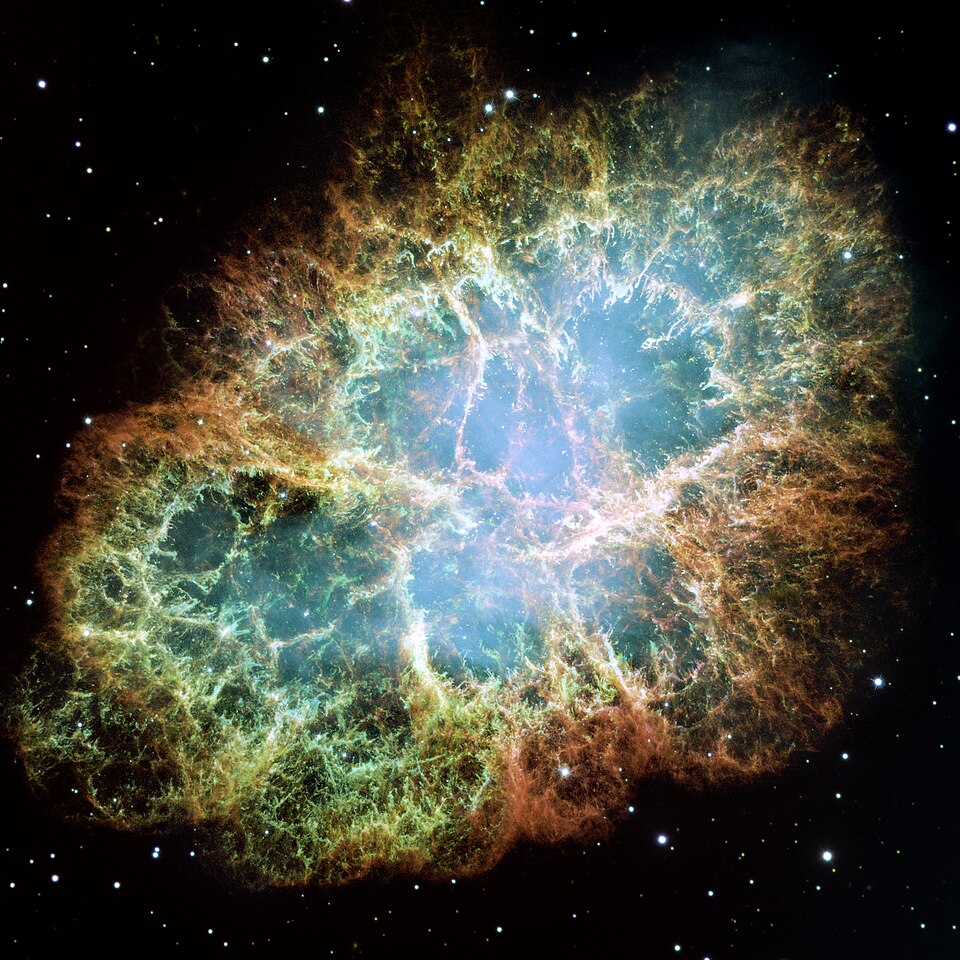
- (c)Explosion of a star: That is a nova or a supernova, and the confusion is a reasonable one, because a pulsar is exactly what a core-collapse supernova leaves behind. The Crab Pulsar sits at the centre of the Crab Nebula, the expanding debris of the supernova of AD 1054 that Chinese and Japanese observers recorded as a 'guest star'. But the explosion is a single event that fades over weeks and months, while the pulsar is the compact remnant that keeps spinning for millions of years afterwards.
- (d)Radio waves emitted by a star: The most tempting wrong answer, because pulsars were discovered in the radio band and radio telescopes are still the main instruments used to find them. It nevertheless confuses the signal with its source: the pulses are what we observe, and the pulsar is the star producing them. The point is sharpened by the fact that pulsars also shine in X-rays and gamma rays (the Fermi space telescope has catalogued hundreds of gamma-ray pulsars) while a few, such as Geminga, are essentially radio-quiet and were found in gamma rays alone.
Concept
A star's end state is decided by the mass left in its core once fusion stops. Below about 1.4 solar masses: the Chandrasekhar limit, worked out by S. Chandrasekhar in 1930: electron degeneracy pressure can hold the core up and a white dwarf results. Above that, electrons and protons are crushed together into neutrons and the collapse is arrested by neutron degeneracy pressure, giving a neutron star of some 10 km radius. Above roughly two to three solar masses even that fails and a black hole forms. Neutron stars therefore occupy the middle rung of stellar remnants, and a pulsar is simply a neutron star whose emission beam happens to sweep across the Earth; most neutron stars are not observed as pulsars because their beams point elsewhere. Sub-classes matter for prelims: millisecond pulsars are old neutron stars spun back up by matter accreted from a binary companion, and magnetars are neutron stars with fields up to about 10^15 gauss, the strongest magnets known in nature. Because their spin is so stable, pulsars are used as natural clocks: for testing general relativity, for mapping interstellar plasma, and even as a proposed navigation beacon system for deep-space craft.
The four options are not random: they are the four categories a candidate might slot 'pulsar' into (a group of objects, a single object, an event, and a form of radiation) and only one of them is right. The safest route is to fix the category first and only then the detail. A pulsar is a thing, not a happening, which eliminates (c), the explosion; and it is a body, not a signal, which eliminates (d), the radio waves. Between (a) and (b) the word itself helps: 'pulse' points to something that repeats regularly, and only a spinning single object can produce a metronomic beat, whereas a group of stars has no common clock at all. A second route is etymological: PSR, the catalogue prefix every pulsar carries, expands to Pulsating Source of Radio, which tells you that a pulsar is a source (an emitter) and therefore cannot itself be the emission described in option (d). Candidates who lose this question generally do so by remembering, correctly, that pulsars were discovered as regular radio pulses and then picking the option that describes the pulses rather than the star. The other frequent error is the pulsar-quasar slip, since a quasar really is defined by its radiation and lies at the heart of a distant galaxy rather than being a stellar remnant at all.
Key facts
- The first pulsar was detected in November 1967 by Jocelyn Bell Burnell, a research student at Cambridge, using Antony Hewish's Interplanetary Scintillation Array; the 1.337-second source was nicknamed LGM-1 and catalogued as PSR B1919+21. The 1974 Nobel Prize in Physics went to Hewish and Martin Ryle, not to Bell Burnell.
- Typical parameters: about 1.4 solar masses inside a sphere roughly 20 km across, density of the order of 10^17 kg per cubic metre, surface magnetic fields of 10^8 to 10^12 gauss and up to about 10^15 gauss for magnetars.
- Rotation periods range from about 1.4 milliseconds for the fastest millisecond pulsars to several seconds; millisecond pulsars are old neutron stars 'recycled' by accreting matter from a binary companion.
- The Crab Pulsar, PSR B0531+21, spins about thirty times a second at the centre of the Crab Nebula, which is the remnant of the supernova of AD 1054 recorded by Chinese and Japanese astronomers.
- The binary pulsar PSR B1913+16, found by Russell Hulse and Joseph Taylor in 1974, showed an orbital decay matching exactly the energy loss to gravitational waves predicted by general relativity, and earned the 1993 Nobel Prize in Physics. In India, the Giant Metrewave Radio Telescope near Pune, run by NCRA-TIFR with thirty steerable 45-metre dishes, is a leading pulsar-observing facility.
Study next
Common traps
- Confusing a pulsar with a quasar: a quasar is the extraordinarily luminous nucleus of a distant galaxy powered by a supermassive black hole, not a stellar remnant in our own galaxy
- Answering with the radiation instead of the object: the pulses are what a radio telescope records, while the pulsar is the star that produces them
- Equating the pulsar with the supernova that made it: the explosion is the event, the pulsar is what remains at its centre long afterwards
BPSC asks astrophysics as a bare one-line definition with four short options, and builds the distractors from neighbouring ideas (a group, an explosion, a radiation) so the entire question turns on identifying what kind of thing a pulsar is. UPSC almost never gives a naked definition; it wraps the same fact in a matching block, as in its 2023 'Cepheids / Nebulae / Pulsars' pairs where the pulsar entry was the only correctly matched one, or it asks for the physical reason behind a property, such as why a black hole lets no radiation escape.
Related PYQs
Consider the following pairs : Objects in space — Description 1. Cepheids : Giant clouds of dust and gas in space 2. Nebulae : Stars which brighten and dim periodically 3. Pulsars : Neutron stars that are formed when massive stars run out of fuel and collapse How many of the above pairs are correctly matched?
- (a) Only one
- (b) Only two
- (c) All three
- (d) None
Answer(a) Only one
Set in the same year and resting on exactly the same fact: the only correctly matched pair in the UPSC item is the one identifying pulsars as neutron stars left by the collapse of massive stars. UPSC packaged it as a pairing exercise; BPSC asked it straight.
A ‘black hole’ is a body in space which does not allow any radiation to come out. This property is due to its
- (a) very small size
- (b) very large size
- (c) very high density
- (d) very low density
Answer(c) very high density
The next rung of the same ladder. Both questions are about compact stellar remnants and both are won by reasoning from extreme density: the property that lets a neutron star spin in milliseconds and that lets a black hole hold light in.
Practice
- practice, not a real PYQ
The first pulsar was discovered in 1967 by:
- (a)Subrahmanyan Chandrasekhar
- (b)Edwin Hubble
- (c)Jocelyn Bell Burnell
- (d)Karl Jansky
Answer(c) Jocelyn Bell Burnell: then a research student at Cambridge, working with Antony Hewish's Interplanetary Scintillation Array; the source is catalogued today as PSR B1919+21, with a period of 1.337 seconds. - practice, not a real PYQ
A quasar differs from a pulsar in that a quasar is:
- (a)A rotating neutron star with a strong magnetic field
- (b)The extremely luminous nucleus of a distant galaxy, powered by a supermassive black hole
- (c)A dense cluster of newly formed stars
- (d)The explosion of a white dwarf in a binary system
Answer(b) The extremely luminous nucleus of a distant galaxy, powered by a supermassive black hole: option (a) defines a pulsar and option (d) describes a Type Ia supernova.