
What is the ‘fibre’ used to make bulletproof jackets?
- (a)Nylon
- (b)Terylene
- (c)Tweed
- (d)Kevlar
Answer
Why
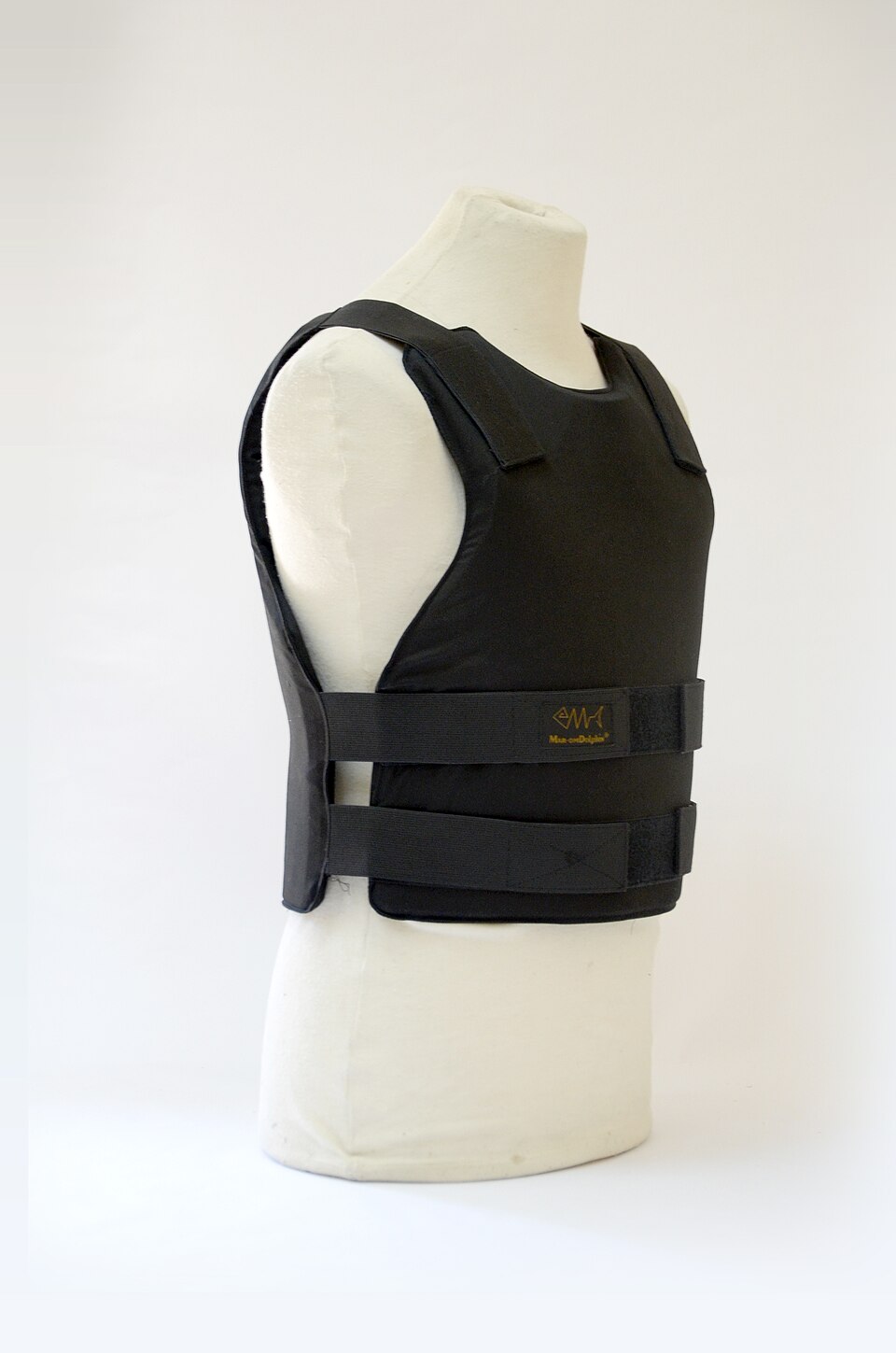
Correct: D, Kevlar. Kevlar is DuPont's trade name for a para-aramid (poly(p-phenylene terephthalamide), repeat unit [-CO-C6H4-CO-NH-C6H4-NH-]n) developed by Stephanie Kwolek at DuPont in 1965 and sold in its modern form from 1971. Two structural features make it ballistic. Its backbone is aromatic and the amide links sit in the para position, so the chains are stiff and rod-like and align almost perfectly along the fibre axis when the liquid-crystalline dope is spun; and the amide groups hydrogen-bond sideways between neighbouring chains, locking them into sheets. The spun fibre reaches a tensile strength of about 3,000 MPa and, weight for weight, is roughly five times stronger than steel, and it does not melt: it decomposes. That combination is what a soft vest needs, because a bulletproof jacket is not a plate but many layers of woven Kevlar cloth: the round is caught by the crossing yarns, its energy is spread across a wide area of fabric and used up stretching them, and the bullet is deformed and decelerated instead of punching through. DuPont sells grades made for exactly this (K129 (higher tenacity for ballistic use) and K149 (highest tenacity, for armour and aerospace)) alongside industrial K29 and high-modulus K49 for cables and ropes. The same fibre goes into helmets, cut-resistant gloves, racing tyres, sails, mooring lines and brake linings. Twaron, developed by Akzo in the 1970s and in commercial production from 1986, is the chemically identical para-aramid competitor.
Why the others are wrong
- (a)Nylon: The most defensible wrong answer. Nylon is the aliphatic polyamide Wallace Carothers developed at DuPont in the 1930s, and ballistic nylon genuinely was the fibre of the flak jackets that preceded modern body armour: the US National Institute of Justice programme that produced the police vest (Lester Shubin and Nicholas Montanarelli) was explicitly a project to replace nylon with Kevlar. But nylon's flexible aliphatic chain cannot pack and hydrogen-bond like a para-aramid, so its tenacity is a fraction of Kevlar's; nylon flak jackets stopped shell splinters, not bullets.
- (b)Terylene: Terylene is Imperial Chemical Industries' trade name for polyethylene terephthalate (PET) fibre: the polyester patented by John Rex Whinfield and James Tennant Dickson in 1941 and sold in the United States as Dacron after DuPont bought the rights in 1946. It is the crease-resistant apparel fibre blended with cotton and wool (terrycot, terrywool) and is chemically the same polymer as a drinking-water bottle. Strong enough for clothing; nowhere near a ballistic fibre.
- (c)Tweed: Tweed is not a fibre at all, which makes it the quickest elimination on the page. It is a rough woollen fabric of soft, open texture, woven in plain, twill or herringbone patterns and associated with Scottish and Irish outerwear (Harris Tweed). The stem asks for a fibre; tweed names a cloth, and the wool it is woven from is a natural protein fibre with no ballistic application whatever.
Concept
Fibres are classified first as natural (cotton, wool, silk, jute) or man-made, and man-made fibres again as regenerated (rayon, made from cellulose) or fully synthetic (polyamides, polyesters, acrylics, polyolefins). What separates an ordinary synthetic from a ballistic one is specific strength (strength divided by density) together with a high modulus and the ability to absorb energy in microseconds. Ordinary polymer chains are coiled and flexible, so a fibre spun from them stretches easily. High-performance fibres are built from chains that are stiff, extended and packed in register: para-aramids such as Kevlar and Twaron, ultra-high-molecular-weight polyethylene such as Dyneema and Spectra, and PBO (Zylon). Aramid simply means aromatic polyamide; the para isomer gives the straight rod-like chain Kevlar needs, while the meta isomer gives Nomex, which is not ballistic but is flame-resistant and is used for firefighters' and racing drivers' suits. Hard armour meant to stop rifle rounds is a different construction again: a ceramic strike face of boron carbide or alumina, backed by an aramid or polyethylene composite.
Sort the four options by category before weighing any of them for strength. Tweed is a fabric, not a fibre, so it fails the stem's own wording and goes first. Terylene is a polyester made for clothing, where the design goal is crease resistance and blendability, not energy absorption. That leaves two polyamides, and this is where the question is actually decided, because nylon is not a throwaway option: it has a real ballistic history. The single fact that discriminates is aromatic versus aliphatic. Kevlar's benzene rings and para-linked amides give a rigid rod that packs into hydrogen-bonded sheets and reaches about 3,000 MPa; nylon's flexible aliphatic chain cannot. If only names come back to you in the hall, hold the pairing the examiners keep using: Kevlar for bullets, Nomex for fire, Terylene for shirts, tweed for a jacket. One more distinction is worth carrying, because it is a separate question in disguise: bullet-resistant glazing is not a fibre problem at all. That is laminated polycarbonate sheet, so a question about bullet-proof glass and a question about a bulletproof jacket have different right answers.
Key facts
- Kevlar is a para-aramid (poly(p-phenylene terephthalamide)) developed by Stephanie Kwolek at DuPont in 1965; modern Kevlar was introduced by 1971 and first used commercially in the early 1970s as a steel replacement in racing tyres.
- Spun Kevlar fibre has a tensile strength of about 3,000 MPa and is roughly five times stronger than steel on a strength-to-weight basis; it does not melt but decomposes, and ultraviolet light degrades it, so it is rarely used outdoors unprotected.
- DuPont's ballistic grades are Kevlar K129 (higher tenacity for ballistic applications) and K149 (highest tenacity, for ballistic, armour and aerospace use); K29 is the general industrial grade and K49 the high-modulus cable and rope grade.
- Before Kevlar, flak jackets were made of ballistic nylon and offered far more limited protection; the modern concealable vest came out of a US National Institute of Justice effort in which Lester Shubin and Nicholas Montanarelli proposed substituting Kevlar for nylon.
- Twaron (Akzo, developed in the 1970s, commercial production from 1986, now made by Teijin Aramid) is a chemically identical para-aramid; Nomex is the meta-aramid sibling, used for flame-resistant rather than ballistic protection.
Study next
Common traps
- Choosing nylon because it is also a polyamide and did historically go into flak jackets: the modern ballistic fibre is the aromatic polyamide (aramid), not the aliphatic one
- Treating tweed as a fibre; it is a woven woollen fabric, and the stem's word 'fibre' rules it out before any chemistry is needed
- Mixing up the two aramids: Kevlar (para-aramid) is for ballistic protection, Nomex (meta-aramid) is for flame resistance, and bullet-resistant glass is polycarbonate, not a fibre at all
BPSC and most State PCS papers ask this as one-line trade-name recall: 'which fibre/polymer is used for X', and load the options with one plausible polymer and one item that is not even a fibre, so the marks go to whoever classifies before recalling. UPSC prefers the property route: statements on polyethylene terephthalate (2022), carbon fibres (2023), or bisphenol A and polycarbonate (2021), where knowing the brand name is worth nothing and knowing what the material actually does is worth everything.
Related PYQs
With reference to polyethylene terephthalate, the use of which is so widespread in our daily lives, consider the following statements: 1. Its fibres can be blended with wool and cotton fibres to reinforce their properties. 2. Containers made of it can be used to store any alcoholic beverage. 3. Bottles made of it can be recycled into other products. 4. Articles made of it can be easily disposed of by incineration without causing greenhouse gas emissions. Which of the statements given above are correct?
- (a) 1 and 3
- (b) 2 and 4
- (c) 1 and 4
- (d) 2 and 3
Answer(a) 1 and 3
The same fibre-identification skill applied to the very polymer behind this question's distractor: polyethylene terephthalate is Terylene, and UPSC tests it exactly where BPSC tests Kevlar: by asking what the fibre can and cannot actually do.
Bisphenol A (BPA), a cause of concern, is a structural/key component in the manufacture of which of the following kinds of plastics?
- (a) Low-density polyethylene
- (b) Polycarbonate
- (c) Polyethylene terephthalate
- (d) Polyvinyl chloride
Answer(b) Polycarbonate
Match the polymer to the application, the same skill this question needs, and it names the material behind the distinction worth remembering here, since bullet-resistant glazing is laminated polycarbonate while a bulletproof jacket is woven para-aramid.
Practice
- practice, not a real PYQ
Kevlar, the fibre used in bulletproof jackets, is chemically classified as
- (a)a polyester
- (b)a para-aramid (aromatic polyamide)
- (c)a polyolefin
- (d)an acrylic fibre
Answer(b) a para-aramid (aromatic polyamide): poly(p-phenylene terephthalamide); the aromatic, para-linked backbone gives the rigid, hydrogen-bonded structure that ordinary aliphatic polyamides such as nylon lack. - practice, not a real PYQ
‘Terylene’ is the trade name of a synthetic fibre made from
- (a)polyethylene terephthalate
- (b)polyacrylonitrile
- (c)hexamethylenediamine and adipic acid
- (d)regenerated cellulose
Answer(a) polyethylene terephthalate: the polyester patented by Whinfield and Dickson in 1941 and marketed by ICI as Terylene and by DuPont as Dacron; option (c) describes nylon-6,6 and option (d) rayon.