
Which city served as the capital of the ancient kingdom of Magadha during the early Vedic period?
- (a)Rajagriha
- (b)Campa
- (c)Vaishali
- (d)Pataliputra
Answer
Why
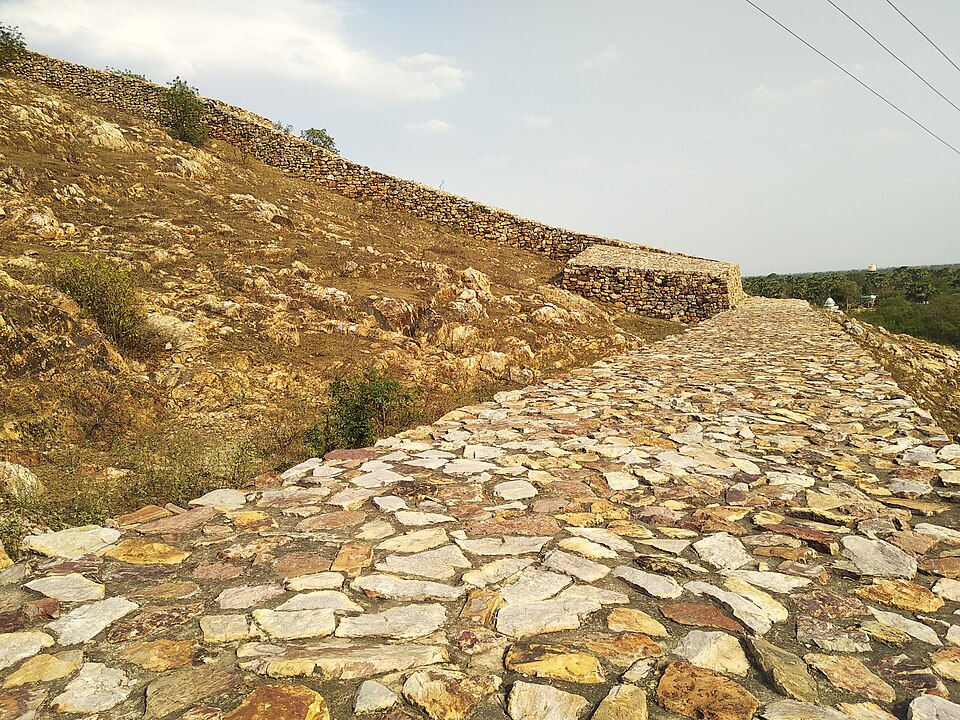
Correct: A, Rajagriha. Magadha's first capital was Girivraja, the fortified settlement the Pali and Prakrit texts call Rajagaha or Rajagriha: modern Rajgir in Nalanda district, Bihar, about 100 km south-east of Patna. The old town lies inside a ring of five hills (Vaibhara, Vipula, Ratna, Udaya and Sona) behind a cyclopean wall of large undressed stone blocks laid without mortar, running along the ridge lines for a length usually given as about 40 km; it is among the oldest surviving fortifications anywhere in India and is protected by the Archaeological Survey of India. Every strand of the tradition puts Magadha's earliest royal seat here. The Mahabharata makes Girivraja the capital of Jarasandha of the Brihadratha line. The Buddhist canon has Bimbisara (c. 544–492 BCE) and then Ajatashatru (c. 492–460 BCE) of the Haryanka dynasty ruling from Rajagaha, and it is at Rajagriha, in the Sattapanni cave, that the First Buddhist Council met soon after the Buddha's death under Ajatashatru's patronage. The seat of government moved only in the following generation: Ajatashatru had fortified the village of Pataligrama on the Ganga as a forward base against the Vajjis, and his successor Udayin turned that fort into Pataliputra and shifted the capital there in the 5th century BCE. So on any reading of 'earliest', Rajagriha is Magadha's first capital and Pataliputra its second. One honesty note the card owes you: the stem's phrase 'early Vedic period' does not actually fit Magadha at all (see the note below) but it does not point at any other option either, and of the four cities offered, only Rajagriha was ever the capital of Magadha.
Why the others are wrong
- (b)Campa: Campa was the capital of Anga, not of Magadha: the neighbouring mahajanapada immediately to the east, in the Bhagalpur region of Bihar, named after the Champa river. Bimbisara's first recorded conquest was the annexation of Anga, which is the only reason Campa appears in Magadhan history at all; it entered the kingdom as a provincial city, never as its seat. Early Buddhist tradition lists Campa among the six great cities of the age, so the name is familiar enough to tempt a candidate who has not fixed which kingdom it belonged to.
- (c)Vaishali: Vaishali was the capital of the Vajji (Licchavi) confederacy: a gana-sangha, a republican-style state north of the Ganga in what is today Vaishali district, Bihar. It was Magadha's chief rival, not Magadha itself. Ajatashatru fought a long war to subdue the Vajjis and it was for that campaign that Pataligrama was fortified. The trap is geographic: Vaishali is an ancient capital, it is in Bihar, and it is roughly contemporary, but it belonged to somebody else.
- (d)Pataliputra: Pataliputra was indeed Magadha's capital, but the later one. Ajatashatru built the fort at Pataligrama; Udayin moved the government there in the 5th century BCE, and it remained the capital under the Shishunagas, the Nandas, the Mauryas from Chandragupta's accession around 322 BCE, and later the imperial Guptas. Because Pataliputra is the name almost every student attaches to Magadha, this is the most attractive wrong answer on the page: the single word 'early' in the stem is the whole discriminator.
Concept
Magadha was one of the sixteen mahajanapadas (the large territorial states of the sixth century BCE Ganga plain) and the one that eventually absorbed the rest. It covered south Bihar, roughly the modern Patna, Nalanda, Gaya, Jehanabad and Nawada belt, and its advantages were material rather than accidental: iron ore in the Rajgir–Gaya hills, war elephants from the forests to the south, the alluvial fertility of the middle Ganga, and control of the river routes that carried east–west trade. Four dynasties ran it in succession (Brihadratha (known mainly from epic tradition), Haryanka (Bimbisara, Ajatashatru, Udayin), Shishunaga and Nanda) before Chandragupta Maurya took Pataliputra around 322 BCE. Its capital moved once, and the move is itself the story: from Girivraja/Rajagriha, a defensible seat locked inside a hill ring, to Pataliputra at the confluence of the Ganga and Son, a river capital positioned to project power outward. A hill kingdom became a river empire.
Two moves settle this question. First, discard the cities that were never Magadhan: Campa belonged to Anga and Vaishali to the Vajjis. Both are in Bihar, both are famous, and that is exactly why they are on the page. Second, choose between Magadha's two genuine capitals on the word 'early': Rajagriha came first, Pataliputra second, and the handover happened under Udayin, two reigns after Bimbisara. That single sequencing fact is the whole discriminator.
The stem's own framing is the weak part, and it is better named than glossed over. 'Early Vedic period' means the Rigvedic age, conventionally about 1500–1000 BCE, whose geography is the Sapta Sindhu (the Indus system and the Punjab) not the middle Ganga. The Rigveda does not know Magadha; the Magadhas are named only in the later Vedic corpus, and Magadha as a kingdom with a capital is an early-historic fact of the sixth century BCE. Strictly, then, there was no 'capital of Magadha in the early Vedic period', because there was no Magadha then. What saves the question is that the looseness costs the candidate nothing: read 'early' as 'earliest' and exactly one option survives. That is also why we mark our confidence here as medium rather than high: the letter is not in doubt, the period label in the stem is.
Key facts
- Rajagriha = Girivraja = modern Rajgir, Nalanda district, Bihar, about 100 km from Patna; the old city sits inside a ring of five hills (Vaibhara, Vipula, Ratna, Udaya and Sona) behind a mortarless cyclopean stone wall along the ridges, commonly measured at about 40 km
- Haryanka rulers at Rajagriha: Bimbisara c. 544–492 BCE, then Ajatashatru c. 492–460 BCE; the capital shifted to Pataliputra under Ajatashatru's successor Udayin in the 5th century BCE
- Campa was the capital of Anga (Bhagalpur region) and was annexed by Bimbisara: Magadha's first recorded conquest; Vaishali was the seat of the Vajji/Licchavi confederacy and was annexed by Ajatashatru
- The First Buddhist Council was held at Rajagriha in the Sattapanni cave shortly after the Buddha's parinirvana, convened under Ajatashatru and presided over by Mahakassapa
- Pataliputra stayed the capital under the Shishunagas, Nandas, Mauryas (from Chandragupta Maurya, c. 322 BCE) and the imperial Guptas: roughly a thousand years as the seat of north Indian power
- The Rigveda does not name Magadha; the Magadhas appear only in later Vedic literature, and Magadha as a mahajanapada belongs to the sixth century BCE, which is why the stem's 'early Vedic period' is anachronistic
Study next
Common traps
- Taking 'early Vedic period' literally and hunting for a Rigvedic city: Magadha is not a Rigvedic kingdom, and the phrase is best read as 'earliest'
- Choosing Pataliputra because it is the capital everyone associates with Magadha: it is the later capital, from Udayin onwards
- Assuming Vaishali or Campa must be Magadhan because both are ancient capitals inside modern Bihar: they belonged to the Vajjis and to Anga respectively
BPSC asks this as a single-fact item about the antiquity of Bihar's own soil (which city, which district, which ruler founded it) and is often loose about period labels, as here. UPSC almost never asks 'name the capital'; it asks which kingdoms were associated with the Buddha's life, or gives a map with four mahajanapadas to identify, or probes the causes of Magadha's expansion. Learn the capitals as a list for BPSC and the geography plus the causal story for UPSC.
Related PYQs
Which of the following kingdoms were associated with the life of the Buddha? 1. Avanti 2. Gandhara 3. Kosala 4. Magadha Select the correct answer using the code given below.
- (a) 1, 2 and 3
- (b) 2 and 3 only
- (c) 1, 3 and 4
- (d) 3 and 4 only
Answer(d) 3 and 4 only
The same middle-Ganga political map. Answering it requires knowing that Magadha and Kosala were the sixth-century BCE kingdoms of the Buddha's world, and the sites that fix Magadha in that answer are Rajagriha and Nalanda, exactly the seat this BPSC question asks you to name.
Who among the following was not a contemporary of the other three?
- (a) Bimbisara
- (b) Gautama Buddha
- (c) Milinda
- (d) Prasenjit
Answer(c) Milinda
Tests the same chronology from the other end. Bimbisara ruled Magadha from Rajagriha alongside the Buddha and Prasenjit of Kosala in the sixth–fifth century BCE; Menander (Milinda) is four centuries later. Fixing Bimbisara at Rajagriha is what makes both questions easy.
Consider the following dynasties of Ancient India : 1) Shunga 2) Maurya 3) Kushana 4) Kanva Which of the following is the correct chronological order of their rule?
- (a) 2-1-4-3
- (b) 1-2-3-4
- (c) 2-3-1-4
- (d) 2-1-3-4
Answer(a) 2-1-4-3
BPSC returned to the same kingdom two years later, sequencing it in time rather than in space. The Mauryas, Shungas and Kanvas all ruled from Pataliputra (the capital Magadha moved to after Rajagriha) so both questions reward one habit: holding Magadha's order of succession, of seats and then of dynasties, as a single line.
Practice
- practice, not a real PYQ
Which ruler of Magadha shifted the capital from Rajagriha to Pataliputra?
- (a)Bimbisara
- (b)Ajatashatru
- (c)Udayin
- (d)Mahapadma Nanda
Answer(c) Udayin: Ajatashatru fortified Pataligrama as a base against the Vajjis, but it was his successor Udayin who moved the seat of government there and made it Pataliputra. - practice, not a real PYQ
Campa, listed among the great cities of the sixth century BCE, was the capital of which mahajanapada?
- (a)Anga
- (b)Vajji
- (c)Kosala
- (d)Vatsa
Answer(a) Anga: Campa, in the Bhagalpur region of Bihar, was Anga's capital; Bimbisara annexed Anga to Magadha, which is how Campa enters Magadhan history.