
The painting of ‘Bodhisattva Padmapani’ is located at
- (a)Bagh
- (b)Ellora
- (c)Ajanta
- (d)Badami
Answer
Why
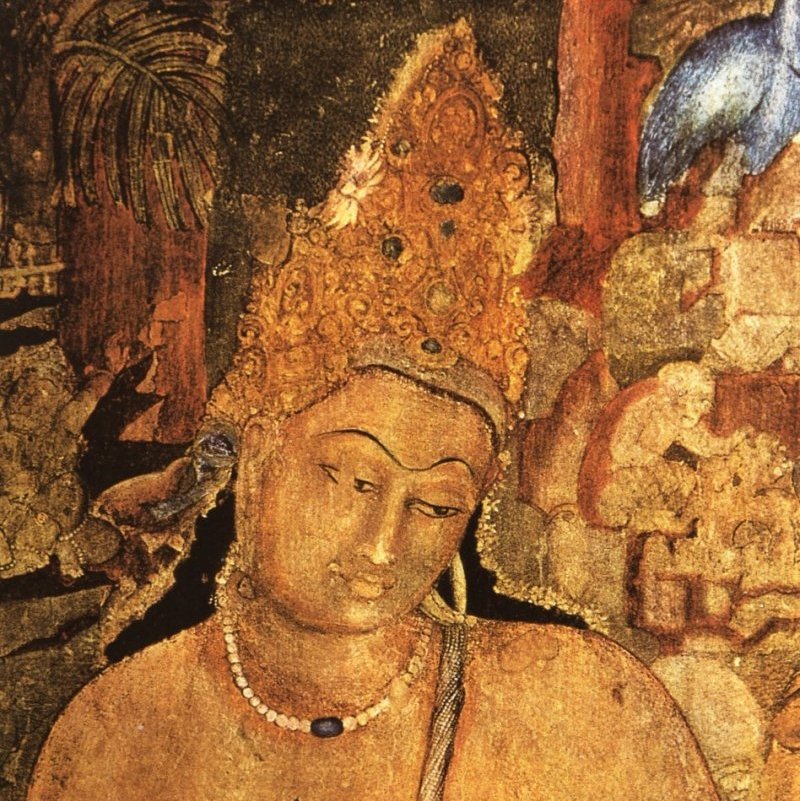
Correct: C, Ajanta. The Padmapani is painted on the rear-aisle wall of Cave 1 at Ajanta, on the left of the doorway that leads into the Buddha shrine; the matching over-lifesize figure of the Bodhisattva Vajrapani, holding the thunderbolt, stands on the right of the same doorway. The two are, by common consent, the most famous individual painted images at the site, and they belong to Ajanta's second building phase, the Vakataka work of roughly 460 to 480 CE carried out in the reign of Harishena, who ruled from 460 until his death in 477. Walter Spink, whose chronology of the caves is now the standard one, attributes Cave 1 to Harishena's own patronage, and reads the cave's choice of Jataka scenes: those telling of the Buddha's former lives as a king rather than as an animal: as fitting a royal donor. The figure itself is unmistakable once described: a tall, gently swaying bodhisattva, eyes lowered, wearing a jewelled crown and a pearl string across the chest, holding a blue lotus in the right hand. Padmapani means 'the lotus-bearer', and the lotus is the attribute by which the Mahayana identifies Avalokiteshvara, the bodhisattva of compassion. Technically the work is not true fresco: the Ajanta painters laid a gritty mud plaster on the rock, primed it with lime, and painted on the dried surface, which is why the murals are described as dry fresco. Cave 1, along with Caves 2, 16 and 17, carries the largest surviving body of ancient Indian wall painting anywhere. The caves (thirty of them, cut into the northern wall of a horseshoe gorge of the Waghur river in Aurangabad district of Maharashtra) have been on the UNESCO World Heritage list since 1983.
Why the others are wrong
- (a)Bagh: The one genuinely dangerous option, because Bagh is the other great surviving set of murals of the same age. Nine rock-cut monuments were cut into a sandstone face above the Baghani stream in Dhar district of Madhya Pradesh, of which five survive; Cave 4 is known as the Rang Mahal, the palace of colours, and the paintings were executed in tempera over a reddish-brown mud plaster with a lime priming, exactly as at Ajanta. But no Padmapani is among them, and since 1982 most of the surviving Bagh paintings have not even been at Bagh: they were detached for preservation and are displayed at the Gujari Mahal Archaeological Museum in Gwalior.
- (b)Ellora: Confused with Ajanta constantly, because the two sites lie about a hundred kilometres apart in the same district and are usually taught in the same breath. Ellora is later (its thirty-four open caves run from about 600 to 1000 CE) and it is above all a site of sculpture and architecture, with twelve Buddhist caves, seventeen Hindu and five Jain, crowned by Cave 16, the Kailasa temple, the largest monolithic rock excavation in the world. Ellora does preserve painted fragments, but they are post-Gupta, much decayed, and do not include the Padmapani.
- (d)Badami: Also a real cave site with real paintings, which is what makes it a usable distractor. The four cave temples at Badami (ancient Vatapi, the early Chalukya capital in Bagalkot district, Karnataka) include Cave 3, dated precisely by Mangalesha's old-Kannada inscription to the Shaka year 500, that is 578 or 579 CE, and preserving some of the earliest surviving coloured painting in Karnataka. But Badami's caves are Hindu, with Cave 4 given over to Jain figures, and their painted and carved subjects are Shaiva, Vaishnava and courtly. A Mahayana bodhisattva guarding a Buddha shrine does not belong there.
Concept
Padmapani is not a separate deity but a form of Avalokiteshvara, the bodhisattva of compassion and the most widely worshipped figure of Mahayana Buddhism, identified by the padma or lotus he carries. A bodhisattva, in Mahayana doctrine, is one who has earned nirvana but postpones it in order to help all beings across, which is why bodhisattva images multiply exactly as Mahayana devotionalism takes hold, and why they appear at Ajanta only in the later, fifth-century caves and not in the first, Satavahana-period group. The pairing at Cave 1 is deliberate and doctrinal: Padmapani, compassion, on one side of the shrine door, and Vajrapani, the holder of the thunderbolt and emblem of power, on the other, the two together flanking the Buddha within. Ajanta itself divides cleanly into two campaigns separated by more than three centuries. The earliest caves (9, 10, 12, 13 and 15A) belong to about 100 BCE to 100 CE under Satavahana patronage, and consist of chaitya-grihas with stupas and plain viharas, with almost no figurative sculpture. The whole of the rest of the site is Vakataka work of the late fifth century, and it is that second campaign which produced the celebrated painting. Excavation stopped abruptly: Spink's reading is that after Harishena's death in 477 the great patrons withdrew, minor donors squeezed small 'intrusive' shrines and images into gaps for a few years, and after about 480 not a single new image was made at the site.
Even a candidate who cannot picture the mural can reason to Ajanta in two steps. First, ask which of the four sites is Buddhist. Ellora is a shared site but is dominated by its Hindu excavations, and Badami is a Hindu and Jain complex of the early Chalukyas; a bodhisattva belongs to neither tradition's core programme. That leaves Ajanta and Bagh, both Buddhist and both painted. Second, ask which is famous for painting on this scale. Ajanta is the answer: Caves 1, 2, 16 and 17 hold the largest surviving corpus of ancient Indian mural painting, and there is a single discriminating fact that finishes the job: the surviving Bagh murals were physically removed from the caves in 1982 and are now in the Gujari Mahal museum at Gwalior, so no famous painting is currently 'located at' Bagh in the way the stem asks. It is also worth registering how this question came to be on a Bihar paper at all. UPSC asked the identical sentence in its 2017 prelims, with the same four options in a different order, and the answer was Ajanta then too. When an examiner recycles a stem this closely, the safest preparation is not to memorise the sentence but to know the site: the cave number, the flanking pair, the dynasty and the century.
Key facts
- Ajanta has thirty rock-cut Buddhist caves in the northern wall of a horseshoe gorge of the Waghur river, Aurangabad district, Maharashtra, and has been a UNESCO World Heritage Site since 1983.
- Two building phases: the Satavahana group (caves 9, 10, 12, 13 and 15A, about 100 BCE to 100 CE) and the Vakataka group, most of it cut between about 460 and 480 CE under Harishena (reigned 460–477).
- Padmapani and Vajrapani are over-lifesize bodhisattvas painted either side of the doorway to the Buddha shrine on the rear-aisle wall of Cave 1, the cave Spink attributes to Harishena's own patronage.
- The paintings are dry fresco: pigment applied to a dried, lime-primed mud plaster rather than into wet plaster; Caves 1, 2, 16 and 17 together preserve the largest surviving corpus of ancient Indian wall painting.
- Ajanta was brought to European notice on 28 April 1819, when Captain John Smith of the 28th Cavalry, on a tiger hunt, was led to the entrance of Cave 10 by a local shepherd boy, and scratched his name and the date across the chest of a painted Buddha on the thirteenth pillar inside.
- The comparison site: Bagh, in Dhar district of Madhya Pradesh, had nine rock-cut monuments of which five survive, painted in tempera; most of the surviving murals were detached in 1982 and moved to the Gujari Mahal Archaeological Museum, Gwalior.
- The site was known before 1819: several medieval Chinese Buddhist travellers mention Ajanta in their memoirs, and Faxian's record of about 400 CE indicates that pilgrims were still visiting the older caves during the three-century gap between the two building campaigns.
- Cave 1 was probably never brought into worship: there is no soot from butter lamps on the base of the shrine image and no wear on the garland hooks, the physical evidence Spink uses to argue that work stopped before the cave was consecrated.
Study next
Common traps
- Calling the Ajanta murals frescoes: they are painted on dried, lime-primed plaster, not into wet plaster, and are properly described as dry fresco
- Placing the Padmapani at Ellora because the two sites are neighbours and taught together; Ellora's fame rests on sculpture and on the monolithic Kailasa temple
- Assuming every Ajanta cave is of one date: the site has two campaigns more than three centuries apart, and the paintings that examiners ask about are almost all from the fifth-century Vakataka phase
BPSC asks it as a one-line locate-the-object question (name the site of a famous painting, a sculpture, an inscription) and it will reuse a UPSC stem when one exists, as it did here from 2017. UPSC prefers the comparative frame: which two sites preserve Gupta-age paintings, what is common to Ajanta and Mahabalipuram, which faiths share the caves at Ellora. Prepare the sites as a set with dates, dynasties and dominant medium, and both versions become answerable.
Related PYQs
The painting of Bodhisattva Padmapani is one of the most famous and oft-illustrated paintings at
- (a) Ajanta
- (b) Badami
- (c) Bagh
- (d) Ellora
Answer(a) Ajanta
The same question with the same four sites, set by UPSC six years before this Bihar paper reused it. Attempting it is the clearest possible demonstration that a state commission's art-and-culture section is often a straight lift from an earlier national paper.
There are only two known examples of cave paintings of the Gupta period in ancient India. One of these is paintings of Ajanta caves. Where is the other surviving example of Gupta paintings?
- (a) Bagh caves
- (b) Ellora caves
- (c) Lomas Rishi cave
- (d) Nasik caves
Answer(a) Bagh caves
The same set of sites approached from the other end: it asks which site pairs with Ajanta rather than which one holds the famous mural, and its answer, Bagh, is precisely the distractor that traps candidates on this 69th CCE question.
Practice
- practice, not a real PYQ
The famous murals of the Bodhisattvas Padmapani and Vajrapani flank the shrine doorway of which cave at Ajanta?
- (a)Cave 1
- (b)Cave 2
- (c)Cave 10
- (d)Cave 26
Answer(a) Cave 1: the two over-lifesize bodhisattvas are painted on the rear-aisle wall either side of the entrance to the Buddha shrine; Cave 10 belongs to the earlier Satavahana phase and Cave 26 is a late chaitya hall famous for its reclining Buddha. - practice, not a real PYQ
The rock-cut cave temples at Badami were excavated under the patronage of which dynasty?
- (a)Rashtrakuta
- (b)Vakataka
- (c)Early Chalukya
- (d)Pallava
Answer(c) Early Chalukya: Badami was Vatapi, their capital, and Cave 3 carries an old-Kannada inscription of Mangalesha dated to the Shaka year 500, that is 578–579 CE. The Rashtrakutas are associated with the Kailasa temple at Ellora and the Vakatakas with the later caves at Ajanta.