
Consider the following statements regarding the Vikramshila University in Bihar : 1. It was located in the present-day Banka district of Bihar. 2. It was established by King Gopala I of the Pala dynasty. 3. The ‘Vajrayana’ sect of Buddhism flourished here. 4. Other subjects like Astronomy, Logic, Law, Grammar and Philosophy were also taught here. Which of the above statements are incorrect ?
- (a)2 and 3
- (b)1 and 4
- (c)1 and 2
- (d)None of the above
Answer
Why
Correct: C, 1 and 2. Read the stem carefully: it asks which statements are INCORRECT, and exactly two of the four are. Statement 1 is wrong on the district. The Archaeological Survey of India's national list of Centrally Protected Monuments places the site under 'Bihar (Patna Circle)' as entry 2: 'Ancient site of Vikramasila Monastery (Locality: Antichak) District: Bhagalpur.' Bhagalpur, not Banka. The mistake is a natural one and worth understanding rather than merely memorising: Banka's own district administration records that 'this district was established on 21st February, 1991. Prior to this, it was a subdivisional town of Bhagalpur', carved out of the parent district after the 1991 Census. So Banka is the daughter district lying immediately south, the excavated remains at Antichak near Kahalgaon stayed with Bhagalpur, and the Bhagalpur district administration still lists Vikramshila among its own tourist places. Statement 2 is wrong on the founder. Gopala was the founder of the Pala DYNASTY itself, raised to power in Bengal about the middle of the eighth century and associated with the monastery at Odantapuri; the Vikramshila establishment was founded by his son and successor Dharmapala, who reigned roughly 770 to 810 CE and who is credited with the great vihara at Somapura as well. Confusing 'founder of the dynasty' with 'founder of the university' is precisely the trap the statement is built on, and it is a trap because both men are real Pala kings who really did found things. Statements 3 and 4 are both correct and must therefore be kept out of the answer: Vikramshila became the leading centre of Vajrayana or tantric Buddhism in eastern India, which is why Tibet drew its teachers from it, and its curriculum went well beyond doctrine to grammar, logic, metaphysics, law and astronomy. Two incorrect statements, 1 and 2: option (c).
Why the others are wrong
- (a)2 and 3: Gets the founder error right but wrongly condemns statement 3. Vajrayana genuinely did flourish at Vikramshila: its reputation as a tantric seminary is exactly why Tibetan kings recruited from it, most famously Atisha Dipankara Srijnana, associated with the monastery as its abbot before he left for Tibet in the eleventh century and reshaped Buddhism there. Choosing this option also leaves statement 1's district error entirely unaccounted for, which should be a warning sign in itself: on a 'which are incorrect' item, an option that lets an obviously checkable claim stand unchallenged is usually the wrong one.
- (b)1 and 4: Correctly spots the district error but wrongly rejects statement 4. The Pala mahaviharas were not seminaries of doctrine alone; grammar, logic, metaphysics, law and astronomy were standard parts of the syllabus, and Vikramshila's scholars were examined at the gates by the dvarapanditas, the gate-scholars whose job was to test an applicant in open debate before admitting him. This option also lets the Gopala-versus-Dharmapala confusion pass unchallenged, so it fails on both halves.
- (d)None of the above: Only survives if all four statements are true, which requires believing both that ASI's own protected-monument list has the district wrong and that Gopala rather than Dharmapala founded the monastery. It is the option a candidate reaches for after recognising statements 3 and 4 as sound and stopping there: a familiar failure on four-statement items, where the last two are made deliberately safe so that the reader relaxes before checking the first two.
Concept
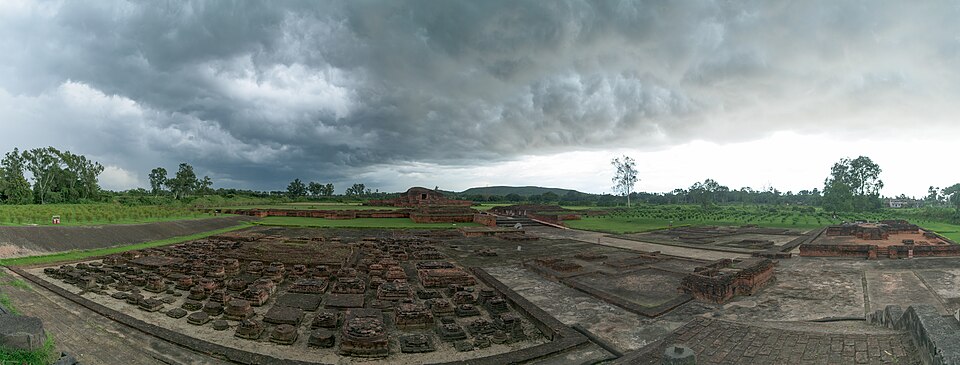
The Palas ruled Bengal and Bihar from about the middle of the eighth century to the twelfth, and their most durable legacy is a network of Buddhist mahaviharas: monastery-universities enclosed within walls, each with a central shrine, a great stupa and hundreds of residential cells. Gopala founded the dynasty and is credited with Odantapuri at what is now Bihar Sharif; his son Dharmapala founded Vikramshila and Somapura; Dharmapala's son Devapala extended the empire and continued the patronage; and Nalanda, older than all of them and Gupta in origin, was sustained by Pala endowments. Vikramshila at Antichak is laid out as a vast square monastery of brick with a cruciform stupa-shrine at its centre and cells opening onto an inner courtyard on all four sides, and the excavated site is protected by ASI and served by a site museum. The complex was destroyed around the turn of the thirteenth century in the same wave of Turkish raids that ended Nalanda and Odantapuri as living institutions, and the scholars who survived carried the tradition into Tibet and Nepal. The region has deep antiquity beyond the Palas: Bhagalpur is the heartland of ancient Anga, whose capital Champa is named in the Atharvaveda Samhita and in Buddhist literature among the kingdoms of northern India.
Two habits solve this question, and both are about reading rather than recall. First, the stem asks for the INCORRECT statements: a candidate who reflexively hunts for true ones will pick option (b) or (d) and lose a third of a mark to a negative-marking scheme. Second, when a statement names a district or a founder, treat that as the checkable part and go straight to it, because setters plant errors in exactly those two slots. Here both planted errors are of the near-miss kind: Banka is the district next door and was literally part of Bhagalpur until February 1991, and Gopala is a real Pala king who really did found something, just the dynasty rather than this monastery. Statements 3 and 4 are the safe ones by their very form: broad, unquantified descriptive claims about a sect and a curriculum are rarely where a setter hides a falsehood, because they are hard to make crisply wrong, whereas a district name is either right or it is not. One nuance to keep honest: 'university' is our word, not theirs. These were monastic establishments, mahaviharas, whose teaching function grew out of the training of monks rather than out of any chartered degree-granting body, which is why the sources describe abbots, acharyas and gate-scholars rather than faculties and degrees.
Key facts
- ASI's Centrally Protected Monuments list, Bihar (Patna Circle), entry 2: 'Ancient site of Vikramasila Monastery', locality Antichak, district BHAGALPUR: the same list places the Barabar caves in Jehanabad and 'All mounds, structures and buildings' at Nalanda in Nalanda district
- Banka district was established on 21 February 1991, having been a subdivision of Bhagalpur until then and carved out after the 1991 Census, which is why the wrong district attribution circulates so widely
- Gopala founded the Pala dynasty in the mid-eighth century and is associated with Odantapuri; his son Dharmapala (c. 770-810 CE) founded Vikramshila as well as the Somapura mahavihara
- Vikramshila was the pre-eminent centre of Vajrayana or tantric Buddhism in eastern India; Atisha Dipankara Srijnana, associated with it as abbot, carried that teaching to Tibet in the eleventh century
- Its curriculum covered grammar, logic, metaphysics, law and astronomy alongside Buddhist doctrine, and admission was controlled by gate-scholars known as dvarapanditas who examined applicants in debate
- The site plan is a large square brick monastery with cells around an inner courtyard and a cruciform stupa-shrine at the centre; the complex was destroyed around the turn of the thirteenth century, as were Nalanda and Odantapuri
- Bhagalpur is the core of ancient Anga, whose capital Champa is named in the Atharvaveda Samhita and in Buddhist texts, so the district's archaeological record runs far deeper than the Pala period alone
- ASI's Patna Circle list runs N-BR-1 to N-BR-70, and the Ashokan columns on it sit at Kolhua in Vaishali district, at Lauriya Areraj in East Champaran and at Lauriya Nandangarh in West Champaran. Kolhua is the same trap as Vikramshila in miniature: Vaishali was carved out of Muzaffarpur in 1972, so older books and much coaching material still file the pillar under Muzaffarpur: exactly the parent-district error this question is built on
Study next
Common traps
- Missing the word 'incorrect' in the stem and answering with the true statements instead
- Assigning Vikramshila to Banka. Banka was created out of Bhagalpur on 21 February 1991 and is the neighbouring district; ASI records the site as Antichak, Bhagalpur
- Treating Gopala as the founder of everything Pala. He founded the dynasty and is linked with Odantapuri; Vikramshila belongs to his son Dharmapala
BPSC prefers the multi-statement form on Bihar heritage and plants the error in a district name or a founder's name, because those are the two details a candidate is least likely to have verified against a government list. It also likes the negative stem: 'which are incorrect', 'who was not', which doubles the cost of skimming. UPSC treats the same material more thematically: the Palas as patrons of Buddhism, Nalanda inside a place-and-attribute matching set, or the transmission of Buddhism to Tibet. A UPSC-trained candidate who knows the dynasty but not the present-day district will still fail this BPSC version, which is the whole point of the state paper.
Related PYQs
Consider the following statements: 1. The Ikshvaku rulers of southern India were antagonistic towards Buddhism. 2. The Pala rulers of Eastern India were patrons of Buddhism. Which of the statements given above is/are correct?
- (a) 1 only
- (b) 2 only
- (c) Both 1 and 2
- (d) Neither 1 nor 2
Answer(b) 2 only
The dynasty behind this question, stated as a bare proposition. UPSC's correct statement (that the Palas patronised Buddhism) is what produced Vikramshila in the first place; BPSC then asks which Pala king and in which district, which is exactly the level the UPSC statement leaves untested.
Which of the following pairs are correctly matched? I. Lothal: Ancient dockyard II. Sarnath: First Sermon of Buddha III. Rajgir: Lion capital of Asoka IV. Nalanda: Great seat of Buddhist learning Select the correct answer using the codes given below: Codes:
- (a) I, II, III and IV
- (b) III and IV
- (c) I, II and IV
- (d) I and II
Answer(c) I, II and IV
Place-and-attribute matching over Bihar's Buddhist sites, broken by exactly the kind of near-miss BPSC uses: the Lion Capital is at Sarnath, not Rajgir, just as Vikramshila is at Bhagalpur, not Banka. Both questions punish the candidate who knows the site but has never checked where it actually sits.
Who among the following was not an Acharya in The Nalanda Vishvavidyalaya?
- (a) Nagarjuna
- (b) Kautilya
- (c) Sheelbhadra
- (d) Shantirakshit
Answer(b) Kautilya
The sibling monastic university, two years later, tested on people instead of place, and again with a negative stem. Shantirakshita links the two directly: a scholar of the Pala mahaviharas who, like Atisha of Vikramshila, was sent to Tibet. BPSC clearly treats Bihar's ancient universities as a recurring block, so learn Nalanda, Vikramshila and Odantapuri together with founders, districts and famous teachers.
Practice
- practice, not a real PYQ
The excavated remains of the Vikramshila mahavihara are located at Antichak in which district of Bihar?
- (a)Banka
- (b)Bhagalpur
- (c)Munger
- (d)Nalanda
Answer(b) Bhagalpur: ASI's Centrally Protected Monuments list records the 'Ancient site of Vikramasila Monastery' at locality Antichak, district Bhagalpur. Banka, created out of Bhagalpur on 21 February 1991, is the adjoining district. - practice, not a real PYQ
Which Pala ruler is credited with the foundation of the Vikramshila mahavihara?
- (a)Gopala
- (b)Devapala
- (c)Dharmapala
- (d)Mahipala I
Answer(c) Dharmapala: the second Pala ruler, c. 770-810 CE, who also founded the Somapura mahavihara. Gopala founded the dynasty itself and is associated with Odantapuri.