
An AC current can be produced by
- (a)choke coil
- (b)dynamo
- (c)transformer
- (d)None of the above
Answer
Why
Correct: B, dynamo. Of the three devices named, only one is a source of electrical energy; the other two act on electricity that is already flowing. A dynamo is a generator, and a generator converts mechanical energy (a hand crank, a bicycle wheel, a falling column of water, a steam turbine) into electrical energy through Michael Faraday's law of electromagnetic induction, which he demonstrated on 29 August 1831. Spin a coil of N turns and area A at angular speed ω in a uniform magnetic field B, and the flux threading it is Φ = NBA cos ωt. The induced emf is the rate at which that flux changes, e = −dΦ/dt = NBAω sin ωt, and that is a sine wave. It peaks when the plane of the coil lies along the field, falls to zero twice per rotation when the plane is perpendicular to it, and (this is the whole point of the question) reverses sign every half turn, because the arm of the coil that was cutting upward through the field is now cutting downward through it. Alternating current is therefore not something bolted on to a rotating generator; it is what the geometry produces by itself. What decides whether the machine hands AC or DC to the outside world is only the pair of contacts on the shaft: two continuous slip rings pass the sine wave out unchanged as AC, whereas a split-ring commutator reverses the external connection at the instant the emf reverses and folds the negative half-cycles upward into DC. Every thermal, hydro, nuclear and wind station feeding the Indian grid is a machine of exactly this kind, which is why household supply in India alternates at 50 hertz (the current reverses direction every 1/100 of a second) at a nominal 230 volts. Neither a choke coil nor a transformer can do any part of this: disconnect the supply and their output is zero, while a dynamo needs nothing but a shaft that turns.
Why the others are wrong
- (a)choke coil: A choke is an inductor (many turns of insulated copper wire, usually wound on a laminated soft-iron core) placed in series in an AC circuit to hold the current down. Its opposition is inductive reactance, X_L = 2πfL, which rises with frequency, and because the current through a nearly pure inductor lags the voltage by close to 90°, the average power it absorbs, VI cos φ, is almost nil. That is exactly why a fluorescent tube uses a choke and not a resistor as its ballast: it limits the current without wasting it as heat, a point UPSC turned into a full question in 2000. Limiting a current is not making one. Put a choke across a steady DC supply, where f = 0, and its reactance vanishes; it behaves as an ordinary length of low-resistance wire.
- (c)transformer: The genuinely tempting option, because a transformer's secondary winding really does carry an alternating current, so it can look like a producer. It is a converter. Two coils sit on one laminated core and are coupled only by mutual induction: the alternating primary current sets up an alternating flux, and it is the changing of that flux that induces the secondary emf, in the ideal ratio Vs/Vp = Ns/Np. Every link in that chain requires change. Feed a transformer steady direct current and the flux is constant, so no emf appears across the secondary at all and the primary (which has very little resistance) simply overheats; UPSC built an assertion-reason item on precisely this in 1996. A transformer also contributes no energy of its own, since ideally power out equals power in. It changes the voltage of an alternating current; it does not originate one.
- (d)None of the above: This would be right only if none of the three devices could generate an alternating current, and one of them plainly can. The option is a trap for the candidate who correctly works out that a choke coil and a transformer are both passive, and then over-generalises that conclusion across the whole list without pausing to ask what a dynamo actually is. On this paper 'None of the above' is the fourth option on a great many items, so treating it as a hint that the first three are all wrong is an expensive habit.
Concept
Electromagnetic induction is the single principle behind almost all electricity generation on Earth. Faraday's law states that an emf is induced in a circuit whenever the magnetic flux through it changes, with magnitude equal to the rate of change of flux, e = −dΦ/dt; Lenz's law supplies the minus sign, meaning the induced current always opposes the change that produced it, which is the reason a generator becomes harder to turn the moment a load is switched on. Three families of machine are built on this one law and are constantly confused with each other. A generator (dynamo or alternator) turns mechanical energy into electrical energy by moving a conductor relative to a field. A motor is the same machine run backwards, turning electrical energy into mechanical energy. A transformer moves no parts at all: it uses the mutual induction between two stationary coils to change the voltage of an alternating supply, and works only because AC is inherently changing. To these is usually added the choke coil, a pure inductor used not to convert energy but to limit current in an AC circuit. Grasping which of the four is a source and which are merely handlers of an existing supply settles most one-line questions in this chapter.
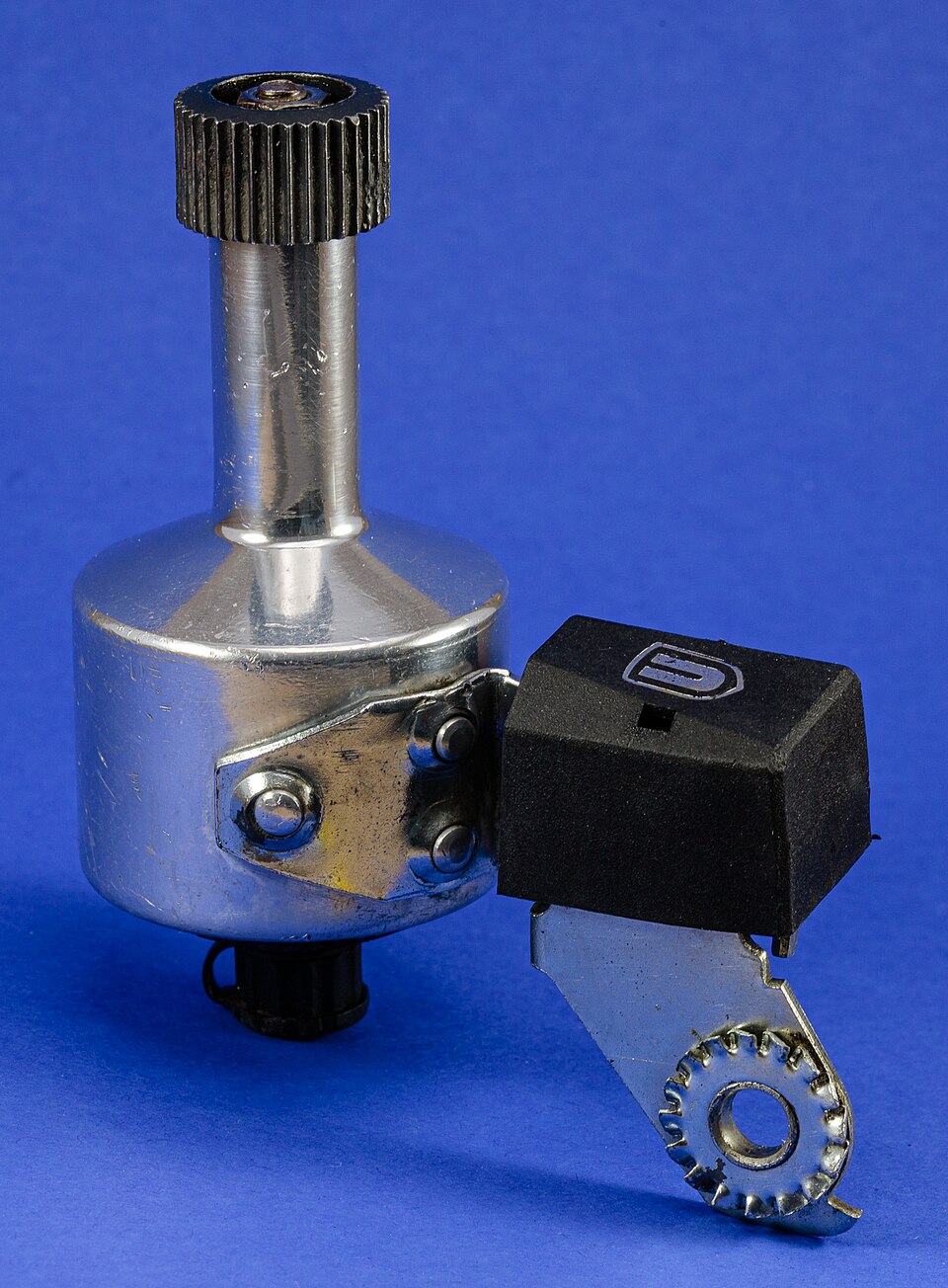
Read the stem as an energy question rather than a circuits question and it collapses in one step: which of these devices can turn something that is not electricity into electricity? A choke coil and a transformer both fail that test at once, because remove the mains and neither has any output: they handle energy, they do not create it. Only the dynamo has an input that is not electrical, namely the mechanical work of a turning shaft. The near-miss to watch is the transformer, and the discriminating fact is the direction of dependence: a transformer's secondary current exists only for as long as an alternating primary current is supplied to it, whereas a dynamo produces its alternating emf from a bicycle wheel or a turbine with no electrical input at all. One honest caveat belongs on this card. In strict engineering usage a 'dynamo' is the commutated machine that delivers DC and an 'alternator' is the slip-ring machine that delivers AC, so a purist would say the exact answer, 'alternator', is not among the options. Indian school and general-studies usage does not preserve that distinction; 'dynamo' there simply means the everyday generator, and the familiar bicycle bottle dynamo is in fact a permanent-magnet alternator whose output is alternating. Since the strictly worded alternative is absent and the other two devices cannot generate anything at all, (b) is the answer both by common usage and by elimination.
Key facts
- Faraday discovered electromagnetic induction on 29 August 1831 using an iron ring wound with two coils; the law is e = −dΦ/dt, the minus sign being Lenz's law. Joseph Henry reached the same result independently in the United States at about the same time, and the SI unit of inductance is named after him.
- In an AC generator the emf is e = NBAω sin ωt: zero when the coil's plane is perpendicular to the field, maximum when it lies along the field, and reversed every half rotation. The same armature yields DC instead of AC if the two slip rings are replaced by a split-ring commutator.
- Indian mains supply is alternating at 50 Hz and a nominal 230 V, so the current changes direction 100 times a second, i.e. once every 1/100 s. The United States and much of the Americas use 60 Hz at about 110–120 V, which is why UPSC's 2004 assertion-reason item on household AC used the 60 Hz figure.
- A choke coil opposes alternating current by inductive reactance X_L = 2πfL and dissipates almost no power because the phase angle is close to 90°; at f = 0, that is on DC, X_L = 0. A tube light's choke also supplies the momentary high-voltage surge that strikes the discharge when the starter's contacts break.
- An ideal transformer obeys Vs/Vp = Ns/Np = Ip/Is and works only on AC. That transformability is the reason the grid is alternating at all: India transmits bulk power at 132, 220, 400 and 765 kV to cut I²R losses and steps it down to 230 V at the consumer, something no equally simple device can do with DC.
Study next
Common traps
- Choosing the transformer because its secondary carries AC: a transformer converts an alternating supply that must already exist, and produces nothing at all on DC
- Assuming a choke coil generates or boosts current because a tube light will not start without one; it only limits current, and the starting surge comes from the sudden collapse of its own field
- Reflexively picking 'None of the above' after correctly ruling out two of the three devices, instead of testing the third on its own merits
BPSC keeps this at NCERT Class 10 level and asks it as a bare device-identification item: a five-word stem, three real devices and a 'None of the above' safety net, so the whole question is settled by knowing what each device does, with no calculation involved; the 71st CCE in 2025 used the identical shape for the fuse. UPSC has never asked it this bluntly. It wraps the same physics in an assertion-reason pair, as with the transformer and DC circuits in 1996 and the frequency of household AC in 2004, or asks what a named component does inside a named appliance, as with the choke of a fluorescent tube in 2000.
Related PYQs
Assertion (A): Transformer is useful for stepping up or stepping down voltages. Reason (R): Transformer is a device used in D.C. circuits. In the context of the above two statements, which one of the following is correct?
- (a) Both A and R are true and R is the correct explanation of A.
- (b) Both A and R are true but R is not a correct explanation of A.
- (c) A is true but R is false.
- (d) A is false but R is true.
Answer(c) A is true but R is false.
The transformer distractor, taken apart in an earlier paper. UPSC's item turns on the same single fact that removes option (c) here: a transformer needs a changing flux and therefore an alternating supply, so it can only alter an AC that already exists and can produce nothing on DC.
Fluorescent tubes are fitted with a choke. The choke coils
- (a) step up the line voltage
- (b) step down the line voltage
- (c) reduce current in the circuit
- (d) choke low-frequency currents
Answer(c) reduce current in the circuit
The other distractor, asked directly. UPSC checks whether the candidate knows a choke's actual function, and the answer, that it reduces the current: is exactly why it cannot be the source of one; a device whose job is to limit an existing current is by definition not generating it.
What is the device to protect equipments from the electric shock?
- (a) Fuse
- (b) Generator
- (c) Motor
- (d) Current controller
Answer(a) Fuse
BPSC came back to the same skill two years later on the 71st CCE: a one-line stem that lists real electrical devices and is decided purely by what each one does. There the candidate has to separate a protective device from a generator and a motor; here, a generator from a current limiter and a voltage converter.
Practice
- practice, not a real PYQ
In an AC generator, the purpose of the slip rings is to
- (a)convert the alternating emf of the armature into direct current
- (b)maintain a continuous connection between the rotating armature and the external circuit
- (c)increase the magnetic flux linked with the armature
- (d)reduce the current drawn by the external circuit
Answer(b) maintain a continuous connection between the rotating armature and the external circuit: each end of the coil is joined to its own unbroken ring, so the output reaches the brushes with its reversals intact and remains alternating. Converting it to DC is the job of a split-ring commutator, not slip rings; the flux is set by the field magnet, and current limiting is a choke's function. - practice, not a real PYQ
Which one of the following statements about a transformer is correct?
- (a)It can step up both the voltage and the power
- (b)It works equally well on direct and alternating current
- (c)In a step-up transformer the secondary has more turns than the primary
- (d)It converts mechanical energy into electrical energy
Answer(c) In a step-up transformer the secondary has more turns than the primary: since Vs/Vp = Ns/Np, more secondary turns mean a higher secondary voltage, and the current falls in the same proportion. Power is not stepped up, a transformer produces no output on steady DC because the flux does not change, and converting mechanical energy into electrical energy is a generator's work.