
What is the device to protect equipments from the electric shock?
- (a)Fuse
- (b)Generator
- (c)Motor
- (d)Current controller
Answer
Why
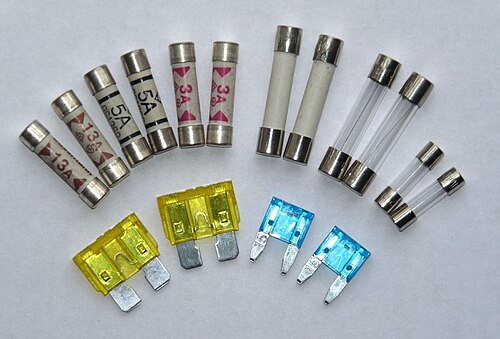
Correct — A, Fuse. Read the object of the sentence before anything else: the question asks for the device that protects EQUIPMENT — उपकरणों, in the Hindi column — from an electrical surge, and that is exactly the fuse's job. A fuse is a deliberately weak link built into a circuit. It is a short piece of wire made of a metal or alloy of suitably low melting point, which NCERT lists as aluminium, copper, iron or lead, connected IN SERIES with the appliance so that the entire current has to pass through it, and usually encased in a porcelain cartridge with metal end-caps. The physics is Joule's law of heating, H = I²Rt. Because the fuse wire is thinner than the rest of the wiring it has the highest resistance per unit length in the loop, so it heats up faster than anything else; and because heating rises with the SQUARE of the current, a modest overcurrent produces a disproportionate temperature rise. Once the current exceeds the rated value the fuse wire melts, the circuit is broken, and the appliance and the house wiring are saved from the fire or damage that a short circuit or an overload would otherwise cause. Domestic fuses are rated 1 A, 2 A, 3 A, 5 A and 10 A, and the rating is chosen from the load: a 1 kW electric iron on a 220 V supply draws 1000/220 = 4.54 A, so a 5 A fuse is the correct one. Now the caveat that matters more than the mark, because it is a genuine safety misconception and this question's loose English invites it. A fuse does NOT protect a human being from an electric shock. It protects the circuit and the appliances from an unduly high current. A current of only a few tens of milliamperes across the chest can be lethal, which is thousands of times below the several amperes a domestic fuse must reach before it melts — the fuse would never even notice. What protects a person is the earth wire, green-insulated and run to a metal plate buried deep near the house, which keeps the metal body of an appliance at earth potential so, in NCERT's own words, the user may not get a severe electric shock; and, in modern installations, an ELCB or RCCB, which compares the current leaving on the live wire with the current returning on the neutral and trips within milliseconds when a small residual current — typically about 30 mA on devices sold for personal protection — is escaping somewhere else, such as through a person. The stem's wording, 'protect equipments', is precisely what makes Fuse the right answer here.
Why the others are wrong
- (b)Generator — A generator is a source, not a safeguard. It converts mechanical energy into electrical energy by electromagnetic induction — a coil rotated in a magnetic field, with slip rings in the AC version and a split-ring commutator in the DC version. It is the thing that pushes current into a circuit in the first place; asking a generator to protect equipment from excess current is asking the supply to protect you from itself. Nothing in its construction senses or interrupts an over-current.
- (c)Motor — The exact converse device: a motor converts electrical energy into mechanical energy, using the force experienced by a current-carrying conductor placed in a magnetic field, and it is what drives fans, pumps, mixers and water coolers. A motor is a LOAD — one of the appliances that itself needs protecting, and one that draws a heavy starting current. Older NCERT editions set 'an electric motor converts mechanical energy into electrical energy' as a true-or-false item, and the answer is false; that is the generator. The statement was dropped in the rationalised text, so do not look for it in the book currently in print.
- (d)Current controller — The intelligent distractor, because it names the right job in the wrong sense. A rheostat or variable resistance does control current, by inserting resistance and letting Ohm's law do the rest, and it is used to dim a lamp or regulate a fan. But regulating current during normal operation is not the same as breaking the circuit when the current turns dangerous: a rheostat cannot disconnect the supply, and at short-circuit currents it would burn out itself. 'Current controller' is not the name of any standard protective device — those are the fuse and the miniature circuit breaker.
Concept
A domestic electrical installation faces three different hazards and answers each with a different device, and confusing them is the commonest and most dangerous gap in a candidate's knowledge. The first hazard is OVERCURRENT: either an overload, when too many appliances are drawn from one circuit or the supply voltage rises accidentally, or a short circuit, when the live and neutral wires touch directly and the resistance of the path collapses. The device for this is the fuse, or its reusable modern equivalent the miniature circuit breaker, placed in series in the live wire so that all the current passes through it; the fuse melts and the MCB trips, and in both cases the circuit is broken before the wiring can catch fire. The second hazard is LEAKAGE to the metal casing of an appliance such as an iron, toaster or refrigerator, and the device for that is the earth wire with green insulation, connected to a metal plate buried deep in the ground near the house, which offers a low-resistance path and holds the casing at earth potential. The third hazard is a residual current actually flowing through a human body, and the device for that is an ELCB or RCCB, which continuously compares the current going out on the live wire with the current coming back on the neutral and cuts the supply the instant the two fail to match. Fuse for the equipment, earthing and RCCB for the person: that separation is the whole of domestic electrical safety in one line.
Two routes reach the answer and both are worth practising. The first is elimination and it needs no electrical knowledge at all: a generator converts mechanical energy into electrical energy, a motor converts electrical energy into mechanical energy, and neither has any protective function — they are the two halves of energy conversion, not safety devices. 'Current controller' is not the name of a standard protective device; it describes a rheostat, which regulates current in normal running rather than interrupting a fault. Only one option is left. The second route is positive and it is what the examiner wants: know that the fuse is defined by what it senses and how it acts — it senses the MAGNITUDE of the current, and it acts by melting, because Joule heating in a thin, low-melting-point wire goes as I². The single discriminating idea in the whole question, though, is the object of the sentence. Ask 'protect WHAT?' A stem that says equipment points to the fuse; a stem that says a person points to earthing and to an ELCB/RCCB. BPSC's English here is imprecise — 'protect equipments from the electric shock' is a literal rendering of the Hindi — and it is the word 'equipments' that legitimises the key. Do not generalise from this question to the belief that a fuse makes a person safe from shock. It does not, and the difference is the difference between a scorched socket and a fatality.
Key facts
- NCERT's description of a fuse: a piece of wire made of a metal or an alloy of appropriate melting point — for example aluminium, copper, iron or lead — placed IN SERIES with the device, usually encased in a cartridge of porcelain or similar material with metal ends. Domestic fuses are rated 1 A, 2 A, 3 A, 5 A and 10 A.
- The mechanism is Joule's law of heating, H = I²Rt. The fuse wire is thin, so it carries the highest resistance per unit length in the loop and heats fastest; when the current exceeds the rated value it melts and breaks the circuit.
- Rating a fuse from the load: an electric iron consuming 1 kW at 220 V draws 1000/220 = 4.54 A, so a 5 A fuse must be used. Choosing a fuse far above the load defeats the purpose; choosing one below it means the fuse blows in normal use.
- What a fuse actually protects, in NCERT's own words: it 'prevents damage to the appliances and the circuit due to overloading', and it 'prevents the electric circuit and the appliance from a possible damage by stopping the flow of unduly high electric current'. It is equipment protection, not personal protection.
- What protects a person: the earth wire, insulated green and connected to a metal plate buried deep in the earth near the house, keeps the metallic body of an appliance at earth potential so that, as NCERT puts it, the user may not get a severe electric shock. Modern boards add an ELCB/RCCB, typically rated to trip at a residual current of about 30 mA — orders of magnitude below the several amperes a fuse needs.
- A fuse is single-use and must be replaced after it blows; a miniature circuit breaker (MCB) performs the same overcurrent function with a switch that trips and can be reset. Both are connected in series and in the live wire, never in the neutral and never in parallel.
Study next
Common traps
- The safety misconception this question invites: a fuse protects EQUIPMENT and wiring from overcurrent — it does not protect a person from an electric shock, because a lethal body current of a few tens of milliamperes is far below any fuse rating. Personal protection comes from earthing and an ELCB/RCCB
- Believing a fuse wire needs a very high resistance; the essential property is a LOW melting point, and UPSC has tested exactly that distinction
- Connecting a fuse in parallel, or in the neutral wire — it must sit in series in the live wire so that the whole current passes through it and so that breaking it truly isolates the appliance
BPSC asks the safety devices as flat one-line recall, and the English is often a literal rendering of the Hindi, so the decisive skill is reading the object of the sentence — 'protect equipments' points to the fuse, whereas 'protect a person' would point to earthing and an ELCB. UPSC, on the only occasion it has set a fuse question, went a layer deeper and asked which property the fuse wire must possess and how it is connected, with 'low melting point' as the answer and 'connected in parallel', 'made mainly from silver alloys' and 'very high resistance' as the traps. So BPSC rewards naming the device; UPSC rewards knowing the material property and the wiring position that make the device work.
Related PYQs
A fuse is used in main electric supply as a safety device. Which one of the following statements about the fuse is correct?
- (a) It is connected in parallel with the main switch
- (b) It is made mainly from silver alloys
- (c) It must have a low melting point
- (d) It must have a very high resistance
Answer(c) It must have a low melting point
The same device, one level deeper. BPSC asks you to name the safety device; UPSC assumes you can and asks which property makes it work — a low melting point, so that the fuse wire is always the first thing in the circuit to give way — while offering 'connected in parallel' and 'very high resistance' as the traps that a half-remembered answer falls into.
Assertion (A): The temperature of a metal wire rises when an electric current is passed through it. Reason (R): Collision of metal atoms with each other releases heat energy.
- (a) Both A and R are true, and R is the correct explanation of A
- (b) Both A and R are true, but R is NOT a correct explanation of A
- (c) A is true, but R is false
- (d) A is false, but R is true
Answer(c) A is true, but R is false
This is the physics a fuse runs on. A current-carrying wire heats because drifting electrons collide with the lattice ions and electrical energy I²R is dissipated as heat — not because metal atoms collide with one another, which is why the stated reason is false. A fuse simply engineers that heating to reach melting point first.
Practice
- practice — not a real PYQ
A fuse wire used in a domestic electric circuit should
- (a)have a high melting point and be connected in parallel with the appliance
- (b)have a low melting point and be connected in series with the appliance
- (c)have a low melting point and be connected in parallel with the appliance
- (d)have a high melting point and be connected in series with the appliance
Answer(b) have a low melting point and be connected in series with the appliance — the fuse must melt before the wiring does, so its alloy is chosen for a low melting point, and it must carry the full current of the circuit, which only a series connection ensures. In parallel it would carry almost no current and would never blow. - practice — not a real PYQ
An electric geyser rated 2 kW is to be operated on a 220 V domestic supply. Which of the following fuses is suitable for its circuit ?
- (a)1 A
- (b)3 A
- (c)5 A
- (d)15 A
Answer(d) 15 A — the geyser draws I = P/V = 2000/220 = 9.09 A in normal operation, so any fuse rated below that would melt every time the geyser is switched on. This is why houses run a separate 15 A circuit for high-power appliances such as geysers and air coolers, keeping the 5 A circuit for lights and fans.