
The process that continually adds new crust is
- (a)subduction
- (b)earthquake
- (c)seafloor spreading
- (d)convection
Answer
Why
Correct: C, seafloor spreading. New crust is manufactured along the mid-ocean ridges. Where two oceanic plates draw apart, the confining pressure on the mantle beneath them falls; the mantle melts by decompression without needing any extra heat; basaltic magma rises into the widening crack and freezes onto the trailing edge of each plate. Repeat that indefinitely and the ocean floor grows outward, symmetrically, from the ridge axis. Three independent lines of evidence pin it down. The mid-ocean ridge is a single continuous submarine mountain range 65,000 km long (the longest on Earth) running down the middle of the Atlantic, through the Indian Ocean and across the Pacific. The ocean floor is youngest at the ridge crest and grows older with distance from it in both directions. And the basalt, as it cools through the Curie point, locks in the direction of Earth's magnetic field at that moment, so the repeated reversals of that field are printed on the seabed as mirror-image magnetic stripes on either side of the axis: the observation Fred Vine and Drummond Matthews published in Nature in 1963, which converted a hypothesis into settled science. Robert Dietz had named the process in Nature in 1961 and Harry Hess of Princeton had laid out its mechanism, calling his own paper an exercise in 'geopoetry'. Measured spreading is slow but relentless: about 25 mm a year in the North Atlantic, 80 to 145 mm a year along the East Pacific Rise. The word doing the work in the stem is 'continually': spreading is a standing, ongoing manufacture of crust, not an episode.
Why the others are wrong
- (a)subduction: The exact opposite end of the same conveyor. At a convergent margin the denser oceanic plate bends down into a trench (the Mariana Trench reaches nearly 11 km) and is consumed back into the mantle, which is why the oldest large-scale oceanic crust anywhere is only about 180 to 200 million years old while continental rocks run past 4 billion. There is a genuine nuance: melting above a subducting slab builds island arcs and adds some new CONTINENTAL crust over geological time. But on balance subduction destroys crust, and Earth's constant surface area requires that it destroy exactly as much as the ridges create.
- (b)earthquake: An earthquake is the sudden release of elastic strain that has been accumulating along a fault; it is a symptom of plate motion, not a manufacturing process. It can move crust (the 2004 Sumatra-Andaman rupture shifted islands by metres) but it adds no new crustal material at all. It also fails the other half of the stem: earthquakes are discrete events separated by decades or centuries, whereas 'continually' describes something that never stops.
- (d)convection: The most sophisticated wrong answer, and the one a well-read candidate reaches for, because slow convection in the mantle is indeed the engine of the whole system: it is the phrase Q24 of this same paper uses to define plate tectonics. But convection is a mantle process, not a crust-forming one. It supplies the driving force and delivers the heat and melt; the actual creation of crust is the emplacement and solidification of that melt at the ridge, which is what 'seafloor spreading' names. Convection is the cause; spreading is the process the stem asks for.
Concept
Earth's crust is not a fixed skin but a conveyor belt with a manufacturing end and a scrapping end, and the two are in balance because the planet's surface area does not change. At divergent boundaries (mid-ocean ridges, and the East African Rift on land) plates separate and new basaltic crust is added by seafloor spreading. At convergent boundaries the denser plate subducts into a trench and is recycled into the mantle, generating deep earthquakes and arc volcanoes on the way down. At transform boundaries plates slide laterally past each other and crust is neither made nor destroyed, only displaced, as along the San Andreas Fault. The two kinds of crust behave very differently in this cycle: oceanic crust is basaltic, only about 6 to 7 km thick and dense at roughly 3.0 g/cm³, so it subducts readily and is constantly renewed; continental crust is granitic, 30 to 70 km thick and lighter at about 2.7 g/cm³, so it resists subduction and survives for billions of years. The repeated assembly and break-up of supercontinents driven by this creation-and-destruction cycle is called the Wilson cycle.
Read the four options as four different roles in one system and the answer falls out. Convection is the CAUSE, the engine turning in the mantle. Earthquakes are an EFFECT, the noise the machine makes when strain snaps. Subduction is the DESTRUCTIVE step, where crust is fed back down. Only seafloor spreading is the CREATIVE step, and it is the only one of the four that produces new rock. The stem reinforces this with 'continually': spreading proceeds year on year at a measurable few centimetres, while an earthquake is an event. The genuine trap is option (d), because the sentence 'mantle convection drives plate tectonics' is true and memorable, and a candidate who has learnt it can persuade himself that convection therefore makes the crust. It does not: it moves the plates and delivers the melt, but the crust appears when that melt solidifies at the ridge. A useful cross-check inside the same paper: Q24 defines plate tectonics as crustal motion 'driven by movement in the mantle', which tells you the setter regards convection as the driver, not as the creator.
Key facts
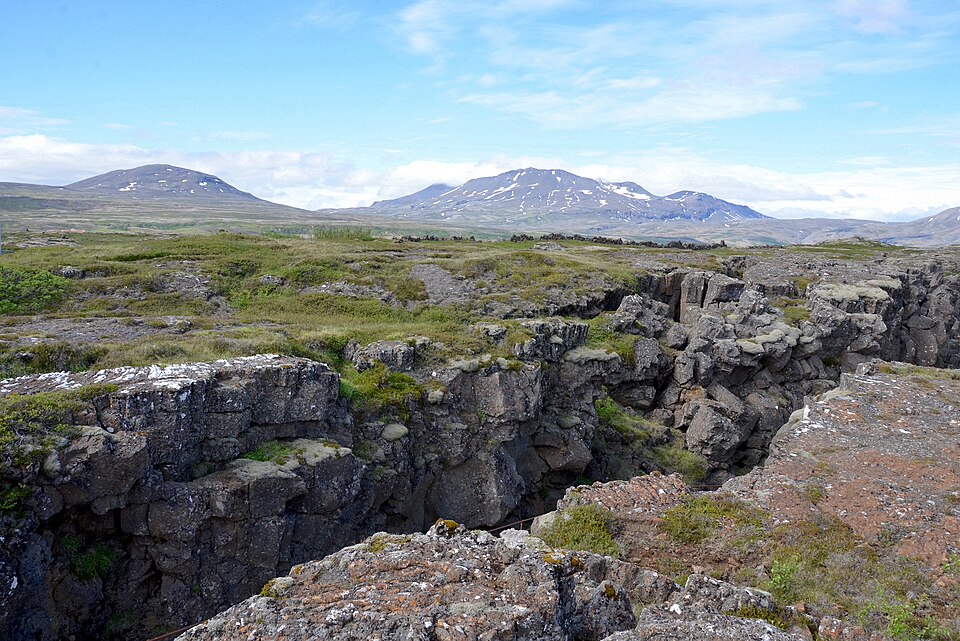
- The mid-ocean ridge is a continuous submarine mountain chain about 65,000 km long (the longest mountain range on Earth, several times the Andes) and the full oceanic ridge system runs to roughly 80,000 km. It surfaces above sea level only in a few places, Iceland being the famous one.
- Measured spreading rates span roughly 10 to 200 mm a year. The slow-spreading North Atlantic manages about 25 mm a year and carries a deep axial rift valley; the fast-spreading East Pacific Rise runs at 80 to 145 mm a year and has no rift valley at all.
- Robert Dietz named the process in Nature in 1961 ('Continent and Ocean Basin Evolution by Spreading of the Sea Floor') and Harry Hess of Princeton set out its mechanism in 1962. Fred Vine and Drummond Matthews confirmed it in Nature in 1963 by showing that magnetic anomalies form symmetric stripes about the ridge axis.
- Oceanic crust is basaltic, about 6 to 7 km thick and around 3.0 g/cm³; continental crust is granitic, 30 to 70 km thick and around 2.7 g/cm³. Because subduction keeps recycling the sea floor, the oldest large-scale oceanic crust (in the west Pacific and north-west Atlantic) is only some 180 to 200 million years old.
- India's own ocean shows both ends of the conveyor: the Carlsberg and Central Indian Ridges are spreading centres in the Arabian Sea and Indian Ocean, while the Andaman–Sunda trench consumes the Indian Plate beneath the Burma plate and feeds Barren Island, the only confirmed active volcano in Indian territory.
Study next
Common traps
- Picking convection because 'convection drives plate tectonics' is true: it is the engine of the system, not the step that makes crust
- Reading subduction as crust creation because volcanoes erupt above subducting slabs; on balance subduction consumes oceanic lithosphere, which is why no sea floor is older than about 200 million years
- Overlooking the word 'continually', which by itself rules out an earthquake, a discrete event rather than an ongoing process
BPSC set this in the plainest NCERT register (a one-line stem and four single-word options) so the whole item is a test of whether the candidate can sort a cause (convection) from an effect (earthquake), a destructive process (subduction) and the creative one. UPSC rarely asks the bare definition; it asks the consequences and the evidence instead, which agents bring dynamic change to Earth's surface (2013), where named oceanic trenches lie (2000), and what geological matches prove that continents have drifted (2025).
Related PYQs
Consider the following: 1. Electromagnetic radiation 2. Geothermal energy 3. Gravitational force 4. Plate movements 5. Rotation of the earth 6. Revolution of the earth Which of the above are responsible for bringing dynamic changes on the surface of the earth?
- (a) 1, 2, 3 and 4 only
- (b) 1, 3, 5 and 6 only
- (c) 2, 4, 5 and 6 only
- (d) 1, 2, 3, 4, 5 and 6
Answer(d) 1, 2, 3, 4, 5 and 6
The same endogenic machinery seen from above: UPSC lists plate movements and geothermal energy among the forces that keep remaking Earth's surface, which is precisely the pairing this BPSC item asks a candidate to separate: the internal heat that convects, and the plate motion that turns it into new crust.
Match List I with List II and select the correct answer using the codes given below the Lists: List I (Oceanic Trench) I. Aleutian II. Kermadec III. Sunda IV. S. Sandwich List II (Location) A) Indian Ocean B) North Pacific Ocean C) South Pacific Ocean D) South Atlantic Ocean Codes:
- (a) I-B, II-D, III-A, IV-C
- (b) I-B, II-C, III-A, IV-D
- (c) I-A, II-C, III-B, IV-D
- (d) I-A, II-D, III-B, IV-C
Answer(b) I-B, II-C, III-A, IV-D
The other end of the conveyor, question by question: every trench UPSC lists here is a place where the crust made at a spreading ridge is being fed back into the mantle, and the Sunda trench in the Indian Ocean is the one consuming the plate on India's own eastern margin.
The two volcanic Islands in the Indian Territory are -
- (a) Kavaratti and New Moore
- (b) Bitra and Kavaratti
- (c) Pamban and Barren
- (d) Narcondam and Barren
Answer(d) Narcondam and Barren
BPSC's own follow-up on the destructive half of this cycle: Barren and Narcondam exist because the Indian Plate is being subducted beneath the Burma plate, so the two islands are the visible product of the process that balances the crust being created at the ridges.
Practice
- practice, not a real PYQ
At which one of the following types of plate boundary is new oceanic crust created?
- (a)Convergent boundary
- (b)Divergent boundary
- (c)Transform boundary
- (d)Subduction zone
Answer(b) Divergent boundary: plates move apart at mid-ocean ridges, the mantle melts by decompression and the rising basalt freezes as new crust. Convergent boundaries and subduction zones consume crust, and at a transform boundary plates merely slide past each other. - practice, not a real PYQ
The symmetrical pattern of magnetic stripes found on either side of a mid-oceanic ridge is best explained by which one of the following?
- (a)Uneven distribution of iron ore on the ocean floor
- (b)Repeated reversals of the Earth's magnetic field recorded in newly formed crust
- (c)The gravitational pull of the Moon on the oceanic crust
- (d)Deposition of sediments carried by ocean currents
Answer(b) Repeated reversals of the Earth's magnetic field recorded in newly formed crust: cooling basalt locks in the field direction of the moment, and spreading then carries that record outward on both sides, the evidence Vine and Matthews published in 1963.