
What is the ‘Manhattan Project’?
- (a)A research and development undertaking that produced the first nuclear weapons
- (b)One of the largest art auctions of the world
- (c)A real estate project in New York City
- (d)A famous theme park
Answer
Why
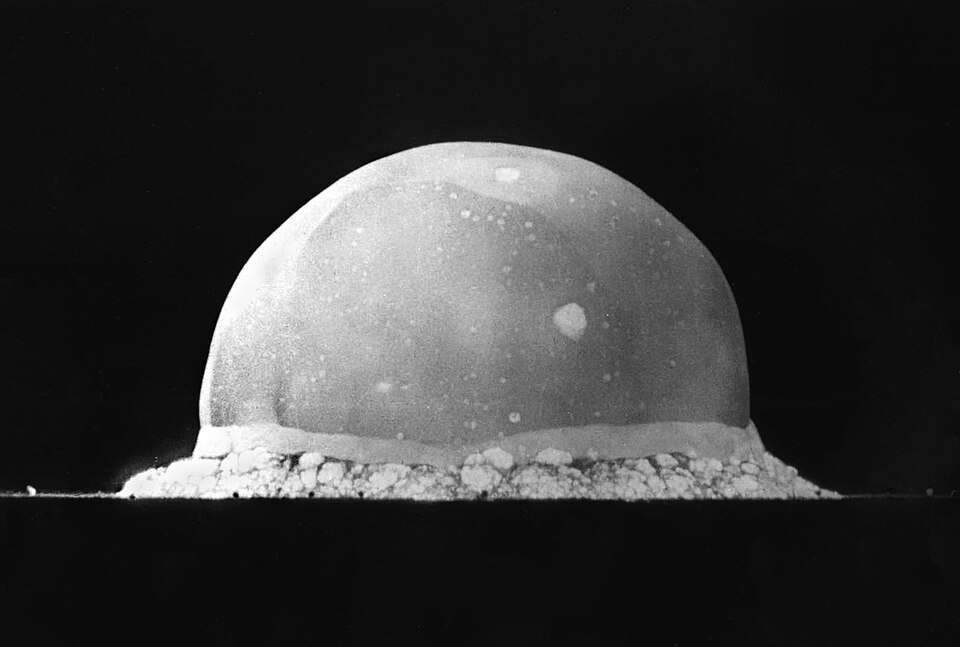
Correct: A, A research and development undertaking that produced the first nuclear weapons. The Manhattan Project ran from 1942 to 1946, led by the United States in collaboration with the United Kingdom and Canada. Major General Leslie Groves of the US Army Corps of Engineers directed it; J. Robert Oppenheimer directed the Los Alamos Laboratory (Project Y) in New Mexico, where the weapons were designed. The name is an accident of address, not a description: the Army programme was designated the Manhattan District because its first headquarters were in Manhattan, New York, and that designation replaced the earlier codename 'Development of Substitute Materials'. The district was constituted on 13 August 1942 and disbanded on 15 August 1947, the civilian Atomic Energy Commission having taken over in January 1947. Its roots are older still: the discovery of fission by Otto Hahn and Fritz Strassmann in 1938, explained by Lise Meitner and Otto Frisch; the Einstein–Szilard letter of August 1939 warning Roosevelt of 'extremely powerful bombs of a new type'; the Frisch–Peierls memorandum of March 1940 and Britain's MAUD Committee, whose Tube Alloys programme the Americans absorbed after the Quebec Agreement of August 1943. The scale was industrial: about 130,000 workers at peak and nearly US$2 billion spent, with more than 80 per cent of that going into fissile-material plants: enriched uranium at the Clinton Engineer Works in Tennessee (Oak Ridge) and plutonium in the world's first industrial-scale reactors at Hanford, Washington. Two designs resulted: Little Boy, an enriched-uranium gun-type weapon, and Fat Man, a plutonium implosion weapon. The first nuclear device ever detonated was the Trinity 'gadget', fired at 05:30 on 16 July 1945 in the New Mexico desert with a yield of about 20 kilotons of TNT.
Why the others are wrong
- (b)One of the largest art auctions of the world: Plausible only because of the borough. Manhattan genuinely is the centre of the world art trade: both Christie's and Sotheby's hold their New York sales there, so a candidate who knows the place but not the programme can be nudged towards this. But no auction has ever been called 'the Manhattan Project'; the phrase is a Second World War military designation for the Manhattan Engineer District of the US Army Corps of Engineers, and it belongs to weapons research, not to the art market.
- (c)A real estate project in New York City: The closest thing to a genuine trap, because 'Manhattan' is a borough of New York City and in American usage a 'project' in a city usually does mean construction. The inversion is the point: the district was named after where its offices first sat, not after anything it built there. Its actual construction was deliberately far away and deliberately remote: Oak Ridge in Tennessee, Hanford in Washington and Los Alamos in New Mexico, all chosen for isolation and secrecy.
- (d)A famous theme park: There is no theme park of this name anywhere, and the option exists only to absorb a blind guess. Manhattan's famous sites are Central Park, Times Square, the Empire State Building and the September 11 Memorial at Ground Zero: a list with no amusement park on it. If a candidate is guessing between four options, this is the one that should go first, because it makes no claim that could survive even a moment's thought about wartime terminology.
Concept
The physics the project had to industrialise is simple to state and brutal to build. Uranium-235 and plutonium-239 are fissile: struck by a neutron they split, releasing energy and more neutrons, and above a critical mass the reaction sustains itself. A reactor holds that reaction steady with moderators and control rods; a weapon forces it to run away in microseconds. There were two routes to the fissile core and the project took both. One was isotope separation, because natural uranium is only about 0.72 per cent U-235 and the rest is U-238: hence the vast gaseous-diffusion, electromagnetic and thermal-diffusion plants at Oak Ridge. The other was breeding plutonium-239 from U-238 inside reactors, which is what Hanford was built for, after Enrico Fermi's team at the University of Chicago's Metallurgical Laboratory achieved the first artificial self-sustaining chain reaction in Chicago Pile-1 on 2 December 1942. The two materials then forced two different weapon designs: uranium could be assembled by firing one subcritical piece into another (the gun method used in Little Boy), but reactor plutonium carries enough plutonium-240, which fissions spontaneously, to pre-detonate a gun weapon, so Fat Man had to be an implosion device, compressing a plutonium sphere with shaped explosive lenses.
This is a definition question, and on a 150-question paper it is one of the cheapest marks available: provided the name does not mislead you. Every wrong option here is built out of the word 'Manhattan' and invites you to reason from the place: auctions, real estate, a theme park. The single discriminating fact is that the name records an office address, not a subject. The US Army titled the programme the Manhattan Engineer District because its first headquarters were in Manhattan, and engineer districts have always been named after cities; the work itself happened in Tennessee, Washington State and New Mexico. Option (a) is, almost word for word, the standard definition of the project, which is another signal: a definition question whose correct option reads like a textbook sentence while the other three read like guesses about a place. It is also worth knowing why this term keeps appearing in general studies papers at all: the Manhattan Project is the origin of the nuclear age, and everything a candidate has to learn downstream: the five Nuclear Weapon States the NPT recognises, the IAEA, the CTBT, India's position outside that framework: dates from what was built between 1942 and 1945.
Key facts
- The Manhattan Project was a research and development programme of 1942–1946, led by the United States with the United Kingdom and Canada, directed by Major General Leslie Groves of the US Army Corps of Engineers, with J. Robert Oppenheimer heading the Los Alamos Laboratory (Project Y) that designed the weapons.
- The name is geographic: the Army designated it the Manhattan District because its first headquarters were in Manhattan, New York, replacing the earlier codename 'Development of Substitute Materials'. The district was constituted on 13 August 1942 and disbanded on 15 August 1947.
- At its peak the project employed about 130,000 workers and by the end of the war had spent roughly US$2 billion (the US Department of Energy puts the figure at $2.2 billion) with over 80 per cent going into fissile-material plants: enriched uranium at the Clinton Engineer Works, Tennessee (Oak Ridge) and plutonium at the Hanford Engineer Works, Washington.
- Enrico Fermi's team achieved the first artificial self-sustaining nuclear chain reaction in Chicago Pile-1 at the University of Chicago on 2 December 1942; the Trinity test at 05:30 on 16 July 1945 in the New Mexico desert was the first nuclear detonation in history, yielding about 20 kilotons of TNT equivalent and leaving a 250-foot crater of trinitite.
- Little Boy (enriched-uranium gun-type) was dropped on Hiroshima on 6 August 1945 and Fat Man (plutonium implosion) on Nagasaki on 9 August 1945; the three principal wartime sites (Oak Ridge, Hanford and Los Alamos) were brought together as the Manhattan Project National Historical Park on 10 November 2015.
Study next
Common traps
- Reading 'Manhattan' as a clue to the subject matter: it records where the Army engineer district first had its offices, while the work was done at Oak Ridge, Hanford and Los Alamos
- Confusing the project (weapons research, 1942–46) with a single event inside it, the Trinity test of 16 July 1945, or with the Atomic Energy Commission that succeeded it in 1947
- Treating it as a purely American effort: it was US-led but absorbed Britain's Tube Alloys programme after the Quebec Agreement of August 1943, with Canada a partner as well
BPSC asks famous project code names flat and by definition: 'What is the Manhattan Project?': treating Manhattan Project, Operation Overlord, Project Tiger and Operation Flood as vocabulary a candidate either recognises or does not, with the wrong options built out of the literal words in the name. UPSC does not ask what it was; it asks around it, testing the physics and the treaty architecture that followed: the difference between a nuclear reactor and an atomic bomb in 1995, which countries the NPT recognises as Nuclear Weapon States in 2015, the consequences of joining the Nuclear Suppliers Group in 2018. Carry the definition for BPSC and the framework for UPSC.
Related PYQs
The difference between a nuclear reactor and an atomic bomb is that
- (a) no chain reaction takes place in nuclear reactor while in the atomic bomb there is a chain reaction
- (b) the chain reaction in nuclear reactor is controlled
- (c) the chain reaction in nuclear reactor is not controlled
- (d) no chain reaction takes place in atomic bomb while it takes place in nuclear reactor
Answer(b) the chain reaction in nuclear reactor is controlled
The physics the Manhattan Project had to solve twice over: Fermi's Chicago Pile-1 held a fission chain reaction steady, while Trinity, Hiroshima and Nagasaki let the same reaction run away: controlled versus uncontrolled is the entire distinction.
Consider the following countries: 1. China 2. France 3. India 4. Israel 5. Pakistan Which among the above are Nuclear Weapons States as recognized by the Treaty on the Non-Proliferation of Nuclear Weapons (NPT)?
- (a) 1 and 2 only
- (b) 1, 3, 4 and 5 only
- (c) 2, 4 and 5 only
- (d) 1, 2, 3, 4 and 5
Answer(a) 1 and 2 only
The direct consequence of what the Manhattan Project started: the NPT's five recognised Nuclear Weapon States are the five that tested before 1967, a list that begins with the United States in July 1945 and is the reason the treaty draws the line where it does.
Practice
- practice, not a real PYQ
The Trinity test, the world's first nuclear explosion, was carried out in July 1945 in the desert of which US state?
- (a)Nevada
- (b)New Mexico
- (c)Tennessee
- (d)Washington
Answer(b) New Mexico: the device was fired at 05:30 on 16 July 1945 at the White Sands Proving Ground near Alamogordo, with a yield of about 20 kilotons; Tennessee and Washington held the Oak Ridge and Hanford production plants, not the test site. - practice, not a real PYQ
Under the Manhattan Project, the plutonium used in the 'Fat Man' bomb was produced at
- (a)Oak Ridge, Tennessee
- (b)Los Alamos, New Mexico
- (c)Hanford, Washington
- (d)Chicago, Illinois
Answer(c) Hanford, Washington: the world's first industrial-scale reactors bred plutonium there; Oak Ridge enriched uranium for Little Boy, Los Alamos designed the weapons, and Chicago's Metallurgical Laboratory built the first experimental pile.