
What is the name of Tesla’s humanoid robot launched in October 2022?
- (a)Sophia
- (b)Atlas
- (c)Pepper
- (d)Optimus
Answer
Why
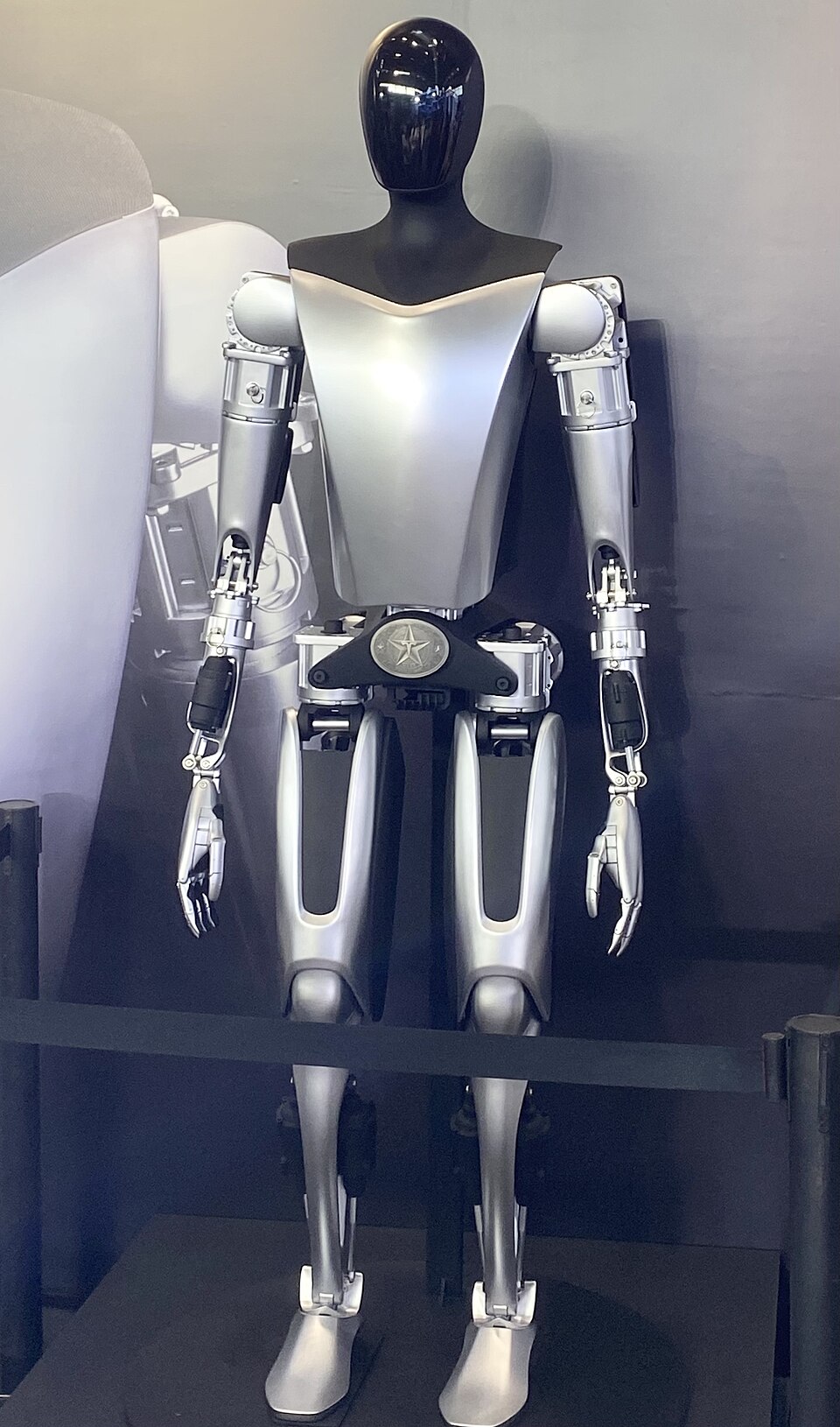
Correct: D, Optimus. Optimus, also called Tesla Bot, is the general-purpose humanoid robot Tesla, Inc. is developing. Elon Musk announced it at Tesla's first AI Day on 19 August 2021 with no hardware at all (only a person in a robot suit) showed a display model at the Cyber Rodeo event at Giga Texas on 7 April 2022, and unveiled semi-functional prototypes at the second AI Day on 30 September 2022. One prototype walked unaided across the stage; a sleeker version built around Tesla's own actuators was wheeled out and moved its arms. That event closed late on 30 September in the United States, and the world read about it on 1 October 2022: the BBC's report is headed "Tesla boss Elon Musk presents humanoid robot Optimus", which is why a question written in India can reasonably date the launch to October 2022. The contemporaneous reporting fixes the detail: the robot waved to the audience and raised its knees; a video showed it watering plants, carrying boxes and lifting metal bars; Musk said the robots would be mass-produced at a cost below USD 20,000 and be available in three to five years, spoke of "a future of abundance" and said Tesla was building in safeguards including a stop button that could not be tampered with, adding "we always want to be careful we don't go down the Terminator path". From the presentations, Optimus is designed to stand about 5 ft 8 in (173 cm), weigh around 125 lb (57 kg) and carry up to 45 lb (20 kg), and the pitch is that it runs the same AI system Tesla built for the driver-assistance software in its cars: a car that already perceives the world with cameras and neural networks is, on Tesla's argument, most of a robot already. Musk has said Optimus has the potential to be more significant over time than Tesla's vehicle business.
Why the others are wrong
- (a)Sophia: The humanoid Indian newspapers have covered most, which is exactly why it is placed first. Sophia is a social robot built by the Hong Kong company Hanson Robotics, activated on 14 February 2016 and first shown publicly at SXSW in Austin the following month. It became famous for being granted Saudi Arabian citizenship in October 2017 (the first robot given legal personhood anywhere) and for being named the UNDP's first Innovation Champion in November 2017, the first non-human to hold a United Nations title. Structurally it is a conversational face and torso whose engineering budget went into expression and speech, not a walking general-purpose worker, and it has nothing to do with Tesla.
- (b)Atlas: Atlas is Boston Dynamics' bipedal humanoid, unveiled on 11 July 2013 with funding and oversight from the US Defense Advanced Research Projects Agency (DARPA) for search-and-rescue work; one of its hands came from Sandia National Laboratories and the other from iRobot. It is the robot in the parkour and backflip videos, and in April 2024 the hydraulic version was retired with an all-electric Atlas announced the next day. In 2022 it was a genuinely more capable machine than Optimus, which is precisely what makes it the strongest distractor here for a candidate who remembers a walking humanoid but not whose it was.
- (c)Pepper: Pepper is a semi-humanoid service robot from Aldebaran Robotics, later SoftBank Robotics, introduced in Tokyo on 5 June 2014 by SoftBank founder Masayoshi Son and marketed as the first personal robot that reads emotions. It has a wheeled base rather than legs, was deployed in SoftBank stores and other retail settings, and was manufactured until 2020. Two things rule it out at once: it is not bipedal, and it is not Tesla's, and its 2014 date puts it eight years before the event the stem describes.
Concept
"Humanoid robot" is a shape, not a capability, and the four names on this page cover three very different design goals. Social robots such as Sophia and Pepper put their engineering into the face and the conversation (expression actuators, speech, emotion recognition) because their job is interaction; Pepper does not even have legs. Locomotion and manipulation platforms such as Boston Dynamics' Atlas put it into balance and power density: a bipedal machine is unstable by construction and must recompute its footfall many times a second, which is why hydraulics dominated that class for a decade before electric actuators caught up. Tesla's Optimus is pitched at a third target, general-purpose labour, and its distinctive claim is not mechanical but computational, that the perception stack trained for autonomous driving transfers to a robot moving through a factory, so the hardest part is already paid for. Where the mechanical work does show is in the details: Optimus uses linear actuators built on planetary roller screws rather than ball screws, because a walking machine has to survive repeated shock loads, and the hand is where the generations are counted: 11 degrees of freedom on the Generation 2 hand shown in December 2023, 22 on Generation 3 in 2024. The bottlenecks in the field are the same everywhere: actuators with enough force per kilogram, batteries that last a shift, hands dextrous enough for unstructured objects, and onboard compute fast enough for real-time perception.
Nothing here is really a robotics question: it is a product-to-company mapping question, and three of the four names are famous robots belonging to somebody else: Sophia to Hanson Robotics, Atlas to Boston Dynamics, Pepper to SoftBank. If those three associations are secure the answer falls out by elimination even if the name Optimus never registered, and that is the discipline to bring to any "which company made X" item: do not try to recall the target, strike the three you can attribute elsewhere. Two things could still push a well-prepared candidate off it. The first is the date. The reveal was staged on the evening of 30 September 2022 in the United States and reported around the world on 1 October, so a stem saying "launched in October 2022" is dating the event by when it was read rather than when it was staged; a one-day mismatch of that kind is never worth abandoning a correct answer for. The second is the word "launched", which in ordinary usage suggests a product on sale. Nothing went on sale in 2022 (Musk spoke of availability in three to five years at under USD 20,000) but current-affairs stems routinely use "launched" for an unveiling, and no other option becomes right if you read the word strictly. The single discriminating fact is the owner, not the date and not the product stage.
Key facts
- Optimus, also called Tesla Bot, is Tesla, Inc.'s general-purpose humanoid robot: announced at Tesla's first AI Day on 19 August 2021, displayed as a model at the Cyber Rodeo event on 7 April 2022, and shown as semi-functional prototypes at the second AI Day on 30 September 2022, with worldwide coverage appearing on 1 October 2022.
- At the 2022 event one prototype walked across the stage unassisted while a sleeker version using Tesla's own actuators was wheeled out and moved its arms; a video showed it watering plants, carrying boxes and lifting metal bars, and Musk said the robots would be mass-produced at under USD 20,000 and available in three to five years.
- Design targets stated in the presentations: about 5 ft 8 in (173 cm) tall, roughly 125 lb (57 kg) in weight and a carrying capacity of 45 lb (20 kg), running the same AI system Tesla developed for the advanced driver-assistance software in its cars. Optimus Generation 2, shown in December 2023, was slimmer with improved hands carrying 11 degrees of freedom, raised to 22 on the Generation 3 hand in 2024.
- Sophia is Hanson Robotics' social humanoid, activated on 14 February 2016; it was granted Saudi Arabian citizenship in October 2017 (the first robot to receive legal personhood in any country) and named the UNDP's first Innovation Champion in November 2017, the first non-human with a United Nations title.
- Atlas is Boston Dynamics' bipedal humanoid, unveiled on 11 July 2013 under DARPA funding for search-and-rescue tasks, with one hand supplied by Sandia National Laboratories and the other by iRobot; the hydraulic version was retired in April 2024 and an all-electric successor announced the next day.
- Pepper is Aldebaran/SoftBank Robotics' wheeled, emotion-reading semi-humanoid, introduced in Tokyo on 5 June 2014 by Masayoshi Son and manufactured until 2020: a service robot on a mobile base rather than a bipedal worker.
Study next
Common traps
- Rejecting option (d) simply because 'Optimus' is not a name you recognise, when the other three are securely attributable elsewhere
- Choosing Sophia because it is the humanoid robot most widely reported in the Indian press; Sophia belongs to Hanson Robotics, not Tesla
- Letting the one-day date gap unsettle you: the reveal was staged on 30 September 2022 in the United States and carried worldwide on 1 October 2022, so 'October 2022' is a fair description of the launch
BPSC leans hard on named-product current affairs from the twelve to eighteen months before the paper (which company built which robot, which city hosted which summit, what a headline abbreviation stands for) and expects one recalled proper noun with no reasoning attached; the 71st in 2025 repeated the pattern with a one-line item on where the AI Action Summit was held. UPSC almost never asks who made a gadget. It asks what a technology can actually do, as in the 2020 question on what artificial intelligence can effectively achieve at its present state of development, or it matches terms seen in the news to their correct field, as in the 2018 pairing of Belle II, blockchain and CRISPR-Cas9. Learn the maker for BPSC and the capability for UPSC.
Related PYQs
Consider the following pairs: Terms sometimes seen in news - Context/Topic 1. Belle II - Artificial Intelligence experiment 2. Blockchain - Digital/Cryptocurrency technology 3. CRISPR - Cas9 - Particle Physics Which of the pairs given above is/are correctly matched?
- (a) 1 and 3 only
- (b) 2 only
- (c) 2 and 3 only
- (d) 1, 2 and 3
Answer(b) 2 only
The same underlying skill (take technology names that have been in the news and attach each to the right owner or field) which is exactly what separates Optimus from Sophia, Atlas and Pepper here.
With the present state of development, Artificial Intelligence can effectively do which of the following? 1. Bring down electricity consumption in industrial units 2. Create meaningful short stories and songs 3. Disease diagnosis 4. Text-to-Speech Conversion 5. Wireless transmission of electrical energy Select the correct answer using the code given below:
- (a) 1, 2, 3 and 5 only
- (b) 1, 3 and 4 only
- (c) 2, 4 and 5 only
- (d) 1, 2, 3, 4 and 5
Answer(b) 1, 3 and 4 only
The same subject from UPSC's preferred angle: not who built the machine but what the artificial intelligence inside it can actually do at its present state of development: the capability question that sits behind Tesla's claim that its driving stack can run a robot.
In which city was the AI Action Summit held in February 2025?
- (a) Bengaluru
- (b) Paris
- (c) Rome
- (d) More than one of the above
Answer(b) Paris
Two years on, BPSC was still mining the same seam (a single headline fact from recent artificial-intelligence news, tested as plain proper-noun recall) which is a reason to track AI and robotics headlines for this paper specifically.
Practice
- practice, not a real PYQ
Sophia, the social humanoid robot granted Saudi Arabian citizenship in October 2017, was developed by
- (a)Boston Dynamics
- (b)Hanson Robotics
- (c)SoftBank Robotics
- (d)Tesla, Inc.
Answer(b) Hanson Robotics: the Hong Kong company that activated Sophia on 14 February 2016; Sophia was also named the UNDP's first Innovation Champion in November 2017. - practice, not a real PYQ
Atlas, the bipedal humanoid robot unveiled in 2013 with DARPA funding for search-and-rescue tasks, is developed by
- (a)Honda
- (b)iRobot
- (c)Boston Dynamics
- (d)Hanson Robotics
Answer(c) Boston Dynamics: unveiled on 11 July 2013; iRobot and Sandia National Laboratories each supplied one of Atlas's hands, which is why iRobot is a tempting near-miss, and Honda's humanoid is ASIMO.