 View answer copy →
Aayushi BansalAIR 7CSE 2024
Answered a very similar question
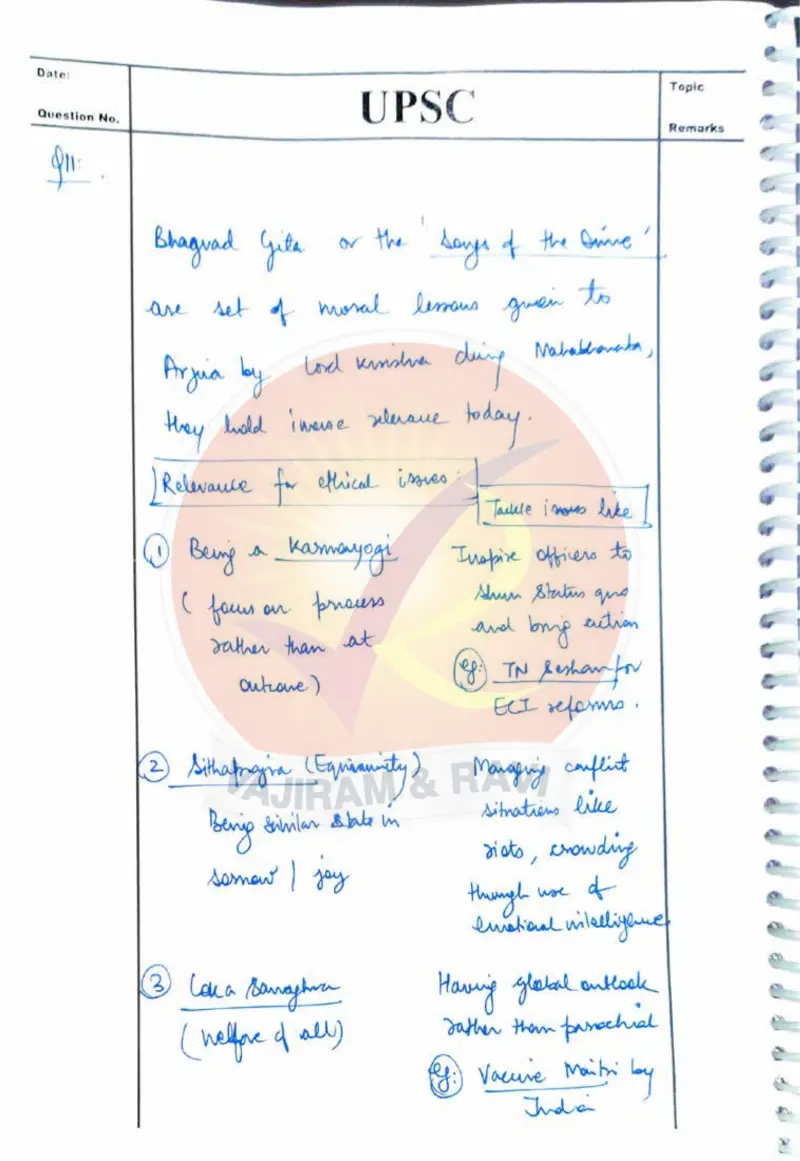
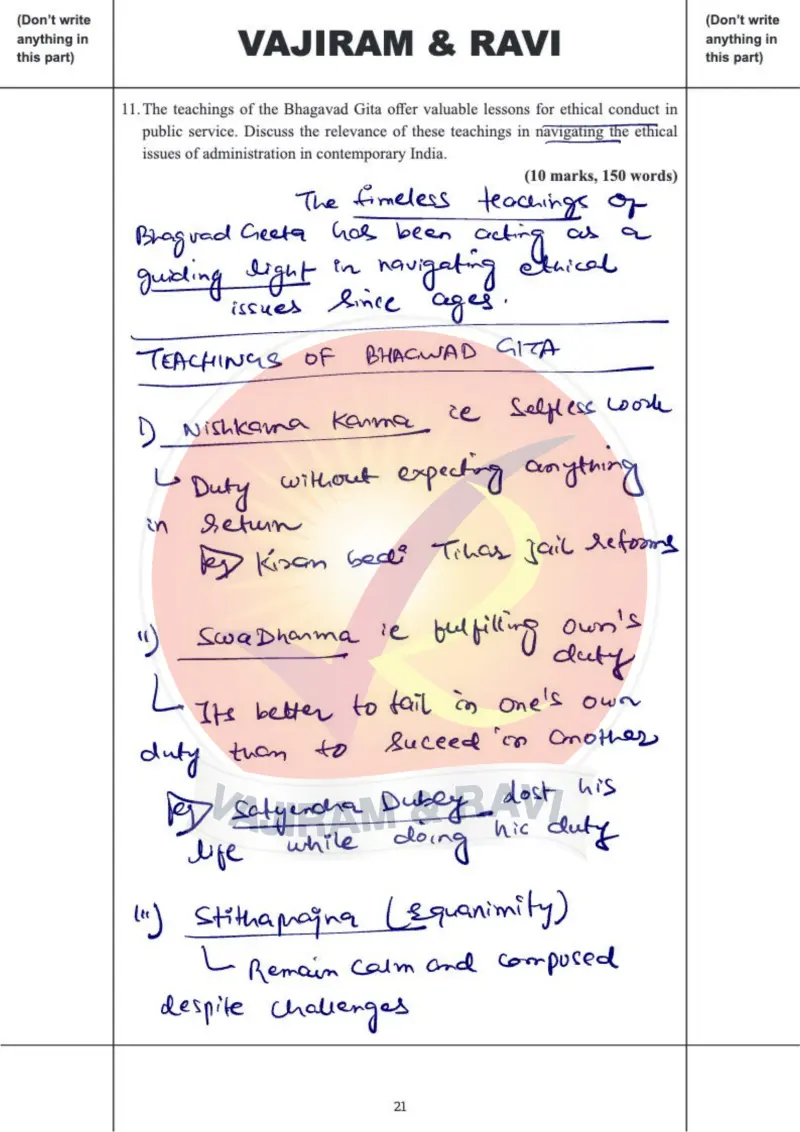
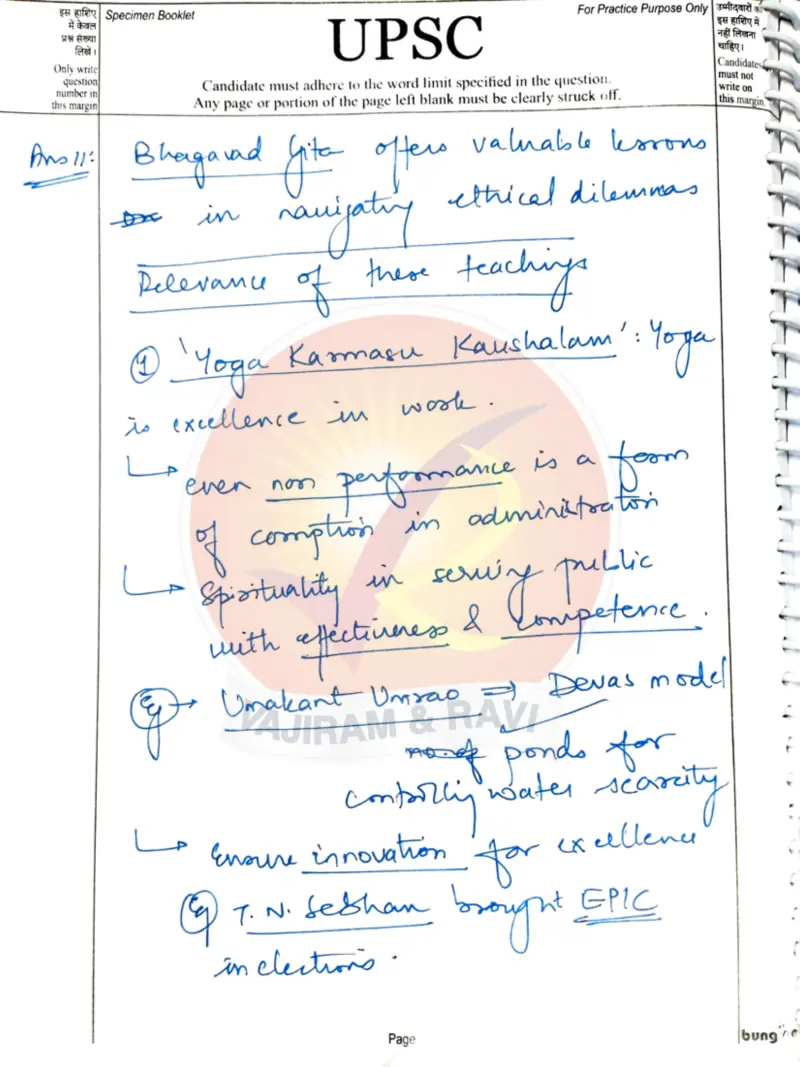
Their question: “Relevance of Bhagavad Gita teachings for ethical conduct in contemporary public service”
The 2025 PYQ ('one devoted to one's duty attains highest perfection') draws on the Gita's karma-yoga; Aayushi's Gita-teachings answer (Nishkaam Karma, Yoga Karmasu Kaushalam, Sthithprajna) directly supplies the source concepts on duty, excellence and detached action.
Key learnings from their answer
- ›She pairs almost every abstract ethics point with a precise, named example rather than a vague reference, e.g. Anne Sullivan mentoring Helen Keller and Jijabai teaching values to Shivaji for value-inculcation (Q2), Copernicus defending heliocentrism and Vidyasagar's widow-remarriage campaign for courage-under-controversy (Q6b/6c), and Baba Amte empathising with leprosy patients for empathy (Q7). Lesson: build a stocked, named example bank so each ethical claim lands on a concrete person/event instead of a generic platitude.
- ›She closes answers on a deliberate value-laden maxim that fits the question, 'Yogakshema' for the welfare-state accountability answer (Q5), 'Vasudhaiva Kutumbakam' for global inequality (Q8), Aristotelian 'eudaimonia' for the AI-policy answer (Q14), 'Nari Shakti' for women's participation (Q13). Lesson: a short, topic-matched maxim as your last line gives Ethics answers a memorable 'signature' ending, but pick one that actually maps to the question, not a stock phrase.
Quotes used: “'Yoga Karmasu Kaushalam' — Bhagavad Gita (excellence in work) [Q11]” “'Nishkaam Karma' — Bhagavad Gita (selfless/detached action) [Q11]” “'Sthithprajna' — Bhagavad Gita (equanimity) [Q11]”