
Each of the digits 1, 2, 3, 4, 5, 6, 7, 8 and 9 is represented by a different letter in the following figure, such that each of “M + N + P”, “P + Q + R”, “R + S + T” and “T + U + V” is equal to 13. Which digit will ‘R’ represent?
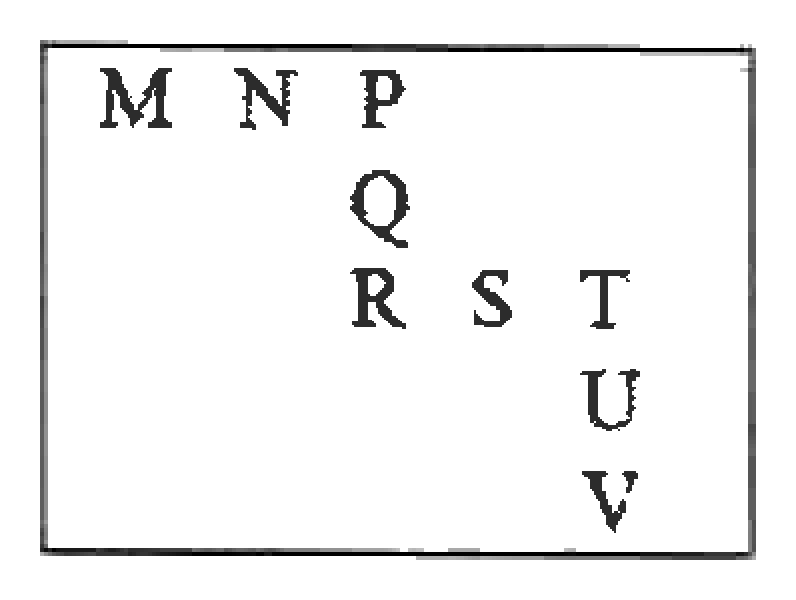
- (1)2
- (2)4
- (3)3
- (4)1
Answer
Why
Correct — option (2), 4.
In the figure, the letters run in two rows (M N P and R S T) and two columns (P Q R and T U V), and three letters sit where a row meets a column.
P belongs to both "M + N + P" and "P + Q + R". R belongs to both "P + Q + R" and "R + S + T". T belongs to both "R + S + T" and "T + U + V".
The stem gives each of the digits 1 to 9 a different letter, so the nine letters take the nine digits once each. The steps below rest on that.
Step 1 — add the four sums: 13 × 4 = 52.
Step 2 — add the nine digits, each used once: 1 + 2 + 3 + 4 + 5 + 6 + 7 + 8 + 9 = 45.
Step 3 — subtract: 52 − 45 = 7. The excess comes from P, R and T, each counted twice, so P + R + T = 7.
Step 4 — three different digits that total 7: 1, 2 and 4 is the only such set.
Step 5 — test R = 1: P and T are then 2 and 4. Whichever of them is 2 leaves 13 − 1 − 2 = 10 for its middle letter (Q or S). 10 is not a digit, so R ≠ 1.
Step 6 — test R = 2: P and T are then 1 and 4. Whichever is 1 leaves 13 − 2 − 1 = 10 for its middle letter. So R ≠ 2.
Step 7 — test R = 4: P and T are then 1 and 2. Q = 13 − 4 − P and S = 13 − 4 − T are then 8 and 7 (Q = 8 when P = 1, Q = 7 when P = 2), both digits.
Step 8 — complete one grid to confirm: P = 1, R = 4, T = 2, Q = 8, S = 7. M + N = 12 from 3, 5, 6, 9 gives 3 and 9. U + V = 11 gives 5 and 6. Every digit is used once.
So R = 4.
The idea to remember: when every digit is used once and the sums overlap, add all the sums and subtract the total of the digits; the difference is the total of the letters counted twice.
Why the others are wrong
- (1)2 — If R = 2, then P + T = 7 − 2 = 5, so P and T are 1 and 4.
Whichever of them is 1 needs a middle letter of 13 − 2 − 1 = 10, which is not a digit.
2 does appear in every valid grid, but as one of the other two corner letters, P or T.
- (3)3 — 3 cannot be R, or any corner letter. P + R + T = 7 with three different digits allows only 1, 2 and 4.
In every valid grid, 3 sits among the end letters M, N, U and V: it pairs with 9 to make M + N = 12 or U + V = 12.
- (4)1 — If R = 1, then P + T = 7 − 1 = 6, so P and T are 2 and 4.
Whichever of them is 2 needs a middle letter of 13 − 1 − 2 = 10, which is not a digit.
1 does appear in every valid grid, but as P or T, paired with 2 at the other corner.
Concept
Double counting: when the same items are added in overlapping groups, the total of all the group sums exceeds the total of the items by the items that were counted more than once.
Here the nine letters take the digits 1 to 9, a different digit each, and those digits total 45. Four lines of three letters each total 13, giving 52. The three corner letters appear in two lines each, so they account for the excess of 7.
Once the corner total is known, each possible corner value is tested against the lines it belongs to. A value that forces a letter outside 1 to 9 is ruled out.
RPSC's 2021 syllabus lists "Analytical Reasoning" under "Logical Reasoning (Deductive, Inductive, Abductive)" in Reasoning & Mental Ability.
A related counting step is used for magic squares. In a 3 × 3 magic square built from 1 to 9, the three rows together contain every digit once, so they total 45 and each row totals 15.
The sum of the first n counting numbers is n(n + 1)/2; for n = 9 that is 9 × 10 / 2 = 45.
Key facts
- 1 + 2 + 3 + 4 + 5 + 6 + 7 + 8 + 9 = 45.
- The four sums in the figure total 4 × 13 = 52.
- With each letter a different digit, P, R and T each lie on two lines, so P + R + T = 52 − 45 = 7.
- Three different digits totalling 7 can only be 1, 2 and 4.
- R = 4; P and T are 1 and 2 in either order, and then Q = 9 − P and S = 9 − T.
R represents 4: option (2).
Study next
Common traps
- Working from one line alone: 13 splits into three different digits in several ways, such as 1 + 3 + 9 and 2 + 5 + 6, so one line does not fix R.
- Forgetting the shared corners: P, R and T appear in two lines each, so the four sums total 7 more than 45.
- Stopping at P + R + T = 7: that gives the set 1, 2, 4 but not which one is R; each case has to be tested against a middle letter.
A question can print letters on overlapping lines, fix the total of each line, and ask the digit one letter stands for.
A question can also change the line total or the number of lines, or ask for the total of the letters where the lines meet.
Related PYQs
UnlockIAS will link similar questions from RAS Pre 2018 and 2013 here once those papers are published on this site.
Practice
- practice — not a real PYQ
In the same figure (M N P on the top line, P Q R going down, R S T across, T U V going down), each of the digits 1 to 9 is represented by a different letter, and each of "M + N + P", "P + Q + R", "R + S + T" and "T + U + V" is equal to 13. What is the value of P + R + T?
- (a)5
- (b)6
- (c)7
- (d)9
Answer(3) — The four sums total 52 and the digits 1 to 9 total 45. P, R and T are each counted twice, so P + R + T = 52 − 45 = 7. Options (1), (2) and (4) do not equal 52 − 45. - practice — not a real PYQ
Each of the digits 1 to 7 is represented by a different letter A, B, C, D, E, F and G, such that each of "A + B + C", "C + D + E" and "E + F + G" is equal to 11. What is the value of C + E?
- (a)4
- (b)5
- (c)6
- (d)7
Answer(2) — Sums total 33; digits 1 to 7 total 28. C and E count twice, so C + E = 33 − 28 = 5. A valid grid: A = 1, B = 7, C = 3, D = 6, E = 2, F = 4, G = 5. Options (1), (3) and (4) are not 5.