
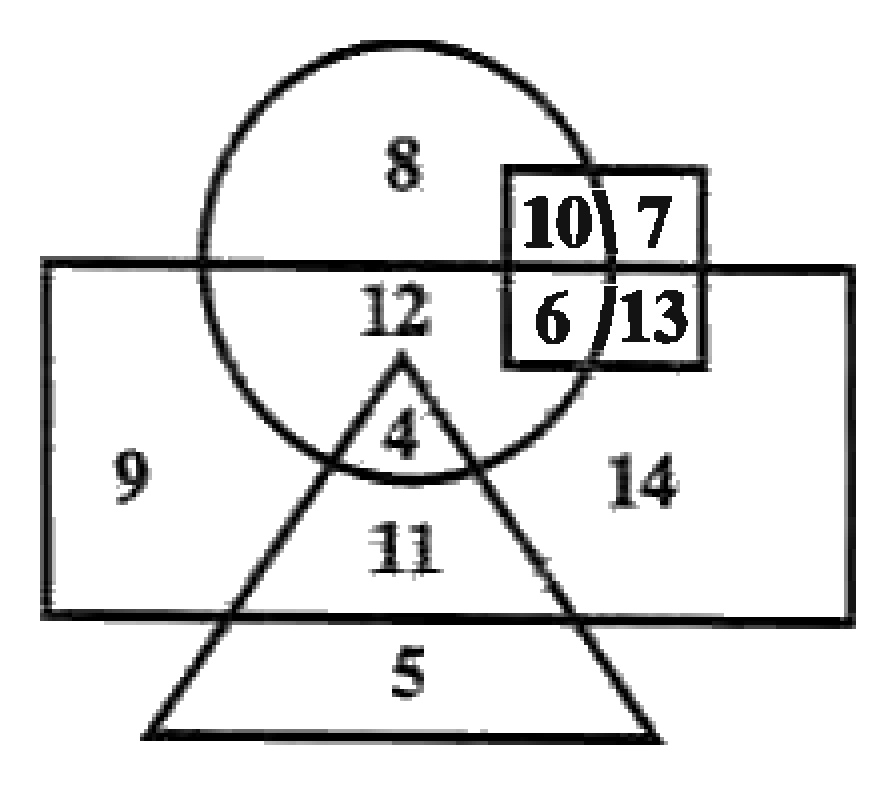
In the following diagram, rectangle represents men, triangle represents educated, circle represents urban and square represents government employees. Which one of the following represents educated men who are not urban?
- (1)4
- (2)11
- (3)9
- (4)14
Answer
Why
Correct — option (2), 11.
Translate each word of "educated men who are not urban" into a position in the figure.
Educated → inside the triangle
Men → inside the rectangle
Not urban → outside the circle
Government employees (the square) → not mentioned, so no condition
Step 1 — regions inside both the triangle and the rectangle.
Region 4: circle, rectangle and triangle
Region 11: rectangle and triangle
Step 2 — remove any region inside the circle.
Region 4 is inside the circle, so it drops out.
Left: region 11
Check the one other triangle region: 5 is in the triangle only, below the rectangle. Those people are educated but not men.
The idea to remember: turn each word into "inside" or "outside" a shape, apply them one at a time, and place no condition on a shape the stem does not mention.
Why the others are wrong
- (1)4 — Region 4 is inside the circle, the rectangle and the triangle: educated urban men.
It meets "educated" and "men" but fails "not urban", because it lies inside the circle. Region 11 is the part of the same overlap that lies outside the circle.
- (3)9 — Region 9 is inside the rectangle only, on its left: men who are not educated, not urban and not government employees.
It meets "men" and "not urban", but it lies outside the triangle, so these men are not educated.
- (4)14 — Region 14 is also inside the rectangle only, on its right. It stands for the same class as region 9: men who are not educated, not urban and not government employees.
A drawing can split one class into separate regions. Both 9 and 14 lie outside the triangle, so neither holds educated men.
Concept
In a Venn-type diagram each shape stands for a class, and each region is a combination of being inside or outside every shape.
A description such as "educated men who are not urban" becomes a list of conditions: inside the triangle, inside the rectangle, outside the circle. A shape the description does not mention places no condition.
Four shapes allow up to 16 inside/outside combinations, but a drawing shows only those its overlaps create. Here the square does not touch the triangle, so no region holds educated government employees.
One class can also appear as two separate regions, as 9 and 14 do.
RPSC's 2021 syllabus lists "Logical Venn diagram" under Mental Ability in Reasoning & Mental Ability.
The same reading is set notation. With T for educated, R for men and C for urban, the class asked for is T ∩ R ∩ C′, where C′ means "not in C".
Intersection (∩) keeps what lies in both shapes, union (∪) what lies in either, and the complement (′) what lies outside a shape.
Key facts
- Region 11 is inside the rectangle and the triangle and outside the circle and the square: educated men who are not urban.
- Region 4 is inside the circle, the rectangle and the triangle: educated urban men.
- Regions 9 and 14 are inside the rectangle only: men who are not educated, not urban and not government employees.
- Region 5 is inside the triangle only: educated people who are not men, not urban and not government employees.
- In set notation the class asked for is Triangle ∩ Rectangle ∩ (not Circle).
Rectangle = men, triangle = educated, circle = urban, square = government employees.
Study next
Common traps
- Keeping region 4. It lies inside the triangle and the rectangle, but also inside the circle, so those men are urban.
- Taking a rectangle-only region. 9 and 14 are men who are not urban, but they lie outside the triangle, so they are not educated.
- Adding a condition the stem does not set. Government employees are not mentioned, so the square neither includes nor excludes a region.
A question can assign classes to overlapping shapes and ask which numbered region shows a described group, as this one does.
A question can also ask which description fits a given region, or give numbers in the regions and ask how many people belong to a group.
Related PYQs
A Venn diagram is drawn followed by the four choices. Select the correct choice which represents the given diagram.
- (1) Teacher, Mother, Doctor
- (2) Universe, Planets, Stars
- (3) Income Tax, Sales Tax, Service Tax
- (4) Library, Books, Furniture
Answer(1)
Same reading of shapes as classes. That question matches a drawn Venn diagram to a group of three classes (RPSC's key: Teacher, Mother, Doctor); this one reads four overlapping shapes and picks the numbered region for one combined class.
Practice
- practice — not a real PYQ
In a Venn diagram, circle W stands for women, circle D for doctors and circle P for players. Which region shows women doctors who are not players?
- (a)Inside W, D and P
- (b)Inside W and D, outside P
- (c)Inside D only
- (d)Inside W and P, outside D
Answer(2) — Women doctors lie inside both W and D, and "not players" puts them outside P. Option (1) adds players; option (3) is doctors who are neither women nor players; option (4) is women players who are not doctors. - practice — not a real PYQ
In a group, 40 people speak Hindi, 25 speak English and 10 speak both. How many people speak only Hindi?
- (a)30
- (b)40
- (c)15
- (d)55
Answer(1) — Only Hindi = Hindi speakers − those who speak both = 40 − 10 = 30. Option (2) still includes the 10 who speak both; option (3) is those who speak only English, 25 − 10; option (4) is everyone who speaks at least one of the two, 40 + 25 − 10.