
Consider the following statements regarding Sanchi and its archaeological findings : 1. When Sanchi was discovered in 1818, three of its four gateways were still standing, the fourth was lying on the spot where it had fallen 2. Animals depicted at Sanchi include elephants, horses, monkeys and cattle Which of the statements given above is/are correct ?
- (a)Only 1
- (b)Only 2
- (c)Both 1 and 2
- (d)Neither 1 nor 2
Answer
Why
Correct — C, Both 1 and 2. Both statements are lifted almost word for word from the NCERT Class 12 History chapter on thinkers, beliefs and buildings. On the discovery it records that when Sanchi was found in 1818, three of its four gateways were still standing, the fourth was lying on the spot where it had fallen, and the mound was in good condition. On the sculpture it records that some of the finest depictions of animals are found there, and that these animals include elephants, horses, monkeys and cattle. Neither statement contains a planted error, so the pairing holds and the answer is that both are correct.
Why the others are wrong
- (a)Only 1 — It accepts the account of the discovery but rejects the animals, and the animals are named explicitly in the same chapter — elephants, horses, monkeys and cattle. Elephants in particular were carved to signify strength and wisdom, and several of the animal scenes come from the Jataka stories.
- (b)Only 2 — It accepts the sculpture but rejects the state of the site in 1818, which is the better documented of the two claims. Sanchi's relatively intact condition at discovery is exactly what the standard account contrasts with the fate of Amaravati.
- (d)Neither 1 nor 2 — Both statements are accurate as written, so rejecting both cannot be right. This option only tempts a candidate who is unsure of either statement and prefers a blanket denial.
Concept
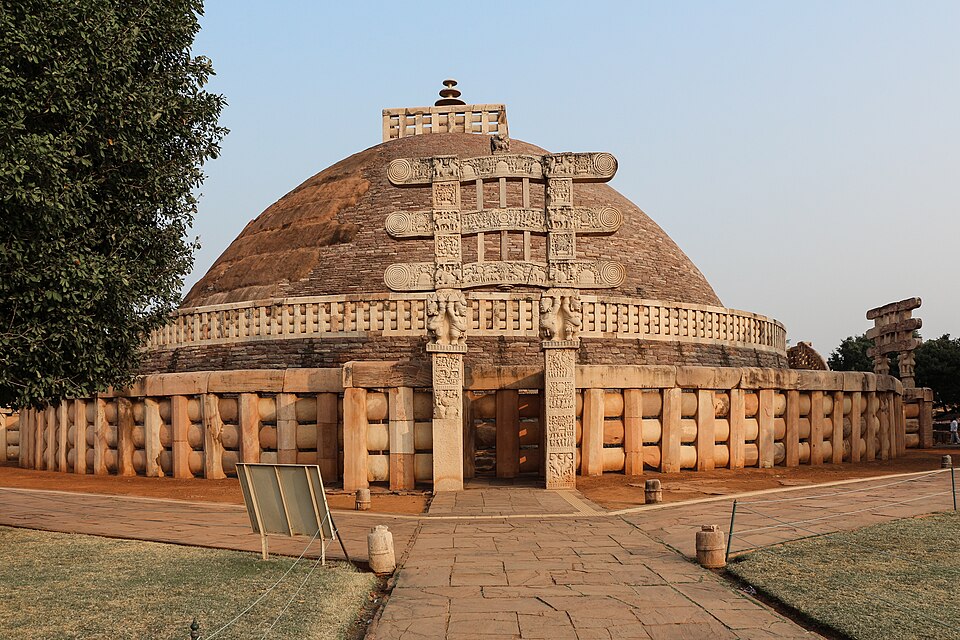
The Great Stupa at Sanchi in Madhya Pradesh is the best preserved of the early Buddhist stupa complexes. A hemispherical mound raised over relics is enclosed by a stone railing and entered through richly carved gateways set at the four cardinal points; worshippers came in and walked around the mound clockwise. Sanchi survived where other sites did not, and it is the surviving carving that makes it the standard source for what early Buddhist sculpture looked like.
The two statements are testing two different kinds of knowledge, and the second is the one candidates doubt. It feels like an oddly specific list, so a student who has not read the chapter suspects a planted error and marks 'Only 1'. There is no error — the list is the textbook's own. Statement 1 is worth reading closely too, because the natural misreading is that Sanchi was found in ruins; the point of the sentence is the opposite, that the site was in unusually good condition, which is precisely why it was preserved rather than dismantled. That story is a useful one to know in full: the French sought Shahjehan Begum's permission to carry off the eastern gateway, the best preserved, for a museum in France, and some Englishmen wanted the same, but both were satisfied with plaster-cast copies and the originals stayed on site. Shahjehan Begum and her successor Sultan Jehan Begum, rulers of Bhopal, paid for the site's preservation, and John Marshall dedicated his volumes on Sanchi to Sultan Jehan, who funded the museum, the guesthouse he wrote in, and the publication itself.
Key facts
- When Sanchi was discovered in 1818, three of its four gateways were still standing, the fourth was lying on the spot where it had fallen, and the mound was in good condition.
- The animals depicted at Sanchi include elephants, horses, monkeys and cattle; elephants were used to signify strength and wisdom.
- The rulers of Bhopal, Shahjehan Begum and Sultan Jehan Begum, funded the preservation of the site, the museum and the publication of John Marshall's volumes on Sanchi.
- The early stupas at Sanchi and Bharhut were plain except for their stone railings and their richly carved gateways, which were installed at the four cardinal points.
Study next
Common traps
- Doubting a very specific list of animals; here the list is exactly the one the textbook gives.
- Reading statement 1 as saying Sanchi was found in ruins, when its point is that the site had survived largely intact.
- Confusing Sanchi with Amaravati, whose sculptured slabs were carried away and whose mound was left denuded.
Asked as a two-statement item on a single monument — one statement on its rediscovery, one on its sculpture.
Related PYQs
With reference to ancient India, consider the following statements: 1. The concept of Stupa is Buddhist in origin. 2. Stupa was generally a repository of relics. 3. Stupa was a votive and commemorative structure in Buddhist tradition. How many of the above statements are correct?
- (a) Only one
- (b) Only two
- (c) All three
- (d) None
Answer(b) Only two
Asked in the same year as this NDA paper and on the same monument type. It tests what a stupa is for — a repository of relics and a votive, commemorative structure — which is the background the Sanchi statements sit against.
Consider the following historical places : 1. Ajanta Caves 2. Lepakshi Temple 3. Sanchi Stupa Which of the above places is/are also known for mural paintings?
- (a) 1 only
- (b) 1 and 2 only
- (c) 1, 2 and 3
- (d) None
Answer(b) 1 and 2 only
Turns on the same point as statement 2 here, from the other side — Sanchi is famous for stone sculpture and carved gateways, not for wall painting, which is why it is excluded there and why its animal carvings are what get tested.
Early Buddhist sculptors did not show Buddha in human form. Through which of the following symbols was Buddha's presence shown by the early sculptors?
- (a) Empty Seat and Stupa only
- (b) Wheel and Tree only
- (c) Wheel, Tree and Stupa only
- (d) Empty Seat, Wheel, Tree and Stupa
Answer(d) Empty Seat, Wheel, Tree and Stupa
Covers the sculptural vocabulary of the very gateways this question describes — the symbols and the animal scenes at Sanchi belong to the same phase, before the Buddha was shown in human form.
Practice
- practice — not a real PYQ
The rulers of Bhopal who funded the preservation of the Sanchi stupa complex were
- (a)Shahjehan Begum and Sultan Jehan Begum
- (b)Sikandar Begum and Nawab Hamidullah Khan
- (c)Qudsia Begum and Nawab Dost Mohammad Khan
- (d)Rani Kamlapati and Nawab Yar Mohammad Khan
Answer(a) Shahjehan Begum and Sultan Jehan Begum — John Marshall dedicated his volumes on Sanchi to Sultan Jehan, who funded the museum, the guesthouse and the publication. - practice — not a real PYQ
The gateways of the Great Stupa at Sanchi were installed
- (a)only on the eastern side
- (b)at the four cardinal points
- (c)at the top of the mound
- (d)inside the stone railing, facing the relic chamber
Answer(b) at the four cardinal points — worshippers entered through the eastern gateway and walked around the mound clockwise.