
Early Buddhist sculptors did not show Buddha in human form. Through which of the following symbols was Buddha's presence shown by the early sculptors?
- (a)Empty Seat and Stupa only
- (b)Wheel and Tree only
- (c)Wheel, Tree and Stupa only
- (d)Empty Seat, Wheel, Tree and Stupa
Answer
Why
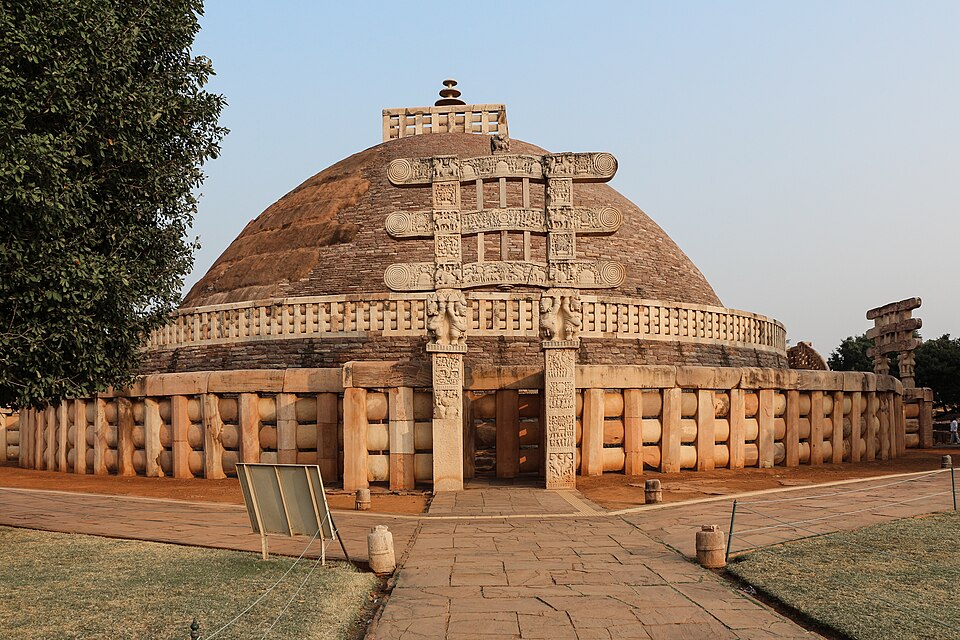
Correct — D, Empty Seat, Wheel, Tree and Stupa. In the early (pre-Kushana) phase of Buddhist art at sites such as Sanchi and Bharhut, sculptors avoided depicting the Buddha in human form. His presence was suggested through symbols — an empty seat or throne, the wheel (dharmachakra), the Bodhi tree and the stupa (as well as footprints). Since all four listed symbols were used, D is correct.
Why the others are wrong
- (a)Empty Seat and Stupa only — The empty seat and stupa were used, but so were the wheel (dharmachakra) and the Bodhi tree; restricting it to two leaves out the other aniconic symbols.
- (b)Wheel and Tree only — The wheel and Bodhi tree were used, but the empty seat and the stupa were equally common symbols of the Buddha's presence.
- (c)Wheel, Tree and Stupa only — This omits the empty seat/throne, one of the most characteristic aniconic symbols; all four were in use, so the complete set is the correct answer.
Concept
The earliest phase of Buddhist art (roughly 2nd century BCE to 1st century CE, at Bharhut, Sanchi and Amaravati) was aniconic — it represented the Buddha not as a person but through symbols. The Buddha in human form appeared later, notably in the Gandhara and Mathura schools of the Kushana period.
Each symbol recalls an event in the Buddha's life or teaching: the Bodhi tree (enlightenment), the wheel (the first sermon, setting the dharmachakra in motion), the stupa (his death and relics) and the empty seat (his presence without depicting him). Wrong options tempt by dropping one or two of these.
Key facts
- Early Buddhist art was aniconic — the Buddha was shown through symbols, not as a human figure.
- Key symbols: empty seat/throne, wheel (dharmachakra), Bodhi tree, stupa and footprints.
- Sanchi, Bharhut and Amaravati are famous early aniconic sites.
- Human images of the Buddha emerged later in the Gandhara and Mathura schools.
Study next
Common traps
- Picking an 'only' option that leaves out one valid symbol.
- Assuming human images of the Buddha existed from the very beginning.
A 'select all that apply' recall of early Buddhist (aniconic) symbols — the trap is the incomplete lists.
Related PYQs
Which one of the following pairs is correctly matched?
- (a) Vikramsila Monastery : Uttar Pradesh
- (b) Hemkund Gurudwara : Himachal Pradesh
- (c) Udayagiri Caves : Maharashtra
- (d) Amaravati Buddhist Stupa : Andhra Pradesh
Answer(d) Amaravati Buddhist Stupa : Andhra Pradesh
Same field — early Buddhist stupa art. That UPSC item locates the Amaravati stupa (a major aniconic-art site); this one tests the symbols such stupas and gateways used to represent the Buddha.
Which one of the following sculptures found at Sanchi Stupa is NOT directly inspired by Buddhist ideas?
- (a) Empty seat
- (b) Shalbhanjika
- (c) Tree
- (d) Wheel
Answer(b) Shalbhanjika
Same concept — the aniconic symbols at Sanchi. That NDA item asks which Sanchi carving is NOT a Buddhist symbol (the Shalbhanjika), while this one asks which symbols were used to show the Buddha's presence.
Practice
- practice — not a real PYQ
The depiction of the Buddha in human form is first prominently associated with which schools of art?
- (a)Bharhut and Sanchi
- (b)Gandhara and Mathura
- (c)Chola and Pallava
- (d)Rajput and Pahari
Answer(b) Gandhara and Mathura — the Kushana-period schools that gave the Buddha a human image. - practice — not a real PYQ
In early Buddhist art, the wheel (dharmachakra) symbolises
- (a)the Buddha's birth
- (b)the Buddha's first sermon
- (c)the Buddha's death
- (d)the Buddha's renunciation
Answer(b) the Buddha's first sermon — 'turning the wheel of law' at Sarnath.