
Which one of the following is the usual unit of measurement for Air Pressure used in India ?
- (a)Centimeter
- (b)Millibar
- (c)Milligram
- (d)Milliliter
Answer
Why
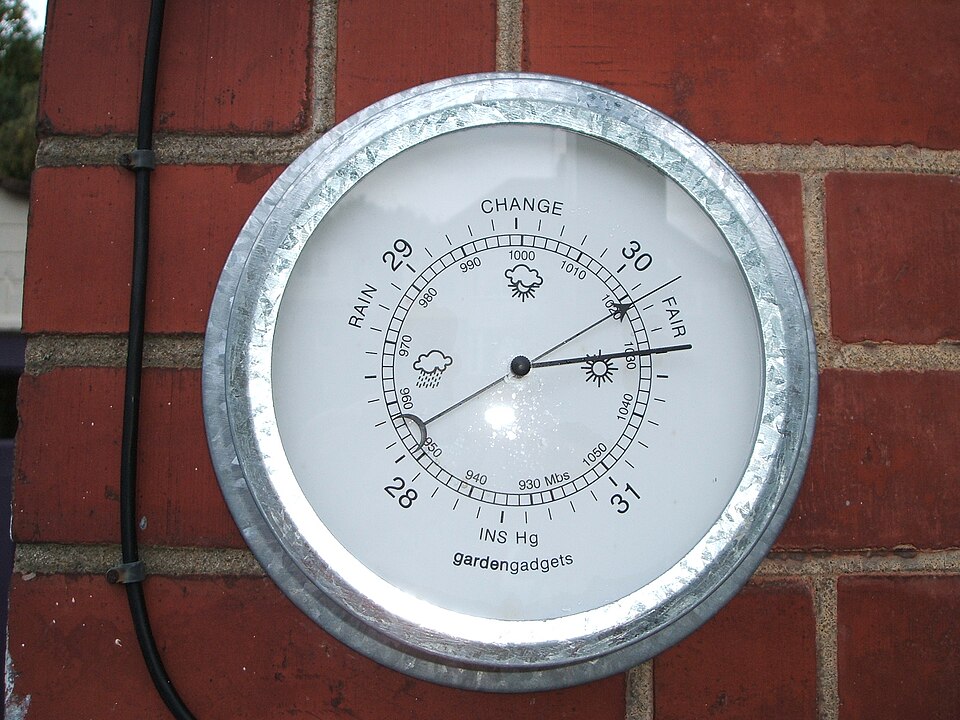
Correct — B, millibar. Air pressure is the weight of a column of air standing on a unit area, so whatever unit measures it has to express force spread over area. Indian meteorological practice, in line with world practice, uses the millibar — the standard geography text states that atmospheric pressure is expressed in units of millibar and that the average value at sea level is 1013.2 millibar, and Indian weather charts draw their isobars in the same unit, for instance the 1019 mb and 1013 mb isobars that run across northwest India and the far south in winter. One millibar equals one hectopascal, which is the same quantity written in SI dress.
Why the others are wrong
- (a)Centimeter — A centimetre measures length. A mercury barometer is read as a height of mercury, but that height is a stand-in for pressure rather than the unit of pressure itself, and it is not what appears on an Indian weather chart.
- (c)Milligram — A milligram measures mass. Air does have mass, and pressure comes from the weight of that air, but a mass on its own says nothing until you specify the area it presses on.
- (d)Milliliter — A millilitre measures volume. It is used for liquids and gases by bulk, and has no bearing on how hard the atmosphere presses on a surface.
Concept
Atmospheric pressure is defined as the weight of the column of air contained in a unit area from mean sea level to the top of the atmosphere. Because it varies with altitude, station readings are first reduced to sea level so that places at different heights can be compared, and only then plotted. Lines joining places of equal pressure on the resulting map are isobars, and the pattern of isobars is what tells a forecaster where the highs and lows are.
The three wrong options are all units of something else — length, mass and volume — so a candidate who simply asks ‘which of these could measure force per unit area’ gets there without knowing any meteorology. Keep the sea-level anchor of about 1013 mb in memory as well, because it converts this into an easy calculation item, because pressure drops to roughly 899 mb at 1 km, 540 mb at 5 km and 265 mb at 10 km in a standard atmosphere. Also note the equivalence 1 mb = 1 hPa; charts published today often print hectopascals, and a candidate who has only ever seen ‘millibar’ should not be thrown by it.
Key facts
- Atmospheric pressure is the weight of a column of air in a unit area from mean sea level to the top of the atmosphere, and it is expressed in millibars.
- The average atmospheric pressure at sea level is 1013.2 millibar; 1 millibar equals 1 hectopascal.
- In a standard atmosphere, pressure falls to about 899 mb at 1 km, 540 mb at 5 km and 265 mb at 10 km.
- Indian winter charts show the 1019 mb isobar over northwest India and the 1013 mb isobar over the far south, which is the pressure gradient that drives the winter winds.
Study next
Common traps
- Picking centimetre because mercury barometers are read in centimetres of mercury.
- Forgetting that the millibar and the hectopascal are the same size, and treating a hectopascal chart as a different system.
As a straight unit-identification item like this one, or as a numerical question on how much pressure falls over a given rise in altitude.
Related PYQs
The amplitude of sound waves is measured in the units of
- (a) pressure
- (b) distance
- (c) time
- (d) speed
Answer(a) pressure
The same skill of asking what kind of quantity a unit belongs to. That paper wanted the quantity behind sound amplitude; this one wants the unit behind air pressure. Both fall to the question ‘force per unit area, or something else?’
Which one of the following is NOT the unit of energy?
- (a) Joule
- (b) Watt-hr
- (c) Newton-metre
- (d) kg-metre/sec²
Answer(d) kg-metre/sec²
The odd-unit-out version of the same drill. NDA returns often to whether a candidate can tell which physical quantity a given unit actually measures, and dimensional sense settles both items faster than memory does.
Practice
- practice — not a real PYQ
The average atmospheric pressure at mean sea level is about
- (a)1013 millibar
- (b)1013 millimetre
- (c)760 millibar
- (d)100 millibar
Answer(a) 1013 millibar — the standard sea-level value, equal to about 1013 hectopascal. - practice — not a real PYQ
Lines drawn on a weather map to join places having equal atmospheric pressure are called
- (a)isohyets
- (b)isotherms
- (c)isobars
- (d)isohalines
Answer(c) isobars — isohyets join equal rainfall, isotherms equal temperature and isohalines equal salinity.