
Which one of the following was NOT a way in which kings in ancient India attempted to claim a higher status ?
- (a)Identifying with a variety of deities
- (b)Assuming pompous titles
- (c)Imposing high taxes
- (d)Conquests and annexation of territories
Answer
Why
Correct — C, Imposing high taxes. Taxation in ancient India was the ordinary fiscal machinery of the state. Revenue paid for the army, the officials and the court, and every settled kingdom collected it — a chief who taxed heavily was not thereby announcing that he outranked other rulers, and a resented tax burden was as likely to damage a king's standing as to raise it. The other three options are exactly the devices the sources show rulers using to advertise superiority — divine association, grand titles, and a record of conquest.
Why the others are wrong
- (a)Identifying with a variety of deities — This was a standard status claim. Kushana rulers took the title meaning 'son of god' — the Rabatak inscription describes Kanishka as a king of kings and a son of god — and later dynasties advertised their devotion to a chosen deity in their own titles.
- (b)Assuming pompous titles — Grandiose titles were the most visible way of ranking oneself above neighbouring rulers. Names such as maharaja-adhiraja, 'great king of kings', were adopted precisely to signal a rung above the ordinary raja.
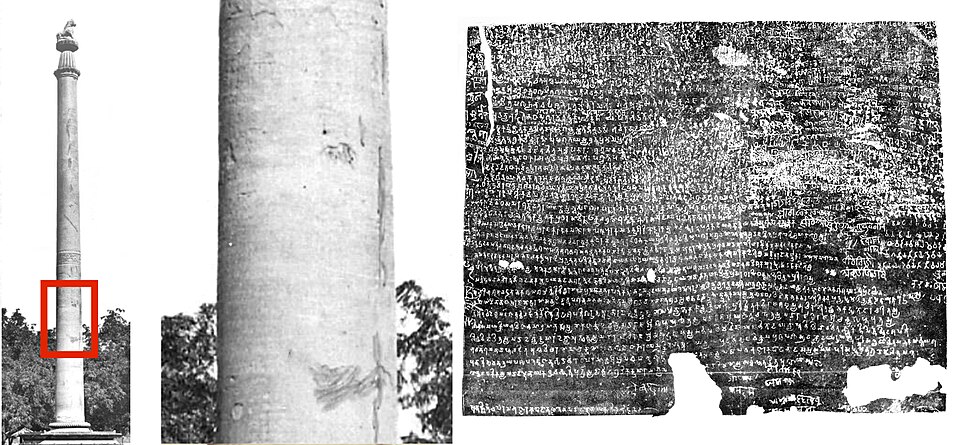
- (d)Conquests and annexation of territories — Military success was routinely turned into a status claim. Court eulogies existed to record it — Samudragupta's conquests were set down in the Prayag Prashasti composed by his court poet Harishena and inscribed on an old Ashokan pillar.
Concept
Kingship in ancient India was not self-evident; a ruler had to be seen to be more than a powerful landholder. Three strategies recur in the inscriptional record. Rulers linked themselves to the divine, by taking god-derived titles or by having images of themselves placed in shrines. They adopted composite titles that stacked kingship on kingship. And they had their military campaigns turned into formal eulogies, or prashastis, carved on pillars and rock faces where they would be read for centuries.
Sort the four options into 'display' and 'administration'. Divine identification, inflated titles and recorded conquest are all display — they exist to be seen and repeated. Tax collection is administration; it is how a state pays for itself, and it appears in the sources as revenue policy rather than as a boast. Do not be misled by the fact that taxes were central to kingship. Being central is not the same as being a claim to higher status, and that is the distinction the question is drawing.
Key facts
- The Rabatak inscription refers to the Kushana ruler Kanishka as a king of kings and a son of god.
- Titles such as maharaja-adhiraja, meaning great king of kings, were used to place a ruler above ordinary kings.
- The Prayag Prashasti, a eulogy of Samudragupta composed by his court poet Harishena, was inscribed on an Ashokan pillar and records his campaigns.
- Taxation supplied the revenue for the army and administration, which is a fiscal function rather than a claim to superior rank.
Study next
Common traps
- Reading 'NOT' too quickly and picking a genuine status-claim option.
- Assuming that anything central to kingship must also be a status claim.
- Confusing royal ritual sacrifices, which were status claims, with the tax revenue that paid for them.
Asked as an odd-one-out on kingship strategies, as a source-based item on a named inscription, or as a match item pairing a ruler with a title.
Related PYQs
Who among the following rulers in ancient India had assumed the titles 'Mattavilasa', 'Vichitrachitta' and 'Gunabhara'?
- (a) Mahendravarman I
- (b) Simhavishnu
- (c) Narasimhavarman I
- (d) Simhavarman
Answer(a) Mahendravarman I
The title strategy in action. UPSC tests the specific epithets a Pallava king took for himself, which is the same practice this NDA question lists as option (b).
The name by which Asoka is generally referred to in his inscriptions is
- (a) Chakravarti
- (b) Dharmadeva
- (c) Dharmakirti
- (d) Priyadarshini
Answer(d) Priyadarshini
Another self-designation item — how a king chose to be named in his own inscriptions, the same self-presentation this question is probing.
Which one of the following statements about Rabatak inscription is not correct?
- (a) It throws important light on Kushana genealogy.
- (b) It refers to Kanishka as 'a king of kings and a son of God'.
- (c) The 23-line inscription is written in Gandhari language.
- (d) It mentions names of States which were part of Kanishka's empire.
Answer(c) The 23-line inscription is written in Gandhari language.
Direct evidence for option (a) here. Its option (b) — which the key treats as a correct statement — is a ruler declaring himself a king of kings and a son of god, exactly the divine-and-title claim being tested.
Who among the following composed the 'Prayag Prashasti' of Samudragupta ?
- (a) Harishena
- (b) Chand Bardai
- (c) Vishakhadatta
- (d) Kalidasa
Answer(a) Harishena
The eulogy behind option (d). A prashasti is a conquest record written to raise a ruler's standing, which is why conquest and annexation count as a status claim.
Practice
- practice — not a real PYQ
The Prayag Prashasti, which records the campaigns of Samudragupta, was composed by
- (a)Kalidasa
- (b)Harishena
- (c)Vishakhadatta
- (d)Banabhatta
Answer(b) Harishena — the court poet of Samudragupta, whose eulogy was inscribed on an Ashokan pillar at Allahabad. - practice — not a real PYQ
The title 'devaputra', meaning son of god, is most closely associated with the rulers of which dynasty?
- (a)Kushana
- (b)Satavahana
- (c)Chola
- (d)Pala
Answer(a) Kushana — the Rabatak inscription describes Kanishka as a king of kings and a son of god.