
Relationship between a flower and honey-bee will help the flower for/in
- (a)Faster development
- (b)Pollination
- (c)Quick germination of pollen
- (d)Increase in size
Answer
Why
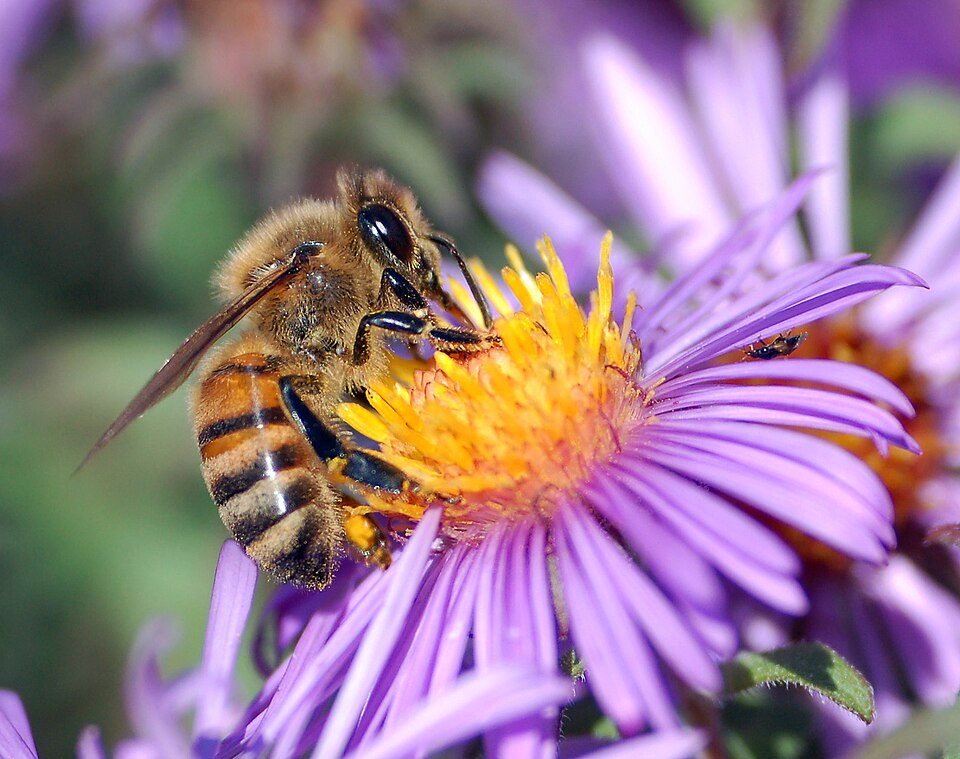
Correct — B, Pollination. The bee comes for food, not for the flower's benefit — it collects nectar and pollen. While it works the flower, pollen grains stick to the hairs on its body, and it carries them to the next flower it visits, where some rub off on the stigma. That transfer of pollen from anther to stigma is pollination, and for a rooted plant that cannot move, an insect courier is the whole point of the relationship. Each side gains something, so this is a classic case of mutualism.
Why the others are wrong
- (a)Faster development — A bee has no effect on how fast the plant grows. It visits a flower only after the flower has already developed and opened, so it cannot be speeding that development up.
- (c)Quick germination of pollen — A pollen grain germinates once it lands on a compatible stigma and responds to the stigma's secretions. The bee's contribution ends with delivering the grain to the right address; it does not make the grain sprout faster.
- (d)Increase in size — The size of a flower is set by the plant's own growth and its genes. What does enlarge later is the ovary as it ripens into a fruit, and that happens after fertilisation — it is a downstream result, not what the bee does for the flower.
Concept
Pollination is the transfer of pollen grains from the anther to the stigma, and it must happen before fertilisation can. Plants that cannot move rely on carriers — wind, water, insects, birds or bats. Pollination by insects is called entomophily, and bees are the most important insect pollinators. The flower pays for the service in nectar and surplus pollen, so both partners benefit and the association is mutualistic.
The stem asks what the flower gains, so eliminate anything the bee physically cannot do. It cannot make a plant grow faster, cannot enlarge a flower, and cannot trigger a pollen grain to germinate — germination is the stigma's business. What it can do is move pollen between flowers, and that single service is the reason insect-pollinated flowers evolved colour, scent and nectar in the first place. Cross-pollination also brings in pollen from a different plant, which is where the genetic variation comes from.
Key facts
- Pollination is the transfer of pollen from anther to stigma; fertilisation can only follow after it.
- Pollination by insects is called entomophily, and honey-bees are among the most effective insect pollinators.
- Insect-pollinated flowers typically offer nectar and carry sticky pollen that clings to a visitor's body.
- The flower-and-bee association is mutualism — the bee takes food, the plant gets its pollen carried to another flower.
Study next
Common traps
- Confusing pollination with fertilisation — the bee delivers the pollen, it does not fuse the gametes.
- Reading the ripening of the ovary into a fruit as the flower itself increasing in size.
- Assuming the bee visits in order to help the plant, when it visits for its own food.
Asked as a plain 'what does the pollinator do' item, as an ecological-interaction item on mutualism, or as an environment item on the consequences of pollinator decline.
Related PYQs
Consider the following kinds of organisms: 1. Bat 2. Bee 3. Bird Which of the above is/are pollinating agent/agents?
- (a) 1 and 2 only
- (b) 2 only
- (c) 1 and 3 only
- (d) 1, 2 and 3
Answer(d) 1, 2 and 3
The same service seen from the agents' side. UPSC's key counts the bee alongside bats and birds as pollinators — which is precisely the role the bee is playing for the flower in this NDA question.
Due to some reasons, if there is a huge fall in the population of species of butterflies, what could be its likely consequence/consequences? 1. Pollination of some plants could be adversely affected. 2. There could be a drastic increase in the fungal infections of some cultivated plants. 3. It could lead to a fall in the population of some species of wasps, spiders and birds. Select the correct answer using the code given below:
- (a) 1 only
- (b) 2 and 3 only
- (c) 1 and 3 only
- (d) 1, 2 and 3
Answer(c) 1 and 3 only
Shows why the relationship matters at scale — remove the insect pollinators and plant pollination suffers, which is the same dependence this NDA question states positively.
Practice
- practice — not a real PYQ
Pollination brought about by insects is termed
- (a)anemophily
- (b)hydrophily
- (c)entomophily
- (d)ornithophily
Answer(c) entomophily — pollination by insects; anemophily is by wind, hydrophily by water and ornithophily by birds. - practice — not a real PYQ
The association between a flowering plant and its insect pollinator is best described as
- (a)parasitism
- (b)mutualism
- (c)commensalism
- (d)predation
Answer(b) mutualism — the insect gains food and the plant gains pollen transfer, so both benefit.