
Which one of the following is NOT an example of Fold Mountain ?
- (a)Mt. Fuji
- (b)Alps
- (c)Andes
- (d)Rockies
Answer
Why
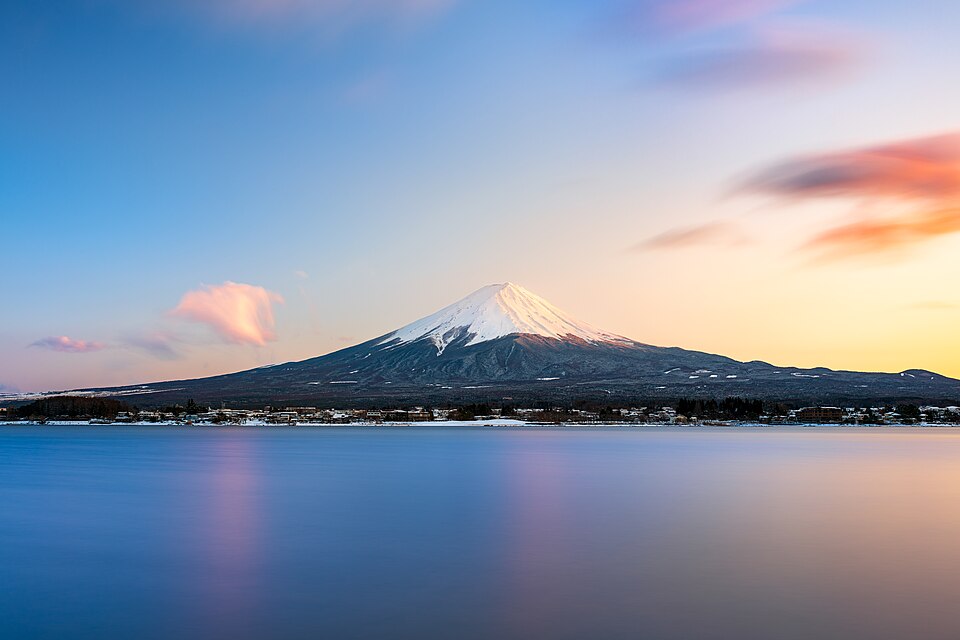
Correct — A, Mt. Fuji. A fold mountain is deformed crust. Two plates converge, the thick pile of sediment lying between them is squeezed, and the layers buckle into folds that are pushed up as a long arc-shaped belt. Mount Fuji was not made that way. It is an active stratovolcano on Honshu in Japan, a single cone about 3,776 m high that has grown from its own erupted lava and ash, standing at a triple junction where the Eurasian, North American and Philippine Sea plates meet and where subduction supplies the magma. Its last eruption ran from 1707 into 1708. A volcano is material piled up at one vent; a fold mountain is crumpled crust along a whole belt. The Alps, the Andes and the Rockies are all folded belts, so Fuji is the one that does not belong.
Why the others are wrong
- (b)Alps — The Alps are Europe's textbook young fold range, raised where the African and Eurasian plates converged and crumpled the sediments that had accumulated in the old Tethys sea. They are the example most physical geography books open the chapter with, so they cannot be the odd one out.
- (c)Andes — This is the most tempting wrong answer, because the Andes carry a long chain of famous active volcanoes. But the range itself is folded and thrust-faulted crust, raised where the Nazca plate dives beneath South America. The volcanoes stand on the fold belt; they are not what built it.
- (d)Rockies — The Rockies of western North America are a fold-and-thrust belt produced by compression along the western margin of the continent. They sit with the Alps and the Andes in the fold-mountain family, not with a volcanic cone.
Concept
Mountains are classified by how they were made, not by how they look. Fold mountains are belts of crust squeezed and buckled at converging plate margins — the Himalaya, Alps, Andes and Rockies. Block mountains are slabs lifted or left standing between faults, such as the Vosges and the Black Forest. Volcanic mountains are cones built by erupted lava and ash at a single vent, such as Fuji, Kilimanjaro and Etna. Residual or relict mountains are the worn-down stumps of far older ranges, such as the Aravalli.
The trap here is the Andes. Students remember that the Andes are dotted with volcanoes and conclude that the Andes must be the volcanic option. The correct test is what raised the whole range, not what sits on top of it — and the Andes were raised by compression along a subduction margin, which makes them a fold range with volcanoes on it. Fuji, by contrast, is a cone and nothing more, and the three other names in this list are the three ranges every syllabus cites as fold mountains. When the question asks for the exception among names you have all met before, the fastest route is to ask which one is a single peak rather than a belt of peaks.
Key facts
- Fold mountains form where converging plates compress and buckle thick sedimentary sequences; the Himalaya, Alps, Andes and Rockies are the standard examples.
- Mount Fuji is an active stratovolcano on Honshu, Japan, with a summit of about 3,776 m.
- Fuji last erupted from 1707 to 1708, in the eruption known as Hoei.
- Fuji stands at a triple junction where the Eurasian, North American and Philippine Sea plates meet, with the Pacific plate subducting beneath.
Study next
Common traps
- Picking the Andes because volcanoes stand on the range; the range itself is folded crust.
- Assuming any very high or very famous peak must be a fold mountain.
- Confusing block mountains such as the Vosges with fold mountains — those are fault-bounded, not buckled.
Asked as a one-step odd-one-out — three fold ranges and one volcanic cone, with the volcano-bearing Andes planted as the decoy.
Related PYQs
Consider the following information: Region — Name of the mountain range — Type of mountain 1. Central Asia — Vosges — Fold mountain 2. Europe — Alps — Block mountain 3. North America — Appalachians — Fold mountain 4. South America — Andes — Fold mountain In how many of the above rows is the given information correctly matched?
- (a) Only one
- (b) Only two
- (c) Only three
- (d) All four
Answer(b) Only two
Tests exactly the same classification, row by row — the Andes as a fold mountain is one of the rows that stands, while the Alps labelled a block mountain is the planted error. Between the two questions you get the fold, block and volcanic categories drilled from both directions.
Match List I with List II and select the correct answer using the codes given below the Lists: List I (Volcanic Mountain) I. Mt. Rainier II. Etna III. Paricutin IV. Taal List II (Country) A. Italy B. Mexico C. Philippines D. USA
- (a) I-D, II-B, III-A, IV-C
- (b) I-D, II-A, III-B, IV-C
- (c) I-B, II-A, III-D, IV-C
- (d) I-D, II-C, III-B, IV-A
Answer(b) I-D, II-A, III-B, IV-C
Works the other category in this question's list. Mount Fuji belongs with Rainier, Etna, Paricutin and Taal as a volcanic mountain, and knowing that family by name is what stops a candidate from lumping it in with the Alps, Andes and Rockies.
The maximum depth of Lithosphere is found in the
- (a) Pacific Ocean.
- (b) Siberian Plain.
- (c) Patagonian Desert.
- (d) Himalayan Mountains.
Answer(d) Himalayan Mountains.
The other half of the same fact. Fold mountains are built by compression, and compression thickens the crust — which is why the deepest crustal root under any of those four places lies beneath the Himalaya, the greatest young fold belt on Earth.
Practice
- practice — not a real PYQ
Which one of the following mountains is a volcanic mountain?
- (a)Aravalli
- (b)Vosges
- (c)Kilimanjaro
- (d)Ural
Answer(c) Kilimanjaro — a volcanic massif in East Africa; the Aravalli is a worn-down residual range, the Vosges a block mountain and the Urals an old fold range. - practice — not a real PYQ
Fold mountains are formed mainly at
- (a)divergent plate boundaries
- (b)convergent plate boundaries
- (c)transform plate boundaries
- (d)the interior of stable continental shields
Answer(b) convergent plate boundaries — compression there buckles thick sedimentary layers into folds and lifts them into a range.