
Consider the following statements regarding the royal center in Vijayanagara Empire : 1. The royal center was located in the south-western part of the settlement 2. It included over 60 temples 3. About 30 building complexes at the site have been identified as palaces Which of the statements given above is/are correct ?
- (a)1 only
- (b)2 only
- (c)1, 2 and 3
- (d)1 and 2 only
Answer
Why
Correct — C, 1, 2 and 3. All three statements are lifted almost word for word from the NCERT Class 12 chapter on Vijayanagara. That chapter opens its section on the royal centre with the line that it was located in the south-western part of the settlement, adds that although designated a royal centre it included over 60 temples, and then states that about thirty building complexes have been identified as palaces — relatively large structures with no apparent ritual function.
Why the others are wrong
- (a)1 only — This keeps the location but rejects the temple count and the palace count, both of which the source text states directly. Nothing in the archaeological record of Hampi contradicts either figure.
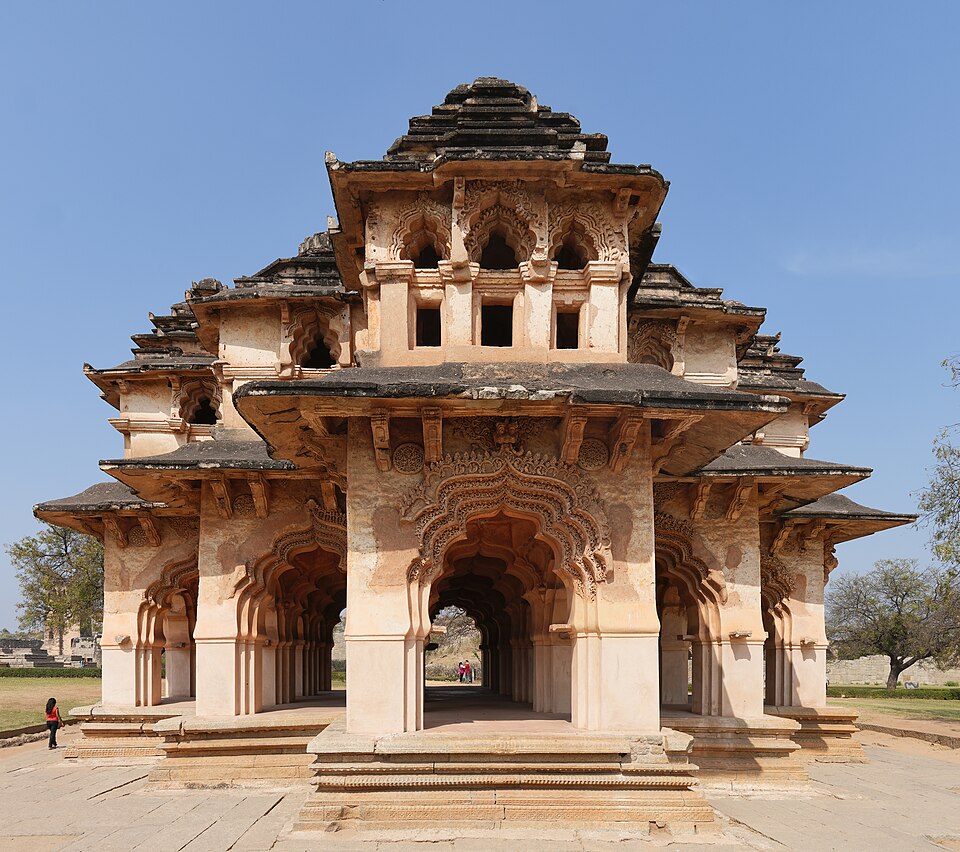
- (b)2 only — This rejects the location, but the royal centre's position in the south-western part of the settlement is exactly how the site is described; it is the quarter of Hampi that holds the enclosures, the Lotus Mahal and the so-called elephant stables.
- (d)1 and 2 only — The tempting trap — it accepts the two easy statements and drops the palace figure. But about thirty building complexes have indeed been identified as palaces, and the number is stated in the same passage as the other two.
Concept
Archaeologists divide the excavated city of Vijayanagara, modern Hampi in Karnataka, into a sacred centre along the Tungabhadra and a royal centre to its south-west. The royal centre is the administrative and residential quarter: high double walls, enclosures, an audience hall and the great platform called the mahanavami dibba. Even so it was not free of religion — the empire's rulers legitimised their authority by patronising temples and cults, which is exactly why a supposedly secular quarter contains more than sixty of them.
Treat the temple count as the teaching point, not as trivia. A candidate who assumes 'royal centre equals palaces, sacred centre equals temples' will reject statement 2 and pick option (d). The source text anticipates that mistake and says the opposite: most temples were in the sacred centre, but several stood in the royal centre as well. A second useful detail explains why so few palaces survive as buildings — temples were built entirely of masonry, whereas the superstructures of the secular buildings used perishable materials, so what remains of the palaces is mostly plinths and platforms.
Key facts
- The royal centre lay in the south-western part of the Vijayanagara settlement.
- It included over 60 temples, because temple patronage was a way for rulers to legitimise their authority.
- About thirty building complexes at the site have been identified as palaces.
- The largest enclosure, called the king's palace, holds two great platforms — the audience hall and the mahanavami dibba — but has yielded no definitive evidence of being a royal residence.
Study next
Common traps
- Assuming the royal centre contained no temples because it is called royal.
- Confusing the mahanavami dibba, a stone platform, with a building or a ritual object.
- Reading 'about thirty palaces' as thirty surviving palace buildings — most survive only as plinths, because their superstructures were of perishable material.
Asked as a two- or three-statement correctness set drawn straight from the NCERT description of the site, or as a single-fact pick on one of the named structures.
Related PYQs
Consider the following statements about the Mahanavami Dibba: 1. It was the name of a giant box of sweets distributed at the Mahanavami festival. 2. It was the name of a massive platform with a base covered with relief carvings. Which of the statements given above is/are correct?
- (a) 1 only
- (b) 2 only
- (c) Both 1 and 2
- (d) Neither 1 nor 2
Answer(b) 2 only
The same royal centre, two years earlier, in the same statement format — that time on the single structure that dominates it. Between the two questions NDA has now tested the quarter's layout and its principal platform.
Who among the following laid the foundation of the Vijayanagara Empire?
- (a) Harihara and Bukka
- (b) Krishnadeva Raya
- (c) Rama Raya
- (d) Virupaksha Raya
Answer(a) Harihara and Bukka
Vijayanagara has appeared in consecutive NDA papers — the founders in 2022-II, the capital's layout here. Prepare the dynasty list and the site together rather than separately.
Practice
- practice — not a real PYQ
At Vijayanagara, the 'mahanavami dibba' refers to
- (a)a stepped tank used for royal bathing
- (b)a massive stone platform in the royal centre with relief carvings on its base
- (c)the gateway of the Virupaksha temple
- (d)a chariot-shaped shrine in the sacred centre
Answer(b) a massive stone platform in the royal centre with relief carvings on its base — one of the two great platforms in the largest enclosure. - practice — not a real PYQ
Consider the following statements about the buildings of Vijayanagara: 1. Temples were constructed entirely of masonry. 2. The superstructures of the secular buildings used perishable materials. Which of the statements given above is/are correct?
- (a)1 only
- (b)2 only
- (c)Both 1 and 2
- (d)Neither 1 nor 2
Answer(c) Both 1 and 2 — that contrast in building material is why temples survive as standing structures and palaces mostly as plinths.